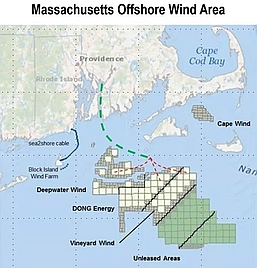
Off the shore of southeastern Massachusetts – Cape Cod, really - there are two relatively large islands (large by Massachusetts standards, not Texas standards): Martha’s Vineyard and Nantucket. They're in a chunk of the Atlantic Ocean called Nantucket Sound.
A conflict arose there recently, not one between the islands per se, but between Vineyard Wind and the residents of Nantucket.
Cape Cod is no stranger to battles regarding wind power. You may recall (I’ve blogged about this previously) that Cape Wind – the planned 130-turbine project – died about four years ago. Read about that adventure here. There are many lessons for project managers in the rise and fall of that project, particularly in the area of stakeholder identification, engagement, and in the unpredictable interaction between stakeholders which is often completely ignored (as it was with Cape Wind) by project managers.
Remember: your stakeholders are not like museum exhibits, frozen behind glass. They are alive, they communicate, they interact with each other in real time, with their own interests in the forefront and your project in the very back corners of their minds.
In this case, the battle is again between some varied stakeholders, aligned against the project – or at least wanting to get their voices heard.
Vineyard Wind is an 84-turbine project based 14 miles southeast of Madaket (on Nantucket - see map) which will “serve about 400,000 homes and eliminate about 1.68 million metric tons of carbon-dioxide emissions each year, the equivalent of taking 325,000 cars off the road”.
On the other side are the various stakeholders, with valid concerns, who have aligned against the project, or, who want to be sure that threats to their objectives are responded to in kind. Read this excellent fair-minded story from Boston University’s WBUR.
Rather than just soldiering forward, Vineyard Wind has been engaging with stakeholders.
“Vineyard Wind has agreed to pay the town $34.4 million over the next 45 years as financial mitigation for the 84-turbine offshore wind farm it has proposed 14 miles southeast of Madaket that some town officials, preservationists, fishermen and environmentalists see as potentially environmentally and visually devastating.”
The solution is a combination of mitigations:
payment to the town of Nantucket of US$34.4 million over 45 years
institute a “move back” of its turbines
install aircraft-activated lighting
repaint the turbine stalks and turbines a color which will blend better into the seascape
The conversations, and the engagement, I’m sure, will continue.
Meanwhile the project appears to be moving forward, based on this story which highlights not only approval but the idea that it may be part of a larger effort to combine projects such as this into a program. In that article there is a great quote that reinforces the point about stakeholder engagement:
"Public input is a core pillar to the renewable energy program and the expanded cumulative scenario is a direct result of stakeholder feedback received by our agency," Acting BOEM Director Walter Cruickshank said. "This expanded cumulative scenario is intended to better understand future impacts of the offshore wind industry while being responsive to the concerns of other ocean industries."
I’ll be keeping an eye on this story as it evolves… resolves, and perhaps soon, as the turbines revolve.
Ashleigh Kennett-SmithICT Project Manager| Australian Red Cross LifebloodAdelaide, South Australia, Australia
It appears that the "2 sides" in this case are actually trying to avoid the false dichotomy problem ie working as if there are ONLY 2 options, all for everything, or all against everything. That is the first step and good to see. (If one "side" refuses to budge on anything then all the stakeholder management in the world won't achieve anything.)