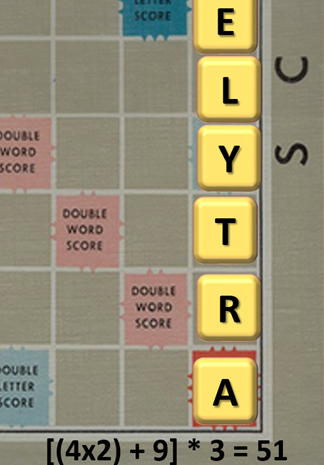
Here we go.Let’s start off with improving your Scrabble game.The word is Elytra.Hey,if you position that word just right (see figure) it can net you 51 points!
OK, now that I've improved your Scrabble game, let's move from etymology to entomology.
So what is “elytra”?Actually it is the plural of elytron, which sounds like a robot villain but is actually the hardened forewings of certain insects, especially beetles.Most beetles use them in flight.However, some beetles have chosen to be earthbound.
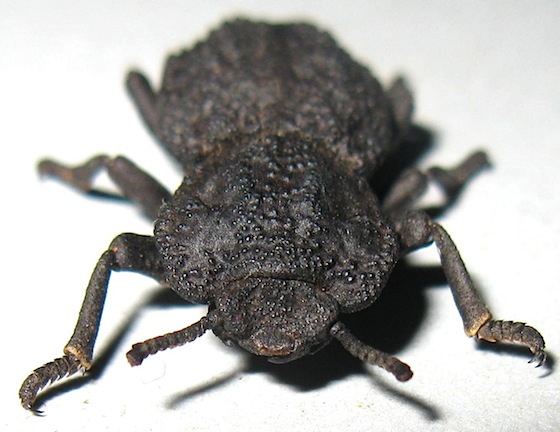
The Diabolical Ironclad Beetle has made that choice eons ago.Their elytron have fused together to help form a protective shield for this critter.The protective shield in this case is quite amazing, and it’s only recently that scientists have uncovered how this works.
Biomimicry
Biomimicry is the process (art and science) of emulating what nature does and taking advantage of some of the amazing things that nature has evolved.I have blogged about this in the past, covering, for example, the ‘stickiness’ of the gecko and the new adhesives developed by engineers and scientists at UMass Amherst.If you haven’t seen that post, or the concept, you really should visit this site: https://geckskin.umass.edu/.
In the case of the diabolical ironclad beetle, the attribute scientists are after is this level of protection yielded by the beetle’s fused elytron.How are they connected?What’s the trick that allows them to withstand, literally, being run over by a car?
The strength comes from two armor-like adaptations in its exoskeleton (the fused elytra!) which have evolved over millions of years.
The structure can take on an applied force of about 150 newtons - a load of at least 39,000 times its body weight - before the exoskeleton begins to fracture
The suture (or connection) between the two elytra is a zig-zag, wiggly connection detectable with the new techniques of 3D microscopy
This is very important, because as engineers, project managers, and actually anyone who flies in an airplane, drives a car, or rides a bike, we are interested in how we fasten things to other things (for example, how an engine is attached to a plane wing!). That last one really always concerns me.
Blogger's confession: Haven’t you ever been seated near the wing, and looked out in wonder (or fright) at how that heavy engine is connected to the wing?I admit it.I have.
Anyway, if we can emulate this form of ‘suture’, we can redesign connectors, strengthening them, avoiding extra weight, and avoiding sources of corrosion and weakness.
It’s well explained in the video below from Purdue University.
Think about how advances like this – and others from studying nature – can accelerate and improve the deliverables from your projects!
Amrapali AmrapaliField Marketing Manager| Keysight TechnologiesHounslow, United Kingdom
Wow loved the article. Thanks for the word trick for the game. I studied biology in my high school and really its so fascinating to learn about nature.




 Community Champion


