


In honor of the 10th anniversary of our book, Green Project Management, I’d like to aim this post at the relationship between Project Success (PS) and Sustainable Project Management (SPM). The connection was always there for me but it sort of came full-circle with the recent publication by Gilbert Silvius and Ophélie Dubois of their article, The Relation Between Sustainable Project Management and Project Success. This article directly cites Green Project Management (despite its ancient 2010 publishing date!) and brings home many of the ideas we published a decade ago. It’s not the only such article. A quick search yielded many more, for example, click here for one from 2016.
However, the Silvius/Dubois article was the most recent and eloquent – and it is supported with data.
In Episode 1 of this romantic suspense thriller, I will summarize some key points and set the stage for the dramatic and (spoiler alert!) happy ending. In the second, I will wrap things up, end the drama, and provide you with further resources to investigate if the subject interests you. It should. You are, after all, right here on this planet. Although we are currently in the throes of a global pandemic which is of urgent and immediate concern to all of us as it should be, the issues of climate change and social impact of project deployment has not been canceled. They’ve been there all along and remain another high priority for our species.
So: on to the article. In the introduction, the authors say:
Project success is indicated as one of the ‘impact areas’ of sustainability in project management (Silvius, Schipper, Planko, van den Brink, & Köhler, 2012) and the relationship between project success and sustainability is identified as one of the emergent ‘narratives’ in the literature on sustainable project management (SPM) (Sabini et al., 2019). Studies on this relationship are still limited in literature review on the topic found only five studies that specifically focused on the relationship (Khalifeh, Farrell, & Al-edenat, 2019) quality. The studies also differ in their operationalization of the variables SPM and project success, making it hard to derive an overall and undisputable conclusion. For example where Martens and Carvalho (2016a) found that considering sustainability is expected to have a positive effect on project success, Silvius and Schipper (2016) concluded that “paying attention to sustainability aspects in projects may also be perceived as costing time or money and therefore as not supportive to the time and budget constraints of a project”. We therefore agree with Khalifeh et al. (2019) that conclude that this relationship is still inadequately addressed in the literature and that more research is needed. It is this gap in the literature that the study reported in this paper addresses. Based on a quantitative survey-based research design, this study aims to answer the question, “how does considering sustainability in project management relate to project success?”
When our book was published, we got lots of pushback from project managers. It often sounded something like this: “Come ON, Rich and Dave, we already get constrained by schedule, budget, and the need to meet requirements. We have to work without authority, in projects, which by definition are unique and therefore are dealing with unknowns. And now, you have the nerve to ask us to also think about the long-term, and bottom lines that have to do with social and environmental stuff that won’t be a factor until after our project is turned over? No THANK YOU, guys, we have PROJECTS to run! Shut up and let us get on with our work!”
It wasn’t always that strong, but sometimes it was even stronger. What we’ve noticed is that this resistance has diminished in the past few years. Perhaps it is the introduction of concepts and practices such as Benefits Realization Management, Value Engineering, and including the ‘transition’ as part of the project closing process, that have softened the responses and even turned them around so that opponents to this idea have now become cheerleaders to including sustainability thinking in projects. But the real ‘kicker’ would be if there was some evidence that putting effort into sustainability thinking in PM provided the PM with higher levels of project success. This article takes a big step in that direction.
Let’s start by getting our terminology straight. Here’s what we mean by Sustainable Project Management (SPM):
“the planning, monitoring and controlling of project delivery and support processes, with consideration of the environmental, economic and social aspects of the life-cycle of the project’s resources, processes, deliverables and effects, aimed at realizing benefits for stakeholders, and performed in a transparent, fair and ethical way that includes proactive stakeholder participation.”
There is an additional wrinkle here:
From the literature on SPM, it appears that the relationship between sustainability and project management can be interpreted in two ways (Sabini et al., 2019; Silvius, 2015). These two interpretations are characterized by Huemann and Silvius (2017) as:
• “Sustainability by the project” (SbP): the sustainability of the deliverable or result that the project realizes.
• “Sustainability of the project” (SoP): the sustainability of the delivery and management processes of the project.
This is very similar to the Rainbow of Green we introduced in Green Project Management in 2010. In the Spectrum of Green, SbP would be Green by Product Impact and SoP would be Green in General. See image below.

Project Success (PS) is a very squishy and even controversial topic. Of course one of the aspects driving this squishiness and controversy is the point of measurement. This is a big deal. When we have our ‘ribbon-cutting ceremony’ are we done as project managers? How much of a role do we have in transitioning the project? Are we concerned about use? Long-term use? Disposal? All of this smacks of life-cycle PM as covered in the 6th Edition of the PMBOK® Guide and much more so in the soon-to-be-released 7th Edition – and it is covered in Prince2 and IPMA standards as well. So PM as a discipline is buying into a longer-term view of ‘Project Success’. See below, from the Silvius article:
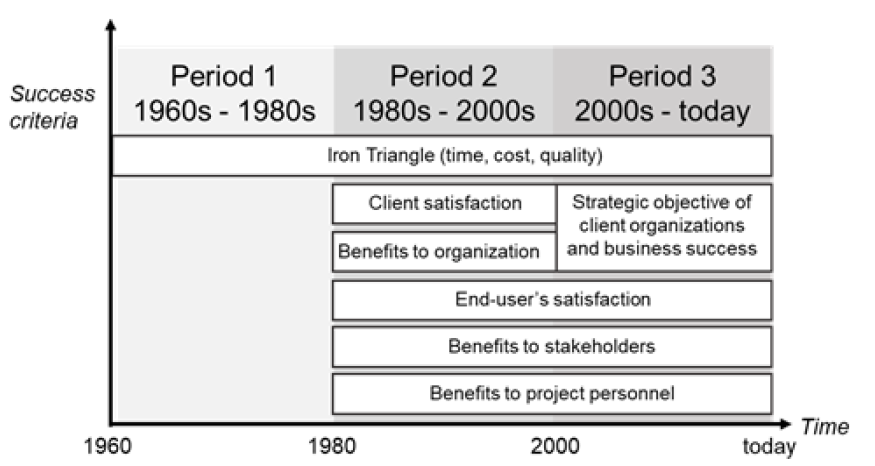
Even if the definition of Project Success includes the more ‘evolved’ definition, it’s clear that there is ‘more to your project’ – and a potential negative - if you focus on SPM. As the article states:
…incorporating environmental and social considerations into projects suggest extra requirements and specifications (Maltzman & Shirley, 2010; Taylor, 2010), which increase the complexity of the project. For example Hwang and Ng (2013) conclude that incorporating sustainability in construction projects makes planning harder, causes more variations in design, causes difficulty in selecting subcontractors, causes uncertainty in the required materials and equipment, requires more coordination with different parties, and leads to more unexpected circumstances at project closure. This increases the pressure on project managers and decision makers (Knight & Jenkins, 2009). Moreover, it has been argued that incorporating sustainability raises the level of expectations of stakeholders of the project (Marcelino-Sádaba et al., 2015) and may increase tensions between them (Brandoni & Polonara, 2012; De Brucker, Macharis, & Verbeke, 2013; Singh, Murty, Gupta, & Dikshit, 2007; Tam, Shen, Yau, & Tam, 2007). Therefore, the expected impact of SPM on the iron triangle variables of PS is considered uncertain.
So we can see that there is tension between these. Is there a chance that the investment of effort into SPM could instead have a positive net effect on Project Sustainability? You’ll just have to wait until the next entry (Part 2 of 2).
Blogger’s note 1: I have permission to use quotes and images from this article directly from the author.
Blogger’s note 2: This post’s banner image above is from The Big Heat (1953). For more about this and 99 other thrillers, see this site: https://www2.bfi.org.uk/thriller/100-thrillers-see-before-you-die




