Consider a forest: One notices the trunks, of course, and the canopy. If a few roots project artfully above the soil and fallen leaves, one notices those too, but with little thought for a matrix that may spread as deep and wide as the branches above. Fungi don’t register at all except for a sprinkling of mushrooms; those are regarded in isolation, rather than as the fruiting tips of a vast underground lattice intertwined with those roots. The world beneath the earth is as rich as the one above.
See? If you are a fan of music from a certain era, that line should pop into your head – especially with the little push I gave it there at the beginning of the post.
But this is not a post about America (the band nor the country). It’s about trees, and the magnificent ignorance we have as a species about them. It’s an ignorance which is fading, however, as we learn more about trees, forests, and the ways in which trees interact.
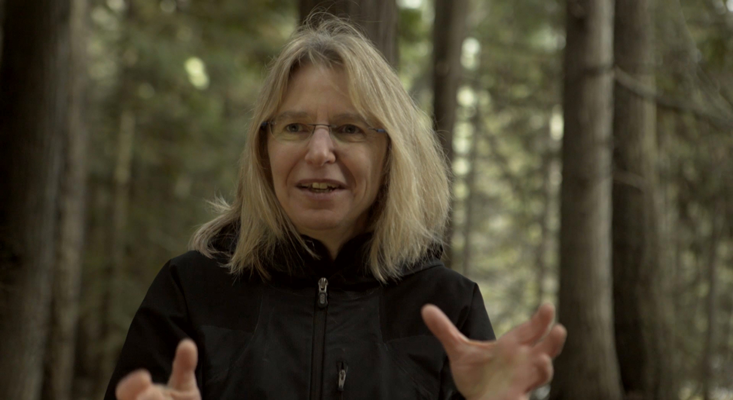
The article features an interview of – more of a conversation with - Suzanne Simard (pictured below),
Simard, a scientist from the University of British Columbia, has shown, through extensive research projects, that fungal ‘mycorrhizae’ (a mashup of the Greek words for fungus and root) helps trees extract nutrients from the soil, also connects trees into root-based ‘networks’. It's a symbiosis - a mutually-beneficial natural relationship. That itself could be considered a form of communication (and even negotiation!). But there is much more to the story.
In these networks, individual ‘hub’ trees (which she calls Mother Trees) form the center of forest communities. These forest communities are even linked to each other – which should sound a little like the Internet, because it quite resembles the Internet.
Where this gets interesting to project managers – aside from the many research projects that are studying this interconnectivity – is best represented by this quote from the article:
(Trees can be) understood as creatures with capacities that in animals are readily regarded as learning, memory, decision-making, and even agency.
This can be difficult to wrap one’s head around. Plants are not supposed to be smart, at least not according to the rubric of traditions known as western thought. There’s also a case to be made that, while these behaviors are indeed extraordinary, they don’t map neatly onto what people usually mean by learning and memory and communication. Perhaps trying to define plants’ behavior according to our own narrow conceptions risks obscuring what is unique about their intelligence.
We all know that communication is 90% of project management. We also know that learning (for example, “lessons learned”) is an important part of improving our discipline. Here we find that trees are doing this? Of course, I’m not suggesting that you hire a birch or oak as your next project manager. What I am suggesting as that we expand our perception of what “intelligence” and “communication” really means.
In Part II I will continue this post by focusing on communications. By understanding the ways in which these ‘tree networks’ operate, we may be able to improve project communications as well.
Between Part I and Part II, you can sit back, relax, and enjoy two videos – the first is the America song I referred to above (A Horse With No Name), and the second, is a 4-minute ‘backgrounder’ on how this tree network gets established and works.
"Anyone can become angry - that is easy, but to be angry with the right person, to the right degree, at the right time, for the right purpose and in the right way - that is not easy."





 Community Champion

