



Picture from https://www.evolves.com.au/trees-can-talk/
In Part 1 of this post, I discussed the communications of trees. Yes, that’s right – trees talk to each other. The post was based on an interview with Suzanne Simard, an expert on underground networks that are now known to convey messages between hub or “mother” trees and other trees, perhaps miles away. In the interview, Simard also talks about communications. And that’s the theme of Part II. Here’s the key portion of the interview for this part:
Q: Another word that can be slippery is “communication.” I would define communication as any exchange of information. That’s a very big umbrella; it can apply to, say, the co-evolution of berry coloration and bird tastes, so that over time berry color becomes more appealing to birds and correlates with nutrient properties. That’s communication—but we categorize that differently than we do the alarm calls squirrels give when a hawk approaches, or the conversation you and I are having right now. Where in that spectrum do plant communications fall?
A: Right in there. And we’re prisoners of our own western science; indigenous people have long known that plants will communicate with each other. But even in western science we know it because you can smell the defense chemistry of a forest under attack. Something is being emitted that has a chemistry that all those other plants and animals perceive, and they change their behaviors accordingly.
Given that definition of communication, you can see that this follows the sender-receiver model described in the PMBOK® Guide and which I use in my courses and consulting. For a really well-done explanation of the PMBOK® Guide 6th Edition’s treatment of this, click on this reference from EdWel. Turns out that the model originated from an article in the Bell Laboratories Technical Journal1, by Claude Shannon and Warren Weaver – you can read more about that 1948 published article and their book here, and see a reference below. We can all take a lesson from this model which involves advancing an idea, a thought into a message by encoding it, and getting that idea to a receiver.
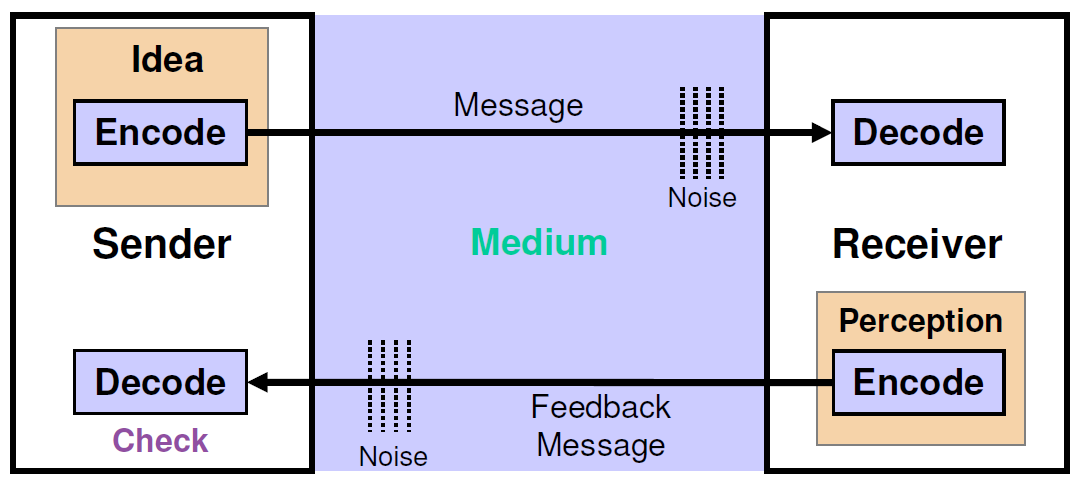
• Encode: To translate thoughts or ideas into a form of language that can be understood by the receiver; eg, written English, spoken Hindi, a text, a wink, or a drawn diagram.
• Message: What is sent: the output of encoding
• Medium: The method used for sending the message (face-to-face, telephone, email, text)
• Noise: Something - ANYTHING - that interferes with the sending or understanding of the message (distance, culture,language differences, stereotyping, predjudice)
• Decode: The translation of the message by the receiver from the medium into their thoughts.
That message has to go through a medium. For us – that’s Slack, Microsoft Teams, email, or even a blog post publishing platform, like projectmanagement.com, which we are using right now in this communication. And here’s where it gets interesting. Noise and perception play a big part of that medium. Even the medium itself can be noise - or indeed, it can be the message! In fact, "The medium is the message" is a phrase coined by the Canadian communication theorist Marshall McLuhan and introduced in his Understanding Media: The Extensions of Man, published in 1964.
You know this to be true as a project manager. You have likely had a situation in which just the very fact that a telephone call rather than an email from your client means that something urgent is happening. The message, of course, is important, but the use of the phone communicates something as well. As a project manager, you can take this to heart and be conscious of what medium YOU use to communicate. For example, to express sympathy when a stakeholder has an illness in the family, is an email or text really the way to express this? Or, should you pick up the darn phone and call the person? Hint: the latter!
Going back to our trees, the medium is the mycorrhizal network discussed in Part I of this post. To remind you and save you from having to refer to Part I, here is a quote from a Yale E360 interview with Suzanne Simard that explains it just a bit differently.
All trees all over the world, including paper birch and Douglas fir, form a symbiotic association with below-ground fungi. These are fungi that are beneficial to the plants and through this association, the fungus, which can’t photosynthesize of course, explores the soil. Basically, it sends mycelium, or threads, all through the soil, picks up nutrients and water, especially phosphorous and nitrogen, brings it back to the plant, and exchanges those nutrients and water for photosynthate [a sugar or other substance made by photosynthesis] from the plant. The plant is fixing carbon and then trading it for the nutrients that it needs for its metabolism. It works out for both of them.
It’s this network, sort of like a below-ground pipeline, that connects one tree root system to another tree root system, so that nutrients and carbon and water can exchange between the trees. In a natural forest of British Columbia, paper birch and Douglas fir grow together in early successional forest communities. They compete with each other, but our work shows that they also cooperate with each other by sending nutrients and carbon back and forth through their mycorrhizal networks.
If that medium is disrupted, perhaps by construction, that introduces noise into the communication. Let’s assume that the message gets through without noise (I could easily produce a whole series of posts – and may do so – about the different kinds of noise and perceptual differences that we, as humans, and especially human project managers need to learn to deal with).
Now, that message gets decoded by a receiver, in the case of the trees, perhaps a seedling, and the seedling acknowledges the message with some sort of feedback. The seedling may be providing this by virtue of growth or health status. In our case, this could be a nod of a head or a text of a smiley face. Importantly, even the feedback message is prone to noise and perceptual problems, and could be misinterpreted. We have all heard the cartoonish but good example of an auctioneer receiving a feedback message of a “bid” for $10,000 for a really ugly painting when the “bidder” had simply meant to scratch her nose. More practically, in some cultures, a “yes” means, ‘yes I heard you’ and not, ‘yes I will take on the important project task you have just assigned me’. So be aware of this! Yes? Yes?
It turns out that there is even more to say about trees and project management. So I have to introduce a “Part III” of this two-part series – and this one will coincide with the Holiday Season’s tradition of gifting, and will feature a tree called the serviceberry tree. Stay tuned – that post should definitely bear fruit.
1 Shannon, Claude Elwood (October 1948). "A Mathematical Theory of Communication". Bell System Technical Journal. 27 (4): 623–666.


 Community Champion

