Project Management

Repurposed Rigs

From the People, Planet, Profits & Projects Blog
by ,

About this Blog

RSS

View Posts By:

Richard Maltzman
Dave Shirley

Recent Posts

Saving the Sahel (Part 1)

You Can't Get They-ah From Hee-yah

Floating an idea into reality: the other side of the AI Project Paradox

The Environment of the Built Environment: an AI Paradox

Is plastic on your mind?

Categories

6th, 6th Edfition, 6th Edition PMBOK, 7th Edition, 7th Edition PMBOK, 8th Edition PMBOK, 8th Edition PMBOK Guide, Activism, actuarial, actuary, adapt, addition by subtraction, Africa, africa, agriculture, airforce, ajaita, Alaska, amazon, analogous, analytics, ancient, and more power, antarctica, anti-science, apple, apps, architecture, arctic, arrakis, Artificial Intelligence, asch paradigm, Assistant, asthma, astronomy, automobile, automotive, autonomous cars, b, bankhar, Banksy Crypto, basalt, baseball, bats, batter, beauty products, benefit, benefits, Benefits Realization, beyond epica, biases, bicycle, big data, big dfata, big dig, bike, biodiversity, biomedicine, birdhouse, blockchain, blood, blue blood, blue trees, bluefin, bluefin tuna, book review, boston, boston university, Boyce, Brazil, brazil, Breakdown Structures, BS, building, buildings, built environment, built environment, bumblebee, cake, capacitor, car, Carbon, carbon, carbon capture, carbon negative, carbon neutral, carbon pool, carbon sequestration, carbonate, careers, CEO, ChatGPT, chatGPT, chatgpt, chatgpt, chess, China, china, chopsticks, citrus, cli-fi, climate, climate change, climate resilience, climeworks, Clumsy, CO2, co2, CO2 Utilization, coalition, cobalt, coffee pods, cognition, cognitive, Collabortion, colombia, concrete, Conflict, construction 5.0, cool projects xyloscope, cooling, coral, corn, cost of good quality, cost of poor quality, cost of quality, crazy, criticism of project management, cryptocurrency, CSR, csr, data, data analytics, data privacy, datacenter, dataset, death spiral, Decision Making, decomposition, Defense and Climate, definition of a project, deforestation, dependencies, dependency, desert, DIKW, dikw, dimopoulos, disposal, dna, DOD, dogs, dolphins, dream, drilling, drink, dune, dune, dutch, early start, earth, eatlocal, eco-tourism, ecological, economic, economics, EKC, electric grid, electricity, electronics, elysis, embodied carbon, emerging technologies, empower, Energy, energy efficiency, environmental degradation, escalate, escalation, ESG, extreme weather, fallacy, FARC, farming, finance, fish, fish brains, fishing, fix, fixing the earth, flint water, Flint Water Supply, flood, flooding, Food supply chain, food waste, forest, forest for the trees, forestation, forrestgump, frank herbert, Fruitcake, fungus, fusion, Galvao, garage, gas, gasoline, geese, gender equality, gender partnerships, generational differences, Generative AI, gladwell, gold, Goodness, google, Government, GPT, great pacific garbage patch, green, green building, green buildings, green energy, green iguana, green project, green project management, greening, guest post, gyre, harkonnen, Harvesting Benefits, hawasina, hedgehogs, heursitics, historical data, hlb, holitsic, holland, horseshoe crab, human-caused climate change, hydrogen, hydrology, ice, iceland, ignition, iguana, imagery, impact, india, inequality, information, initiatives, injection, insurance, intelligence, interacting risk, internal combustion engine, invasive species, investment, isomer, issue escalation, issues, ITER, jobs, Jupiter, justification, kids, kill point, knowledge, koch brothers, Kuznets, laboratory, LAL, landscape mode, lapampa, launch, LCA, Leadership, Leadership, life cycle analyses, life cycle analysis, lifecycle, Linkedin, liquid, lizard, local, long term, long-term, long-term thinking, look up, loud, maintenance, maker, makermovement, malcolm gladwell, management, marathon, marine biology, market, mars, Martin Luther King, mean, megawatt, MeHg, melting, mercury, metal, Microgrid, microplastics, migration, military, millennial, mindset, minerals, mission, mitigate, MLK, mongolia, museum, museum of london, nature, nematodes, net gain, Net Project Success Score, net zero, netherlands, network, New book, New Jersey, New Practitioners, new york, NFT, nitrogen, noise, noreaster, norway, nova, NPSS, NREL, ocean, ocean cleanup, ocean life, oil rig, oil rigs, oklahoma, oman, only murders in the building, opportunity, overall risk, oxygen, packaging, pareto, PBS, permafrost, persistence, peru, Pharmaceutical, planet, planet.com, planning, plant, plasma, plastic, playground, pm, pm education, pmbok, pmbok guide, pmnetwork, PMXPO-2018, podcast, pollutants, pollution, poop, poor, portfolio, power, power skills, privacy, privacy concerns, professors, program, Program Management, project, project leader, project leadership, project management, project management 3.0, project on fire, project progress, Project Success, project success, projecticity, projectleadership, projectmanagement, projects, psychology, pulse of the profession, purple bacteria, purpose, quiet, rainforest, rationale, reef, refugees, renewable, renewables, Repair, repair, repeatable process, repeatable processes, repurpose, research, resource breakdown strucuture, Resource Management, reversing climate change, revisionist history, rich, rigs2reefs, ripe, risk, risk avoidance, Risk Management, risk mitigation, risk response, risk responses, river, robots, rocks, rules of thumb, rural, rural India, russia, Sarcasm/Irony, satellite, saudi, schedule, sci-fi, Science, science, science-fiction, scientific american, screaming monkeys, sea, sea life, Sea-Level Rise, sea-level rise, seagreens, seawall, seawater, seawater temperature, seaweed. beat;es. farming, secondary risk, selena gomez, sequestration, shipping, skyscraper, SLR, smart cities, smart city, smelting, social, social pressure, soil, solar, solar panels, solar perovkites, solar saheli, sonic, sponge cities, SRI, stage-gate, stagegate, stakeholder, stakeholder management, steward, stewardship, storage, strategy, stupid, success, suffer, sulphur, sunk cost, supercapacitor, supply chain, survey, Sustainability, sustainability, Sustainable Investing, Sustainable Tourism, sybiosis, symbiosis, system 03, TBL, temperature, terraform, terraforming, test, threat, threats, totem, touchscreen, tour, tower, Trains, transparency, transportation, trash, tree, tree species, trees, trillion, triple bottom line, triple constraint, truth to power, UMass, us army corps of engineers, USDA, vacuum, value, venus, vision, voice, voltage optimization, vw scandal, washing machine, waste, wastewater, water, we mean business, whales, Whirlpool, wind, wisdom, women, Women in Project Management, wood wide web, woonerf, Work Breakdown Structures (WBS), world breakdown structure, worms, xian, xylotron, Yale

Date

linkedin twitter facebook Request to reuse this  

Categories: coral, oil rigs, reef, rigs2reefs


Photo Courtesy of Getty Images

Photo: Getty Images

This introductory blog post is the first part of a series that is themed heavily around “thinking past the end of a project” with an inspirational implementation of that idea.

If you have been following People, Planet, Profits, and Projects, or if you have read Green Project Management or its follow up book, Driving Sustainability Success, or you have any sense of what ‘sustainability in project management’ really means, you know that it is not only about projects to build wind farms and solar panels.  It is about integrating a thoughtful, holistic, responsible, long-term view into planning and executing projects, which, we like to say, means “thinking past the end of the project”, even to that point in time when the product of your project is (for lack of better words) dead, useless, kaput, “finito”, over-and-done-with.

We don’t like to think that way, do we?  As project managers, we think about the ribbon-cutting ceremony, the celebratory party, the congratulations-on-a-project-well-executed, and we want to begin working on our next project.  It’s in our blood, our DNA, to get things done.  And we see “done” as that time when that black diamond milestone that says “END” has passed.

Let’s say your project is an oil rig.  Or, perhaps it’s a drilling project based on an oil rig. 

Should you be thinking about what happens to the rig when it is no longer useful?  After all, an oil rig, at some point, reaches its end of useful life.  It then has to be decommissioned.

A primer on the Waste Hierarchy

All of us, I’m sure, have heard the phrase, “Reduce, Reuse, Recycle”.  And many of us do a good job living our lives with that mantra.  But not everyone is aware that there is a certain precedence to these different ways of reducing impact on the environment, or even that those are not the only three ways to do so.

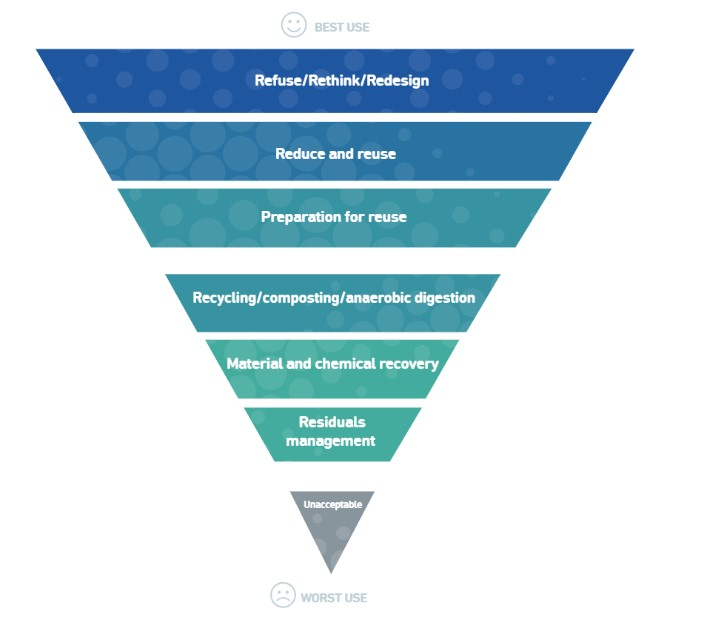
There are several version of this, but I prefer the one below (see image).  It involves not three, but six ways of dealing with waste (whether that’s the plastic beverage bottle you from the iced tea you just finished while reading this, or an unusable oil rig).  From Zero Waste Europe comes the Waste Hierarchy shown below.waswaswwaswwdd

At the top, you see “Refuse/Rethink/Redesign”, which, in the case of the oil rig, would mean moving away from carbon-based energy.  That’s a non-starter for the existing 12,000+ oil rigs already out there.  So let’s drop down a level and look at Reduce and Reuse.  That’s where we are.  Although it doesn’t say “repurpose” that’s what we’re going to discuss here – giving a new use to an oil rig – a new purpose.  Note that Recycle is further down on the hierarchy.  In fact, as we’ll dive into (excuse the pun) later, the recycling of materials from an oil rig is exceedingly costly, from both an economic and ecological perspective.


To summarize, we want you to think past the end of the project.  Designing, deploying, and drilling from an oil rig – all are projects. 

Let’s look at some statistics.  Already mentioned are the 12,000+ oil rigs in the Earth’s oceans.  It costs about US$50M to decommission each oil rig.

However, it costs about US$1M to repurpose them to become artificial reefs.

And that is where we have a whole bunch of new projects to consider: repurposing these defunct oil rigs to become reef habitats.


A January 2021 article in BBC Future is what sent me down this path, and it features two marine scientists, Emily Hazelwood and Amber Sparks, based in California, who founded an organization in 2015 called Blue Latitudes.  Their mission: to find silver linings in our oceans at the intersection of industry and the environment. We unite science, policy, and communications to create innovative solutions for the complex ecological challenges associated with offshore industry.

In this introductory post, we just want to stress the importance of looking past (and thinking through) the end of your project by having you watch this visually stunning and engaging 38-minute video that will prepare you for the following posts.  To understand the title, know that a transect is a method consisting of a field survey performed with a video-camera along a line of fixed length, with the registered images further analyzed using a computer.

Really.  Don’t skip this.  Watch it.  Watch it to be entertained by the amazing and quite beautiful underwater photography, and watch it from the perspective of a project manager (which  you probably cannot help doing!).  Make sure you watch for a key statistic at the end which compares a natural reef's ability to support a habitat for fish and coral with the same ability for a repurposed oil rig.  The statistic will probably surprise you!

We would like you to also consider some of the controversy here – it plays well into our role as PMs to consider multiple stakeholder views.  Some environmental groups think this repurposing is actually counterproductive because it encourages more drilling.  Some think this is an elegant solution for the existing oil rigs and should be pursued extensively.  I will discuss that in the follow-up posts, and will also discuss how government (another stakeholder!) is playing a role.

But for now, we would like to build your interest in this initiative because it is so intertwined with our discipline of PM, and helps make the point that sustainability is not an afterthought, or even a forethought – it needs to be integrated into our PM mindset.


Posted by Richard Maltzman on: January 30, 2021 12:28 PM | Permalink

Comments (1)

Please login or join to subscribe to this item
avatar
Kwiyuh Michael Wepngong
Community Champion
Financial Management Specialist | US Peace Corps Yaounde, Centre, Cameroon
".. sustainability is not an afterthought, or even a forethought – it needs to be integrated into our PM mindset."

Please Login/Register to leave a comment.

ADVERTISEMENTS

"The higher up you go, the more mistakes you are allowed. Right at the top, if you make enough of them, it's considered to be your style."

- Fred Astaire

ADVERTISEMENT

Sponsors