Pillar Four - Open the Door - Part II
From the People, Planet, Profits & Projects Blog
by Richard Maltzman,
Dave Shirley

View Posts By:
Richard Maltzman
Dave Shirley
Recent Posts
What is AI doing to the sustainability of our profession???
Stepwells – Insight from a Particularly Valid Angle
Climb-it Change: Pre-Interview Connector
Climb-it Change: New Relevance for the Stepwells of India
A PATH to more equitable health - via AI project leadership
Categories
6th,
6th Edfition,
6th Edition PMBOK,
7th Edition,
7th Edition PMBOK,
8th Edition PMBOK,
8th Edition PMBOK Guide,
Activism,
actuarial,
actuary,
adapt,
addition by subtraction,
Africa,
africa,
agriculture,
airforce,
ajaita,
Alaska,
amazon,
analogous,
analytics,
ancient,
and more power,
antarctica,
anti-science,
apple,
apps,
architecture,
arctic,
arrakis,
Artificial Intelligence,
asch paradigm,
Assistant,
asthma,
astronomy,
automobile,
automotive,
autonomous cars,
b,
bankhar,
Banksy Crypto,
basalt,
baseball,
bats,
batter,
beauty products,
benefit,
benefits,
Benefits Realization,
beyond epica,
biases,
bicycle,
big data,
big dfata,
big dig,
bike,
biodiversity,
biomedicine,
birdhouse,
blockchain,
blood,
blue blood,
blue trees,
bluefin,
bluefin tuna,
book review,
boston,
boston university,
Boyce,
Brazil,
brazil,
Breakdown Structures,
BS,
building,
buildings,
built environment,
built environment,
bumblebee,
cake,
capacitor,
car,
Carbon,
carbon,
carbon capture,
carbon negative,
carbon neutral,
carbon pool,
carbon sequestration,
carbonate,
careers,
CEO,
ChatGPT,
chatGPT,
chatgpt,
chatgpt,
chess,
China,
china,
chopsticks,
citrus,
cli-fi,
climate,
climate change,
climate resilience,
climeworks,
Clumsy,
CO2,
co2,
CO2 Utilization,
coalition,
cobalt,
coffee pods,
cognition,
cognitive,
Collabortion,
colombia,
concrete,
Conflict,
construction 5.0,
cool projects xyloscope,
cooling,
coral,
corn,
cost of good quality,
cost of poor quality,
cost of quality,
crazy,
criticism of project management,
cryptocurrency,
CSR,
csr,
data,
data analytics,
data privacy,
datacenter,
dataset,
death spiral,
Decision Making,
decomposition,
Defense and Climate,
definition of a project,
deforestation,
dependencies,
dependency,
desert,
DIKW,
dikw,
dimopoulos,
disposal,
dna,
DOD,
dogs,
dolphins,
dream,
drilling,
drink,
dune,
dune,
dutch,
early start,
earth,
eatlocal,
eco-tourism,
ecological,
economic,
economics,
EKC,
electric grid,
electricity,
electronics,
elysis,
embodied carbon,
emerging technologies,
empower,
Energy,
energy efficiency,
environmental degradation,
escalate,
escalation,
ESG,
extreme weather,
fallacy,
FARC,
farming,
finance,
fish,
fish brains,
fishing,
fix,
fixing the earth,
flint water,
Flint Water Supply,
flood,
flooding,
Food supply chain,
food waste,
forest,
forest for the trees,
forestation,
forrestgump,
frank herbert,
Fruitcake,
fungus,
fusion,
Galvao,
garage,
gas,
gasoline,
geese,
gender equality,
gender partnerships,
generational differences,
Generative AI,
gladwell,
gold,
Goodness,
google,
Government,
GPT,
great pacific garbage patch,
green,
green building,
green buildings,
green energy,
green iguana,
green project,
green project management,
greening,
guest post,
gyre,
harkonnen,
Harvesting Benefits,
hawasina,
hedgehogs,
heursitics,
historical data,
hlb,
holitsic,
holland,
horseshoe crab,
human-caused climate change,
hydrogen,
hydrology,
ice,
iceland,
ignition,
iguana,
imagery,
impact,
india,
inequality,
information,
initiatives,
injection,
insurance,
intelligence,
interacting risk,
internal combustion engine,
invasive species,
investment,
isomer,
issue escalation,
issues,
ITER,
jobs,
Jupiter,
justification,
kids,
kill point,
knowledge,
koch brothers,
Kuznets,
laboratory,
LAL,
landscape mode,
lapampa,
launch,
LCA,
Leadership,
Leadership,
life cycle analyses,
life cycle analysis,
lifecycle,
Linkedin,
liquid,
lizard,
local,
long term,
long-term,
long-term thinking,
look up,
loud,
maintenance,
maker,
makermovement,
malcolm gladwell,
management,
marathon,
marine biology,
market,
mars,
Martin Luther King,
mean,
megawatt,
MeHg,
melting,
mercury,
metal,
Microgrid,
microplastics,
migration,
military,
millennial,
mindset,
minerals,
mission,
mitigate,
MLK,
mongolia,
museum,
museum of london,
nature,
nematodes,
net gain,
Net Project Success Score,
net zero,
netherlands,
network,
New book,
New Jersey,
New Practitioners,
new york,
NFT,
nitrogen,
noise,
noreaster,
norway,
nova,
NPSS,
NREL,
ocean,
ocean cleanup,
ocean life,
oil rig,
oil rigs,
oklahoma,
oman,
only murders in the building,
opportunity,
overall risk,
oxygen,
packaging,
pareto,
PBS,
permafrost,
persistence,
peru,
Pharmaceutical,
planet,
planet.com,
planning,
plant,
plasma,
plastic,
playground,
pm,
pm education,
pmbok,
pmbok guide,
pmnetwork,
PMXPO-2018,
podcast,
pollutants,
pollution,
poop,
poor,
portfolio,
power,
power skills,
privacy,
privacy concerns,
professors,
program,
Program Management,
project,
project leader,
project leadership,
project management,
project management 3.0,
project on fire,
project progress,
Project Success,
project success,
projecticity,
projectleadership,
projectmanagement,
projects,
psychology,
pulse of the profession,
purple bacteria,
purpose,
quiet,
rainforest,
rationale,
reef,
refugees,
renewable,
renewables,
Repair,
repair,
repeatable process,
repeatable processes,
repurpose,
research,
resource breakdown strucuture,
Resource Management,
reversing climate change,
revisionist history,
rich,
rigs2reefs,
ripe,
risk,
risk avoidance,
Risk Management,
risk mitigation,
risk response,
risk responses,
river,
robots,
rocks,
rules of thumb,
rural,
rural India,
russia,
Sarcasm/Irony,
satellite,
saudi,
schedule,
sci-fi,
Science,
science,
science-fiction,
scientific american,
screaming monkeys,
sea,
sea life,
Sea-Level Rise,
sea-level rise,
seagreens,
seawall,
seawater,
seawater temperature,
seaweed. beat;es. farming,
secondary risk,
selena gomez,
sequestration,
shipping,
skyscraper,
SLR,
smart cities,
smart city,
smelting,
social,
social pressure,
soil,
solar,
solar panels,
solar perovkites,
solar saheli,
sonic,
sponge cities,
SRI,
stage-gate,
stagegate,
stakeholder,
stakeholder management,
steward,
stewardship,
storage,
strategy,
stupid,
success,
suffer,
sulphur,
sunk cost,
supercapacitor,
supply chain,
survey,
Sustainability,
sustainability,
Sustainable Investing,
Sustainable Tourism,
sybiosis,
symbiosis,
system 03,
TBL,
temperature,
terraform,
terraforming,
test,
threat,
threats,
totem,
touchscreen,
tour,
tower,
Trains,
transparency,
transportation,
trash,
tree,
tree species,
trees,
trillion,
triple bottom line,
triple constraint,
truth to power,
UMass,
us army corps of engineers,
USDA,
vacuum,
value,
venus,
vision,
voice,
voltage optimization,
vw scandal,
washing machine,
waste,
wastewater,
water,
we mean business,
whales,
Whirlpool,
wind,
wisdom,
women,
Women in Project Management,
wood wide web,
woonerf,
Work Breakdown Structures (WBS),
world breakdown structure,
worms,
xian,
xylotron,
Yale
Date

In the prior post I discussed the 3 Pillars of PPM (From scholar and all-around gentleman Jamal Moustafaev's book, Project Portfolio Management in Theory and Practice).

The Three Pillars of PPM
1. Projects selected must maximize the value for the company.
2. Projects selected must constitute a balanced portfolio.
3. The final portfolio of projects must be strategically aligned with the company’s overall business strategy.
Then I covered the fact that in an article by Javed Mohammad, Yu-Chun Pan, published just in 2022, and forwarded to me by graduated student Daria Risso as we work on her thesis for Politecnico di Torino, these authors imagine a fourth pillar: a pillar dedicated to sustainability and a holistic view. I like that pillar. A lot. I would like to give a shout out to my former Boston University student Daria Risso for pointing this article out to me.
In this post, I want to summarize the remainder of the article and, with the kind permission of the authors, to share some of the key points and figures. But please, don’t read only this blog post – please read their very-well assembled and meaningful article (you can find it available on ResearchGate at no charge – just click here).
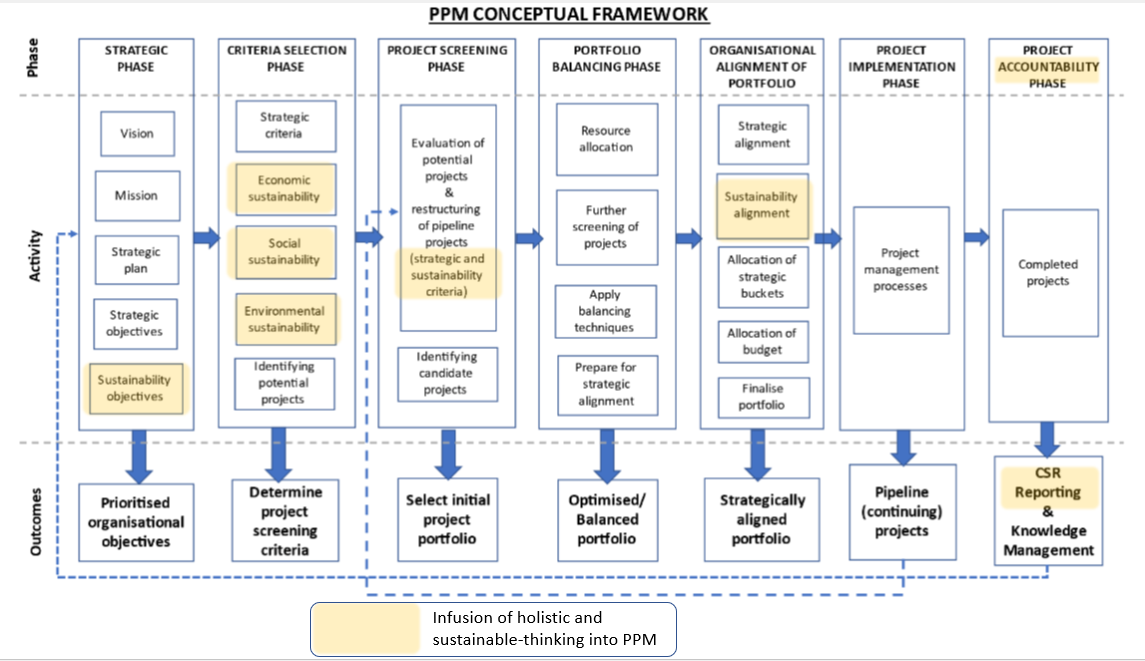
The authors start by re-imagining the PPM Framework in the following phases, each of which is tinged, or perhaps better-stated, infused with long-term, holistic, responsible thinking:
- Strategic
- Criteria Selection
- Project Screening
- Portfolio Balancing
- Organizational Alignment or Portfolio
- Project Implementation
- Project Accountability
See the figure below (highlighting mine) to show how they have done a great job to avoid tacking-on sustainability, but rather building it in.
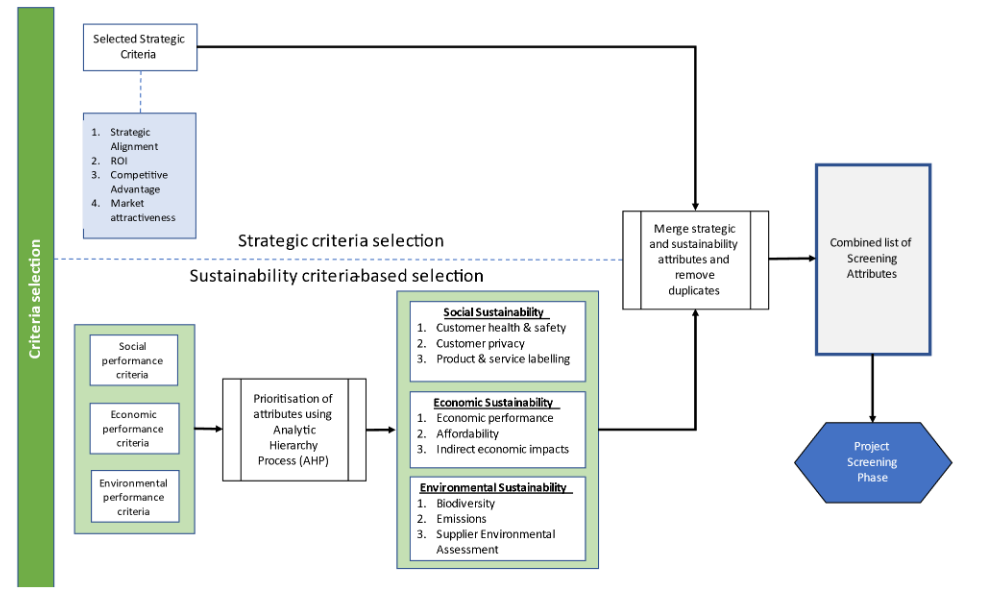
They have also put effort into criteria for project selection. It’s ironic that this comes up at a time when I happen to be teaching graduate PM students about exactly this – the selection of projects based on a multiplicity of criteria, including mathematical techniques like AHP:
In this step, the participants may use any multi-criteria decision-making method (MCDM), e.g., the Analytic Hierarchy Process (AHP), that allows for pairwise comparison of variables thus establishing the relative importance of one variable against another. The process is repeated for the three categories of sustainability i.e., economic, environmental and social.
See the figure below – it assures that these criteria categories are included.
Figures above used with permission of the authors (thanks!).
I’ve been thinking (and writing) for a while about how some organizations have apparently misguided, or perhaps disconnected projects – projects like VW’s special sensors and software which led to Dieselgate while their C-Suite was indicating their desire to be a automotive leader in environmental sustainability. Somewhere there is a break in the connection between vision and execution – a break that I insist is at the PPM level. Perhaps Mohammad and Pan have found the fix for that breakage – a renewed focus on sustainability by those at the PPM level, those in powerful PMO positions who could filter out, with the right criteria, those projects which are misaligned from a sustainability perspective. If the organization is telling the world that sustainability is strategically important, that has to prevent projects which are producing sustainability disbenefits from ever being chartered.
Here is a piece of the authors’ conclusion:
It is recommended that other reporting tools should be applied to the proposed framework for a much wider understanding of these processes. Another area that requires research is whether sustainability is built into the framework bottom-up or top-down in the process and which method would be more effective. Finally, the proposal is open to contributions from the research, academic and practitioner community and should be viewed as an initial step towards developing a tried and tested framework that addresses some of the difficulties that organisations face when implementing sustainability into their project-related processes.
These authors, in my opinion, are one of a group on the leading edge of building sustainability thinking into projects with the intelligence and wisdom that comes from a PPM perspective. This is important. I urge you to read the article (that’s one reason I kept this blog post short – they say it all in their article!) and consider case studies or other suggestions that may help us as project leaders and citizens of the third rock from the sun to ‘get stuff done’ in efficient but also long-term effective ways.
Posted
by
Richard Maltzman
on: October 23, 2022 07:51 PM |
Permalink
Comments (6)
Please login or join to subscribe to this item

Stéphane Parent
Retired (for now)| Leader Maker
Prince Edward Island, Canada
I totally agree that sustainability should be part of parcel of everything we do, rather than an afterthought.

Hillel Selznick
Hillel Selznick| Hillel Selznick Art Studio
New York, Ny, United States
I also agree with the author. He has a great understanding of the topic.
Major Organizational Transformations Globally.. mindsets need to change.
Sustainability is a culture
Good read.
Thank you for sharing
Yes, it is a tremendous contribution to the deciders in recognize the variables of sustainability as so important as the others in this process of moulding a sustainable portfolio aligned with the expectations of the organization itself as well its stakeholders. Thanks for sharing, Mr. Maltzman.

Mishirika Scott
PMO Portfolio Manager, IT Strategic Initiatives| University of California, Los Angeles (UCLA)
Greater Los Angeles Area, Ca, United States
@Richard M. and Dave S. ...well-written article and the visuals are tremendously helpful. The key phrase I'll start adopting today-- sustainability thinking. It will be interesting to see how sustainability thinking as an agile practice may intersect more closely in the future. Thanks!
Please Login/Register to leave a comment.
|
What a waste it is to lose one's mind. Or not to have a mind is being very wasteful. How true that is.
- Dan Quayle
|







