
View Posts By:
Richard Maltzman
Dave Shirley
Recent Posts
What is AI doing to the sustainability of our profession???
Stepwells – Insight from a Particularly Valid Angle
Climb-it Change: Pre-Interview Connector
Climb-it Change: New Relevance for the Stepwells of India
A PATH to more equitable health - via AI project leadership
Categories
6th,
6th Edfition,
6th Edition PMBOK,
7th Edition,
7th Edition PMBOK,
8th Edition PMBOK,
8th Edition PMBOK Guide,
Activism,
actuarial,
actuary,
adapt,
addition by subtraction,
Africa,
africa,
agriculture,
airforce,
ajaita,
Alaska,
amazon,
analogous,
analytics,
ancient,
and more power,
antarctica,
anti-science,
apple,
apps,
architecture,
arctic,
arrakis,
Artificial Intelligence,
asch paradigm,
Assistant,
asthma,
astronomy,
automobile,
automotive,
autonomous cars,
b,
bankhar,
Banksy Crypto,
basalt,
baseball,
bats,
batter,
beauty products,
benefit,
benefits,
Benefits Realization,
beyond epica,
biases,
bicycle,
big data,
big dfata,
big dig,
bike,
biodiversity,
biomedicine,
birdhouse,
blockchain,
blood,
blue blood,
blue trees,
bluefin,
bluefin tuna,
book review,
boston,
boston university,
Boyce,
Brazil,
brazil,
Breakdown Structures,
BS,
building,
buildings,
built environment,
built environment,
bumblebee,
cake,
capacitor,
car,
Carbon,
carbon,
carbon capture,
carbon negative,
carbon neutral,
carbon pool,
carbon sequestration,
carbonate,
careers,
CEO,
ChatGPT,
chatGPT,
chatgpt,
chatgpt,
chess,
China,
china,
chopsticks,
citrus,
cli-fi,
climate,
climate change,
climate resilience,
climeworks,
Clumsy,
CO2,
co2,
CO2 Utilization,
coalition,
cobalt,
coffee pods,
cognition,
cognitive,
Collabortion,
colombia,
concrete,
Conflict,
construction 5.0,
cool projects xyloscope,
cooling,
coral,
corn,
cost of good quality,
cost of poor quality,
cost of quality,
crazy,
criticism of project management,
cryptocurrency,
CSR,
csr,
data,
data analytics,
data privacy,
datacenter,
dataset,
death spiral,
Decision Making,
decomposition,
Defense and Climate,
definition of a project,
deforestation,
dependencies,
dependency,
desert,
DIKW,
dikw,
dimopoulos,
disposal,
dna,
DOD,
dogs,
dolphins,
dream,
drilling,
drink,
dune,
dune,
dutch,
early start,
earth,
eatlocal,
eco-tourism,
ecological,
economic,
economics,
EKC,
electric grid,
electricity,
electronics,
elysis,
embodied carbon,
emerging technologies,
empower,
Energy,
energy efficiency,
environmental degradation,
escalate,
escalation,
ESG,
extreme weather,
fallacy,
FARC,
farming,
finance,
fish,
fish brains,
fishing,
fix,
fixing the earth,
flint water,
Flint Water Supply,
flood,
flooding,
Food supply chain,
food waste,
forest,
forest for the trees,
forestation,
forrestgump,
frank herbert,
Fruitcake,
fungus,
fusion,
Galvao,
garage,
gas,
gasoline,
geese,
gender equality,
gender partnerships,
generational differences,
Generative AI,
gladwell,
gold,
Goodness,
google,
Government,
GPT,
great pacific garbage patch,
green,
green building,
green buildings,
green energy,
green iguana,
green project,
green project management,
greening,
guest post,
gyre,
harkonnen,
Harvesting Benefits,
hawasina,
hedgehogs,
heursitics,
historical data,
hlb,
holitsic,
holland,
horseshoe crab,
human-caused climate change,
hydrogen,
hydrology,
ice,
iceland,
ignition,
iguana,
imagery,
impact,
india,
inequality,
information,
initiatives,
injection,
insurance,
intelligence,
interacting risk,
internal combustion engine,
invasive species,
investment,
isomer,
issue escalation,
issues,
ITER,
jobs,
Jupiter,
justification,
kids,
kill point,
knowledge,
koch brothers,
Kuznets,
laboratory,
LAL,
landscape mode,
lapampa,
launch,
LCA,
Leadership,
Leadership,
life cycle analyses,
life cycle analysis,
lifecycle,
Linkedin,
liquid,
lizard,
local,
long term,
long-term,
long-term thinking,
look up,
loud,
maintenance,
maker,
makermovement,
malcolm gladwell,
management,
marathon,
marine biology,
market,
mars,
Martin Luther King,
mean,
megawatt,
MeHg,
melting,
mercury,
metal,
Microgrid,
microplastics,
migration,
military,
millennial,
mindset,
minerals,
mission,
mitigate,
MLK,
mongolia,
museum,
museum of london,
nature,
nematodes,
net gain,
Net Project Success Score,
net zero,
netherlands,
network,
New book,
New Jersey,
New Practitioners,
new york,
NFT,
nitrogen,
noise,
noreaster,
norway,
nova,
NPSS,
NREL,
ocean,
ocean cleanup,
ocean life,
oil rig,
oil rigs,
oklahoma,
oman,
only murders in the building,
opportunity,
overall risk,
oxygen,
packaging,
pareto,
PBS,
permafrost,
persistence,
peru,
Pharmaceutical,
planet,
planet.com,
planning,
plant,
plasma,
plastic,
playground,
pm,
pm education,
pmbok,
pmbok guide,
pmnetwork,
PMXPO-2018,
podcast,
pollutants,
pollution,
poop,
poor,
portfolio,
power,
power skills,
privacy,
privacy concerns,
professors,
program,
Program Management,
project,
project leader,
project leadership,
project management,
project management 3.0,
project on fire,
project progress,
Project Success,
project success,
projecticity,
projectleadership,
projectmanagement,
projects,
psychology,
pulse of the profession,
purple bacteria,
purpose,
quiet,
rainforest,
rationale,
reef,
refugees,
renewable,
renewables,
Repair,
repair,
repeatable process,
repeatable processes,
repurpose,
research,
resource breakdown strucuture,
Resource Management,
reversing climate change,
revisionist history,
rich,
rigs2reefs,
ripe,
risk,
risk avoidance,
Risk Management,
risk mitigation,
risk response,
risk responses,
river,
robots,
rocks,
rules of thumb,
rural,
rural India,
russia,
Sarcasm/Irony,
satellite,
saudi,
schedule,
sci-fi,
Science,
science,
science-fiction,
scientific american,
screaming monkeys,
sea,
sea life,
Sea-Level Rise,
sea-level rise,
seagreens,
seawall,
seawater,
seawater temperature,
seaweed. beat;es. farming,
secondary risk,
selena gomez,
sequestration,
shipping,
skyscraper,
SLR,
smart cities,
smart city,
smelting,
social,
social pressure,
soil,
solar,
solar panels,
solar perovkites,
solar saheli,
sonic,
sponge cities,
SRI,
stage-gate,
stagegate,
stakeholder,
stakeholder management,
steward,
stewardship,
storage,
strategy,
stupid,
success,
suffer,
sulphur,
sunk cost,
supercapacitor,
supply chain,
survey,
Sustainability,
sustainability,
Sustainable Investing,
Sustainable Tourism,
sybiosis,
symbiosis,
system 03,
TBL,
temperature,
terraform,
terraforming,
test,
threat,
threats,
totem,
touchscreen,
tour,
tower,
Trains,
transparency,
transportation,
trash,
tree,
tree species,
trees,
trillion,
triple bottom line,
triple constraint,
truth to power,
UMass,
us army corps of engineers,
USDA,
vacuum,
value,
venus,
vision,
voice,
voltage optimization,
vw scandal,
washing machine,
waste,
wastewater,
water,
we mean business,
whales,
Whirlpool,
wind,
wisdom,
women,
Women in Project Management,
wood wide web,
woonerf,
Work Breakdown Structures (WBS),
world breakdown structure,
worms,
xian,
xylotron,
Yale
Date

A news item that popped up on several news outlets caught my attention this week – it was about the combined effect of the weight of the built environment in Manhattan (and New York City in general) and the rise of the sea level along NYC’s coastline.
Bottom line 1: the City of New York is sinking, and the concurrently, the water is rising.
Bottom line 2: This means programs, projects, and meaningful opportunities for project leaders
Let’s start with the background:
Coming Down!
According to an article from The Guardian:
New York City is sinking in part due to the extraordinary weight of its vertiginous buildings, worsening the flooding threat posed to the metropolis from the rising seas, new research has found.
The Big Apple may be the city that never sleeps but it is a city that certainly sinks, subsiding by approximately 1-2mm each year on average, with some areas of New York City plunging at double this rate, according to researchers.
Going up!
The Guardian article goes on to say:
The water that flanks New York City has risen by about 9in, or 22cm, since 1950 and major flooding events from storms could be up to four times more frequent than now by the end of the century due to the combination of sea level rise and hurricanes strengthened by climate change.
Referenced in the Guardian article is a paper from a Wiley publication called Earth’s Future.
The study is titled: The Weight of New York City: Possible Contributions to Subsidence From Anthropogenic Sources
Its plain-language summary is below:
New York City faces accelerating inundation risk from sea level rise, subsidence, and increasing storm intensity from natural and anthropogenic causes. Here we calculate a previously unquantified contribution to subsidence from the cumulative mass and downward pressure exerted by the built environment of the city.
A 2022 sea level rise report from the US NOAA (National Oceanic and Atmospheric Administration) says that without remediation (and this does NOT account for ‘that sinking feeling’) the sea level in NYC will rise by one foot by 2050.
This is about triple the rate of the past 100 years.
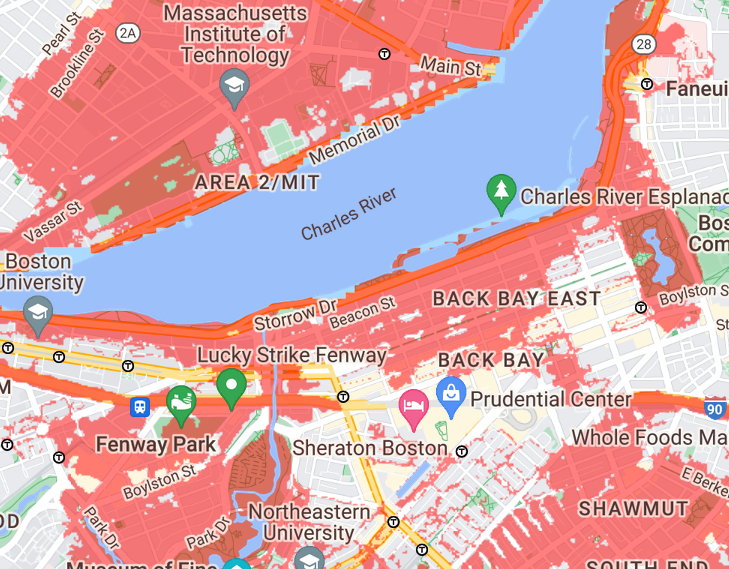
If you would like to see what that means for New York City - or your area of the world, you can actually generate interactive maps for your region in a cool site provided here by Climate Central. Here’s an example of Boston with 5.5 feet of sea-level rise. Doesn’t look too promising for MIT, Fenway Park, or Boston University:
To mitigate the situation in New York City, the US Army Corps of Engineers is proposing a very large program (mistakenly called a project by some) which I will cover in detail in a follow-up post.

From an article recently published in The City,
The Army Corps estimates construction on the $52 billion project would begin in 2030 and be complete by 2044. The project must be first approved by federal, state and local officials and funded before any of the work can start.
The public can comment on the project proposal through Jan. 6 — via email or snail mail — in order to inform the design, which is expected to be finalized in 2025.
Some specific proposals for neighborhoods include:
- Sheet-pile reinforced dunes along Rockaway Beach and boardwalk
- Floodwalls, seawalls and levees along Coney Island peninsula and along the Greenpoint/Long Island City shore
- Elevated promenades near East River Esplanade and Coney Island Beach
- Bulkheads, berms and elevated roads in Broad Channel
- Seawalls at Carl Schurz Park on the Upper East Side and Hunters Point in Queens
In the next post, I would like to cover the Army Corps of Engineers’ proposal, but also the way in which they considered stakeholders and presented this major, important program to taxpayers and other stakeholders.
REFERENCES:
Guardian article: https://www.theguardian.com/us-news/2023/may/19/new-york-city-sinking-skyscrapers-climate-crisis
Parsons, T., Wu, P.-C., (Matt) Wei, M., & D'Hondt, S. (2023). The weight of New York City: Possible contributions to subsidence from anthropogenic sources. Earth's Future, 11, e2022EF003465. https://doi.org/10.1029/2022EF003465
Posted
by
Richard Maltzman
on: May 21, 2023 08:56 PM |
Permalink






