Projecticity
From the People, Planet, Profits & Projects Blog
by Richard Maltzman,
Dave Shirley

View Posts By:
Richard Maltzman
Dave Shirley
Recent Posts
What is AI doing to the sustainability of our profession???
Stepwells – Insight from a Particularly Valid Angle
Climb-it Change: Pre-Interview Connector
Climb-it Change: New Relevance for the Stepwells of India
A PATH to more equitable health - via AI project leadership
Categories
6th,
6th Edfition,
6th Edition PMBOK,
7th Edition,
7th Edition PMBOK,
8th Edition PMBOK,
8th Edition PMBOK Guide,
Activism,
actuarial,
actuary,
adapt,
addition by subtraction,
Africa,
africa,
agriculture,
airforce,
ajaita,
Alaska,
amazon,
analogous,
analytics,
ancient,
and more power,
antarctica,
anti-science,
apple,
apps,
architecture,
arctic,
arrakis,
Artificial Intelligence,
asch paradigm,
Assistant,
asthma,
astronomy,
automobile,
automotive,
autonomous cars,
b,
bankhar,
Banksy Crypto,
basalt,
baseball,
bats,
batter,
beauty products,
benefit,
benefits,
Benefits Realization,
beyond epica,
biases,
bicycle,
big data,
big dfata,
big dig,
bike,
biodiversity,
biomedicine,
birdhouse,
blockchain,
blood,
blue blood,
blue trees,
bluefin,
bluefin tuna,
book review,
boston,
boston university,
Boyce,
Brazil,
brazil,
Breakdown Structures,
BS,
building,
buildings,
built environment,
built environment,
bumblebee,
cake,
capacitor,
car,
Carbon,
carbon,
carbon capture,
carbon negative,
carbon neutral,
carbon pool,
carbon sequestration,
carbonate,
careers,
CEO,
ChatGPT,
chatGPT,
chatgpt,
chatgpt,
chess,
China,
china,
chopsticks,
citrus,
cli-fi,
climate,
climate change,
climate resilience,
climeworks,
Clumsy,
CO2,
co2,
CO2 Utilization,
coalition,
cobalt,
coffee pods,
cognition,
cognitive,
Collabortion,
colombia,
concrete,
Conflict,
construction 5.0,
cool projects xyloscope,
cooling,
coral,
corn,
cost of good quality,
cost of poor quality,
cost of quality,
crazy,
criticism of project management,
cryptocurrency,
CSR,
csr,
data,
data analytics,
data privacy,
datacenter,
dataset,
death spiral,
Decision Making,
decomposition,
Defense and Climate,
definition of a project,
deforestation,
dependencies,
dependency,
desert,
DIKW,
dikw,
dimopoulos,
disposal,
dna,
DOD,
dogs,
dolphins,
dream,
drilling,
drink,
dune,
dune,
dutch,
early start,
earth,
eatlocal,
eco-tourism,
ecological,
economic,
economics,
EKC,
electric grid,
electricity,
electronics,
elysis,
embodied carbon,
emerging technologies,
empower,
Energy,
energy efficiency,
environmental degradation,
escalate,
escalation,
ESG,
extreme weather,
fallacy,
FARC,
farming,
finance,
fish,
fish brains,
fishing,
fix,
fixing the earth,
flint water,
Flint Water Supply,
flood,
flooding,
Food supply chain,
food waste,
forest,
forest for the trees,
forestation,
forrestgump,
frank herbert,
Fruitcake,
fungus,
fusion,
Galvao,
garage,
gas,
gasoline,
geese,
gender equality,
gender partnerships,
generational differences,
Generative AI,
gladwell,
gold,
Goodness,
google,
Government,
GPT,
great pacific garbage patch,
green,
green building,
green buildings,
green energy,
green iguana,
green project,
green project management,
greening,
guest post,
gyre,
harkonnen,
Harvesting Benefits,
hawasina,
hedgehogs,
heursitics,
historical data,
hlb,
holitsic,
holland,
horseshoe crab,
human-caused climate change,
hydrogen,
hydrology,
ice,
iceland,
ignition,
iguana,
imagery,
impact,
india,
inequality,
information,
initiatives,
injection,
insurance,
intelligence,
interacting risk,
internal combustion engine,
invasive species,
investment,
isomer,
issue escalation,
issues,
ITER,
jobs,
Jupiter,
justification,
kids,
kill point,
knowledge,
koch brothers,
Kuznets,
laboratory,
LAL,
landscape mode,
lapampa,
launch,
LCA,
Leadership,
Leadership,
life cycle analyses,
life cycle analysis,
lifecycle,
Linkedin,
liquid,
lizard,
local,
long term,
long-term,
long-term thinking,
look up,
loud,
maintenance,
maker,
makermovement,
malcolm gladwell,
management,
marathon,
marine biology,
market,
mars,
Martin Luther King,
mean,
megawatt,
MeHg,
melting,
mercury,
metal,
Microgrid,
microplastics,
migration,
military,
millennial,
mindset,
minerals,
mission,
mitigate,
MLK,
mongolia,
museum,
museum of london,
nature,
nematodes,
net gain,
Net Project Success Score,
net zero,
netherlands,
network,
New book,
New Jersey,
New Practitioners,
new york,
NFT,
nitrogen,
noise,
noreaster,
norway,
nova,
NPSS,
NREL,
ocean,
ocean cleanup,
ocean life,
oil rig,
oil rigs,
oklahoma,
oman,
only murders in the building,
opportunity,
overall risk,
oxygen,
packaging,
pareto,
PBS,
permafrost,
persistence,
peru,
Pharmaceutical,
planet,
planet.com,
planning,
plant,
plasma,
plastic,
playground,
pm,
pm education,
pmbok,
pmbok guide,
pmnetwork,
PMXPO-2018,
podcast,
pollutants,
pollution,
poop,
poor,
portfolio,
power,
power skills,
privacy,
privacy concerns,
professors,
program,
Program Management,
project,
project leader,
project leadership,
project management,
project management 3.0,
project on fire,
project progress,
Project Success,
project success,
projecticity,
projectleadership,
projectmanagement,
projects,
psychology,
pulse of the profession,
purple bacteria,
purpose,
quiet,
rainforest,
rationale,
reef,
refugees,
renewable,
renewables,
Repair,
repair,
repeatable process,
repeatable processes,
repurpose,
research,
resource breakdown strucuture,
Resource Management,
reversing climate change,
revisionist history,
rich,
rigs2reefs,
ripe,
risk,
risk avoidance,
Risk Management,
risk mitigation,
risk response,
risk responses,
river,
robots,
rocks,
rules of thumb,
rural,
rural India,
russia,
Sarcasm/Irony,
satellite,
saudi,
schedule,
sci-fi,
Science,
science,
science-fiction,
scientific american,
screaming monkeys,
sea,
sea life,
Sea-Level Rise,
sea-level rise,
seagreens,
seawall,
seawater,
seawater temperature,
seaweed. beat;es. farming,
secondary risk,
selena gomez,
sequestration,
shipping,
skyscraper,
SLR,
smart cities,
smart city,
smelting,
social,
social pressure,
soil,
solar,
solar panels,
solar perovkites,
solar saheli,
sonic,
sponge cities,
SRI,
stage-gate,
stagegate,
stakeholder,
stakeholder management,
steward,
stewardship,
storage,
strategy,
stupid,
success,
suffer,
sulphur,
sunk cost,
supercapacitor,
supply chain,
survey,
Sustainability,
sustainability,
Sustainable Investing,
Sustainable Tourism,
sybiosis,
symbiosis,
system 03,
TBL,
temperature,
terraform,
terraforming,
test,
threat,
threats,
totem,
touchscreen,
tour,
tower,
Trains,
transparency,
transportation,
trash,
tree,
tree species,
trees,
trillion,
triple bottom line,
triple constraint,
truth to power,
UMass,
us army corps of engineers,
USDA,
vacuum,
value,
venus,
vision,
voice,
voltage optimization,
vw scandal,
washing machine,
waste,
wastewater,
water,
we mean business,
whales,
Whirlpool,
wind,
wisdom,
women,
Women in Project Management,
wood wide web,
woonerf,
Work Breakdown Structures (WBS),
world breakdown structure,
worms,
xian,
xylotron,
Yale
Date

Image generated by incredibly thoughtful prompts from the author and the help of DALL-E
The title of this post – projecticity, is a mashup of the words project and ‘electricity’… electricity in the sense of electrifying growth in PM career opportunities.
Here, I continue the series on Project Management and Smart Cities. A new guest post is around the corner from Dr. Beverly Pasian, an expert in this area. However, given the projectmanagement.com focus on careers this month, I wanted to provide this post, focused (you guessed it) on the opportunities already here and coming along in the next few years for project managers (and project leaders) in the field of Smart Cities.
I found a great resource from the Information and Communications Technology Council, Canada. It’s a summary of research on career roles based on the explosive growth of Smart Cities. Project management features heavily in it. One way that’s made obvious is that the word “project” appears 43 times in this 40-page document!
The document (pictured below) can be found here or by clicking on the image below.
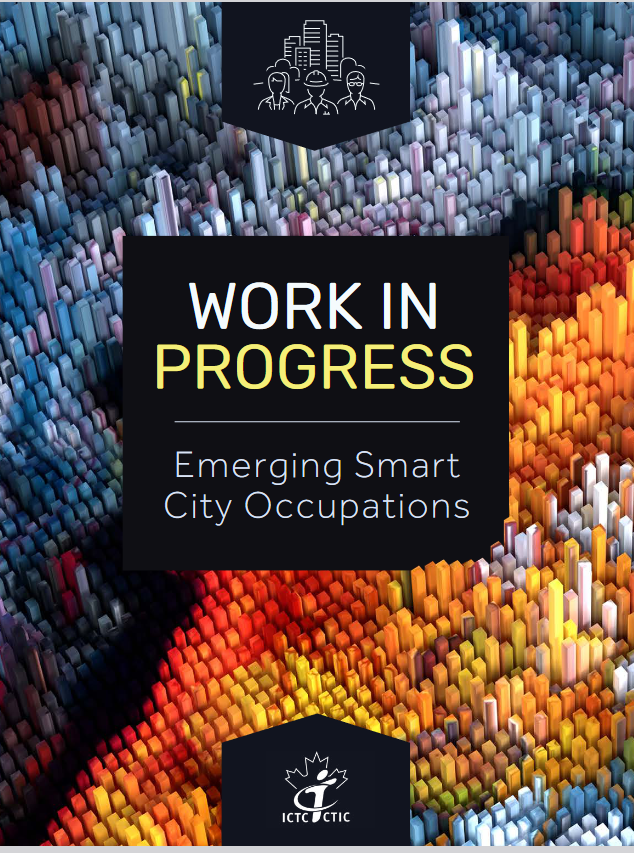
From this report, the focus was on five categories of roles:
- Privacy, Cybersecurity, and Risk Management
- Equity, Ethics, and Inclusivity
- Innovation and Growth
- Infrastructure and Mobility
- Sustainability and Resilience
I would argue that true project leaders are often working all 5 of these roles simultaneously.
Like most reports of this nature, it begins with the promising growth of Smart Cities:
Revenues from smart city projects worldwide are projected to grow from $116 billion (USD) in 2020 to $241 billion (USD) in 2025. 1 These initiatives, along with globalization, urbanization, and rapid digital disruption, will impact existing jobs and establish a demand for newly defined occupations in smart cities and beyond.
In the research, the ICTC interviewed industry leaders in the Smart Cities area, whose overarching message was:
“future skill needs will likely be centered around data and digital literacy combined with strong soft skills.”
To expound further on this,
The skills interviewees sought when building their teams included cross-disciplinary talent with technical skills combined with data analytics knowledge and an awareness of issues around privacy and ethics, and inclusivity and equity in technology design. In discussing cross-disciplinary talent, interviewees pointed to the need to overlap fields of study that have traditionally been more pursued in isolation. The theme of combining fields of study came up multiple times, with interviewees saying that a greater combination of technical and analytical skills and certifications (for example business along with engineering, or civil engineering and data science) would help prepare people for their department. Interviewees from one department had recently begun working on university partnerships, stating that such initiatives “provide students that key level of life experience that they need in the workforce.
In terms of certifications, as expected, Certified PMP® was one of only five certifications listed as desired, along with PE, MBA, Safety Professional and Microsoft Certified Systems Engineer.
Amongst the Power Skills listed were (should sound familiar to project managers!):
- Communications
- Self-Motivation
- Problem Solving
- Leadership
- Teamwork
- Coordinating
- Innovation
- Integration
The report (and others, like this one from BurningGlass, and this one from PMI) said that employers saw their skill requirements focused in the areas of
- proficiency in IT, privacy, and data analysis
- a core set of strong soft, or “human” skills
Listed under these human skills were:
- project management
- organizational leadership
- governance or delivery-related skills
- ability to foster change management across an organization
- manage collaborative multi-stakeholder projects
- work with user experience in mind
- ability to understand the bigger picture
To close this brief post, here’s an actual example of a job posting for a PMO leader for a Smart Cities initiative in Saudi Arabia:
Job Title: PMO - Smart Cities
Location: Riyadh, Saudi Arabia
Overview:
- We are seeking a highly skilled and experienced Program Management Lead to join our client's team and drive the successful delivery of smart city projects. As the PMO, you will collaborate closely with business stakeholders to oversee projects from initiation through requirements, solutioning, estimations, planning, and end-to-end delivery into production. Your expertise in Internet of Things (IoT), Smart Cities/Services, software or network engineering, and telecommunications infrastructure or operations will be crucial to your success in this role. You will lead a diverse team of experts with different backgrounds, ensuring their cohesive collaboration and excellent performance.
Responsibilities:
- Establish and implement a fully functional PMO for the smart city project, encompassing consistent methods and tools for project initiation, team structure, financial management, risk management, development processes, systems integration processes, project/program reviews, escalation processes, testing, business case development, and cross-functional team leadership.
- Foster a culture of continuous improvement in project delivery and leadership by utilizing valuable project performance metrics and defining performance improvement plans.
- Collaborate with leadership teams to ensure effective planning, execution, visibility, tracking, and leadership to enhance project success rates.
- Develop and implement project performance metrics to provide a data-centric view of PMO performance and validate ongoing improvements.
- Conduct comprehensive resource planning and allocation activities while ensuring appropriate project financial management for planning the project portfolio.
- Communicate and promote the adoption and alignment of standards, policies, and procedures across projects.
- Accumulate and disseminate PMO best practices, driving their use and applying lessons learned to enhance performance outcomes.
- Lead departmental or cross-functional teams dedicated to delivering the smart city blueprint.
- Drive the strategic management of identified programs, ensuring alignment with customer needs and enterprise business goals.
- Contribute to strategic planning and implementation of major engineering, technology, and innovation strategies and initiatives as determined by the Smart City PMO, Technology Council, and client stakeholders.
More here: https://aventusglobal.com/job/pmo-smart-cities
Posted
by
Richard Maltzman
on: December 22, 2023 03:04 PM |
Permalink
Comments (4)
Please login or join to subscribe to this item

Kwiyuh Michael Wepngong
 Community Champion
Financial Management Specialist | US Peace Corps
Yaounde, Centre, Cameroon
Thanks, interesting coining of the word Projecticity

Markus Kopko
AI Enabler for Project & Program Mgmt | Founder PMotion.ai / The PM
AI Coach| PMotion.ai
Hamburg, Hamburg, Germany
The concept of "projecticity" as a blend of project management and the dynamic, electrifying growth in Smart Cities is a compelling perspective. It’s clear that the field of Smart Cities is not just an emerging area of technological innovation but also a burgeoning realm of career opportunities for project managers and leaders.
The focus on the five categories of roles within Smart Cities - Privacy, Cybersecurity, and Risk Management; Equity, Ethics, and Inclusivity; Innovation and Growth; Infrastructure and Mobility; Sustainability and Resilience - highlights the diverse range of skills and expertise needed in this field. It's fascinating how these roles encompass a broad spectrum of challenges and opportunities, emphasizing the need for a multifaceted approach in project management.
The rapid growth in Smart Cities, as indicated by the projected increase in revenues, signals a significant transformation in urban development and management. This transformation is not just about the technological advancements but also about the impact on job roles and the skills required. The emphasis on data and digital literacy combined with strong soft skills reflects a comprehensive skill set that balances technical acumen with human-centric capabilities.
The need for cross-disciplinary talent is particularly interesting. It suggests that the future of Smart Cities and project management therein will require a blend of diverse fields such as business, engineering, data science, and more. This interdisciplinary approach seems to be a key factor in driving innovation and addressing the complex challenges of Smart Cities.
As for certifications, the mention of Certified PMP® among the top desired qualifications underscores the continued relevance and value of project management skills. The emphasis on Power Skills like communication, leadership, problem-solving, and innovation aligns with the evolving nature of project management, where soft skills are increasingly recognized as critical for success.
The report’s insights into the skill requirements, focusing on IT proficiency, privacy, data analysis, and a core set of human skills, paint a picture of a project manager who is not only technically adept but also skilled in leadership, governance, and change management. The ability to manage multi-stakeholder projects and keep the user experience in mind while understanding the bigger picture is crucial in this context.
This evolution in the project management landscape, especially in the context of Smart Cities, is indeed exciting. It opens up new avenues for project managers to expand their skill sets and adapt to the changing demands of this dynamic field.
I'm curious, how do you see these developments influencing the training and development programs for project managers? And what strategies do you think project managers should adopt to stay ahead in this rapidly evolving field? Your insights would be incredibly valuable, especially for those looking to carve a niche in managing Smart City projects.
BR,
Markus
@Markus, thanks for the comments - very insightful. Yes, this is exciting, and we at Boston University are working very hard to incorporate the entire Built Environment area into our curricula - and to add to it specialty courses and certifications in this area. We see it as ... well, very electrifying. We need to prepare the next generation of project leaders to think broadly, deeply, and for the longer term - and Smart Cities are a big part of that movement.
Thanks again for the comment!
-Rich
Interesting... thanks for sharing!
Please Login/Register to leave a comment.
|
"I know the meaning of life - it doesn't help me a bit."
- Howard Devoto
|




