I thought I would bring us back to our world from Arrakis in this final posting of my series on Dune, by taking us very intentionally to New Orleans, Louisiana.
That’s actually perfect, because if you know that city, you know it’s (justifiably) recognized for its food, including the beignets at Café du Monde. And what does Café du Monde mean? Café of the World. Our world - Earth.
On Arrakis, most of the planet’s surface is sand. The ecology is based on sand, the very lack of water, and the giant sandworms that cruise through (and under) the sand. Here on Earth, sand is the basic ingredient of glass. Glass is the basic ingredient of wine and beer bottles, and wine and beer (and whisky, and bourbon...) are basic ingredients of New Orleans. After all, one famous expression from the city is "Laissez les bons temps rouler" - let the good times roll!
What happens to all of those bottles when there is no recycling program in the state of Louisiana?
From their “About” page, here’s what this organization is about:
As seniors at Tulane University in 2020, we were disappointed and frustrated with the lack of glass recycling in New Orleans. One night, over a bottle of wine that we knew would end up at the landfill unless we did something about it, we hatched a plan to combat this problem. Specifically, we wanted a system that was transparent, accessible, and most importantly, actually recycled glass into something functional. Instead of trying to take on the task of reforming the current system, we decided to look at the ‘glass half full’ by implementing our own grassroots glass recycling program.
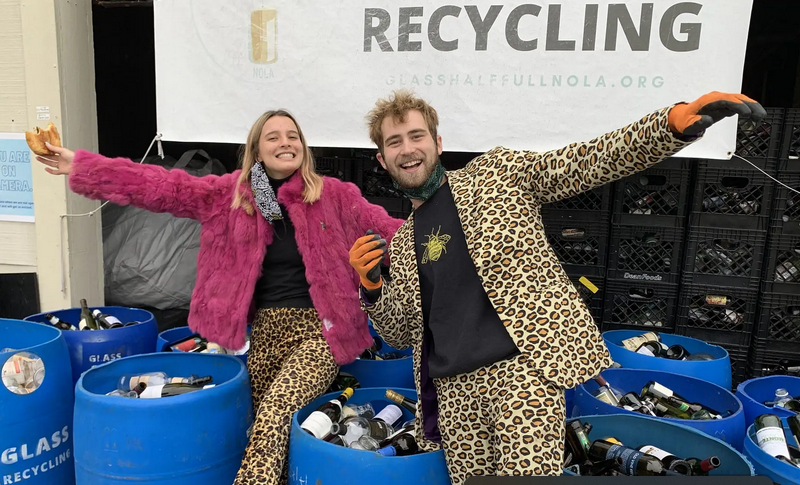
So they started their own grassroots recycling program, offering multiple free drop-off hubs across the city, where they collect glass “waste” from residents throughout Louisiana. This was all destined for landfill. Instead, they (see photos below)
sort it by color and remove all plastic and metal components.
process the glass by pulverizing it with hammer-mill crushers
sift the crushed product to remove labels and sort the various size distributions
This provides them with the ability to make gravel or (you guessed it!) sand.
What happens to the sand?
Ironically, one of the issues faced by Louisiana is erosion, caused, at least in part, by rising water levels and a greater quantity of and more intense hurricanes. In fact, the forecast for the 2024 season is very foreboding. In a press release from just a couple of days ago, the US National Oceanographic Atmospheric Administration (NOAA) is forecasting 17 to 25 total named storms (winds of 39 mph or higher). Of those, 8 to 13 are forecast to become hurricanes (winds of 74 mph or higher), including 4 to 7 major hurricanes (category 3, 4 or 5; with winds of 111 mph or higher). Forecasters have a 70% confidence in these ranges.
The other causes of beach erosion serve as a good example of secondary project risk. Flood control structure projects have a good rationale but have caused significant problems in the long term. Project managers should be thinking not only of the short-term outputs and outcomes of their initiatives but also of what happens in the years or decades that follow.
From the Glass Half Full website:
Louisiana has lost a quarter of its wetlands since the 1930s as a result of flood control structures designed to protect communities and businesses from flooding. While well-intentioned, such structures have prevented the deposition of sediment into barrier islands and wetland areas by the Mississippi River’s spring floods, a natural process critical to the preservation of coastal areas. Consequently, land is disappearing much faster than it can regenerate.
So the sand can be use for re-establishing beaches as well as many other purposes.
From the Glass Half Full website:
New Orleans wastes millions of tax dollars per year dumping recyclables in landfills (we pay per pound that's discarded) and on importing millions of pounds of sand.
Turning glass back into sand saves money on both ends (less dumping, less importing of sand).
I find this inspiring and a project (turned operation) worth our attention, and a solid example of how we can be more sustainability-oriented project leaders.
For those of you who are more visual, here’s a video that describes this initiative:



 Community Champion


