In this short series, I want to cover a portfolio of programs that are aimed at the long term, as described in the last series, “Faith in the Eighth” (referring to the Eighth Edition of the PMBOK® Guide).
In Part 1, I want to introduce you to the portfolio and in Part 2, I want to derive meaning and meaningfulness (that is, lessons learned) from the portfolio.
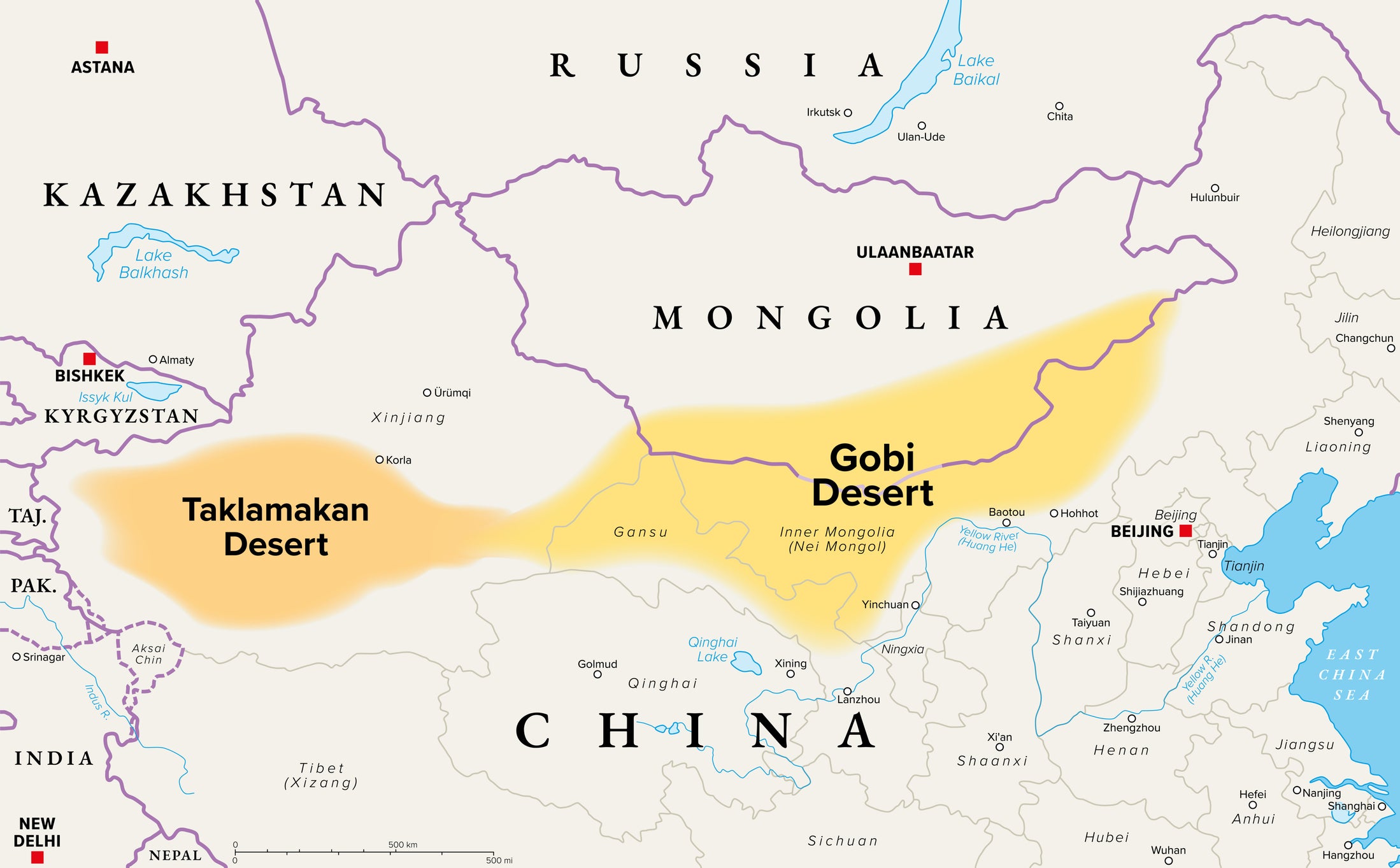
In China, there is a large desert (see map below) which is called the Taklamakan Desert (which is also sometimes called the Taklimakan or Takla Makan Desert – or even by its haunting nickname, “The Sea of Death”.). The portfolio, which, in turn, is part of a larger portfolio, aims to plant millions of trees and shrubs and to geo-engineer the land, building a “Great Green Wall” around this – and other – deserts. as drawn to this portfolio because of the recently reported results – and the fact that the projects in the portfolio have been going on for more than 45 years.
Map source: Getty Images
The official name of the overarching portfolio that includes the Taklamakan Desert afforestation work is: Three-North Shelterbelt Forest Program.
It is also commonly referred to as:
The Three-North Shelterbelt Program
The Three-North Afforestation Program
Informally: China’s “Great Green Wall”
“Three-North” refers to the three northern regions of China covered by the program:
Northeast China
North China
Northwest China
The Taklamakan Desert project is part of the Northwest China component of this broader ecological program. So for one immediate lesson learned we can see the concept of projects, which are part of programs, which in turn are part of portfolios which are part of still other portfolios – is a real thing. Beginning with the end in mind (to be covered mainly in Part 2), scientific studies now conclude that there are positive results (value!!) delivered by this portfolio. "We found, for the first time, that human-led intervention can effectively enhance carbon sequestration in even the most extreme arid landscapes, demonstrating the potential to transform a desert into a carbon sink and halt desertification," study co-author Yuk Yung, a professor of planetary science at Caltech and a senior research scientist in NASA's Jet Propulsion Laboratory, told Live Science in an email. Yung’s research can be found here: https://web.gps.caltech.edu/~yly/yly_mac/ReprintsYLY/N457_noor-2026-taklamakan-afforestation-project.pdf
The Taklamakan Desert (the portion of the portfolio covered here) is slightly larger than Montana – or roughly the size of Germany, covering about 130,000 square miles (337,000 square kilometers). High mountains, which block moist air from reaching the desert for most of the year, encircle the area, creating extremely arid conditions that are too harsh for most plants – this, combined with massive wind and dust storms – gives it the nickname “Sea of Death”. Most of the desert sand is ‘shifting sand’ – dunes – which has been growing since the 1950s.
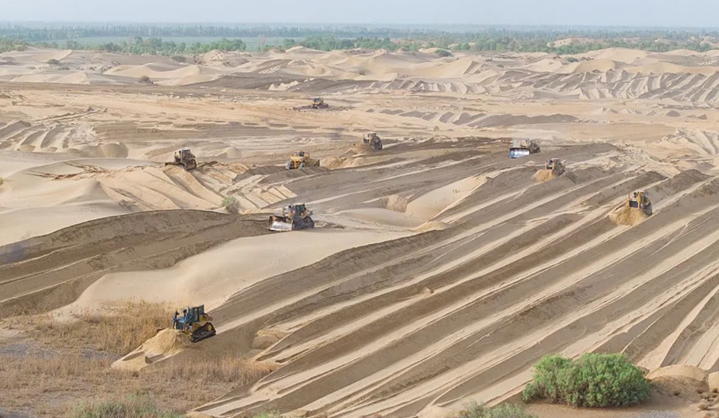
In 1978, China began this Three-North Shelterbelt Program, a combination of geo-engineering, botanical science and massive infrastructure, including trench digging and solar panel installations.
In late 2024, the Sea of Death was finally completely encircled with vegetation – and recently, the findings have begun to emerge – thus this blog post series, focused, as is the last series, on the delivery of value. Rewinding for a moment to its start – The Taklamakan Desert initiative is part of the Northwest China component of this portfolio, focused specifically on the Xinjiang region, to do the following:
Stabilize the world’s second-largest shifting-sand desert
Protect the Tarim Basin ecosystem
Prevent further expansion of desertified land
The Taklamakan initiative is not “just tree planting.” It includes (amongst others) this set of projects:
Afforestation projects
Shrub planting and grassland restoration
Irrigation infrastructure
Soil stabilization engineering
Monitoring and carbon measurement systems
Solar panel installations
I found several good, short videos that can do a better job than I of describing the initiative.Have a look at these.
I hope this gives you sufficient context. I will be coming back in Part 2 to show the relevance of this portfolio to People, Planet, Profits and Projects.
What an incredible transformation project. This shows how project management skills can drive large-scale environmental restoration. The scope and ambition are truly inspirational.