


Faith in the Eighth, Part 2


 In Part 1 of this post, I hopefully conveyed the idea (and hopefully you agree!) that the 8th Edition PMBOK® Guide represents a breakthrough in project management maturity – so much so that it literally redefined the “P” and the “PM” in PMBOK. I even assert that the “M” should maybe be advanced to “L” for Leadership. Who knows, maybe the 9th Edition could be the PLBOK® Guide? NOTE: I had thought this would be a 2-part post. Nope. It’s going to be 3 parts. Turns out there’s more to say about this – and more to learn about this – than I originally thought! This post focuses on what that advancement looks like when viewed through the lens of that figure. The header of the figure (repeated here for your convenience) indicates that of course projects produce outputs – interim deliverables – along the way. These deliverables (think “frame of house completed”) don’t necessarily produce value to the end-user. First, here's the infographic I created, for your convenience. 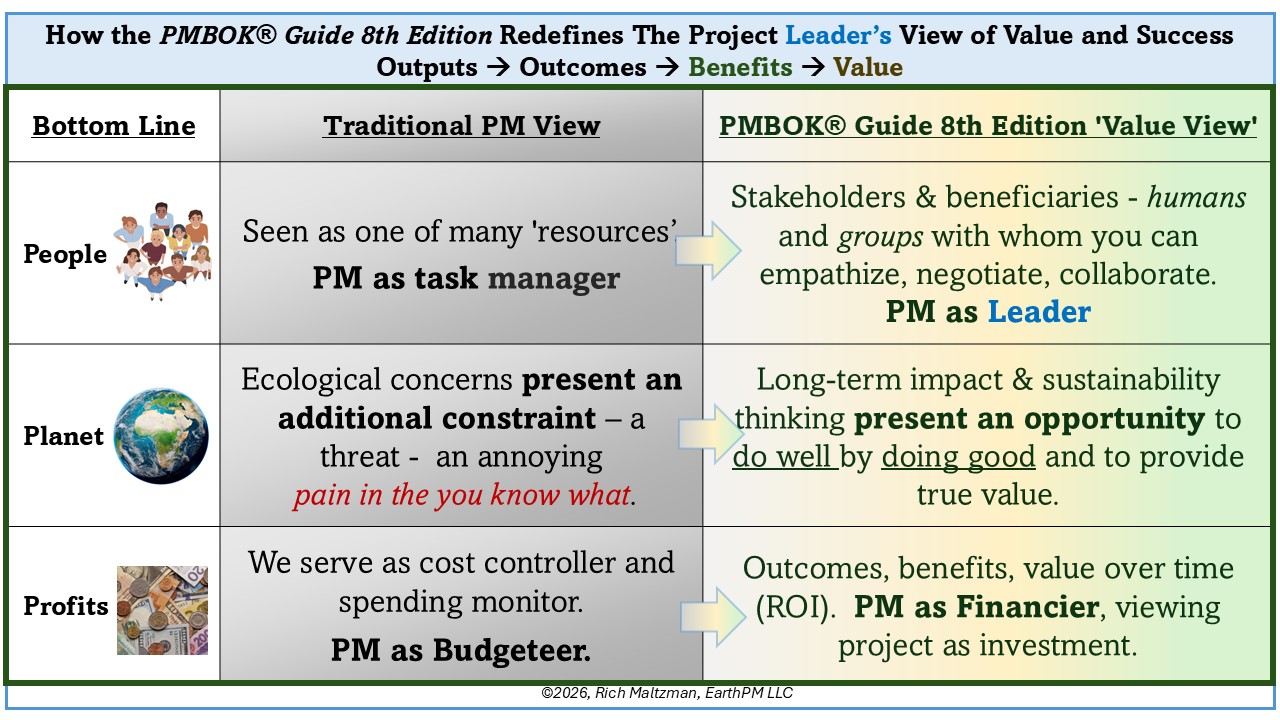 I need to take a brief tangent and a story to illustrate some of this – these outputs can and should be used by thoughtful project leaders as a way to motivate teams and to celebrate success along the way. I recall the so-called “Jenga” building construction project at Boston University. This is formally called the Duan Family Center for Computing and Data Sciences. I happened to be teaching a course in Project Leadership in the building across the street while teaching a segment on motivation. Literally in the midst of that conversation on project motivation with the students, a huge "top-off" celebration took place at the base of the building – music, food, with probably over 350 construction workers, managers, officials – marking the completion of the steelwork for the building (see below image). In other words, they were celebrating a milestone – an interim deliverable. I would argue that there is value there – perhaps not easily measured, but real value in terms of human team-building and motivation, which shows itself in the remaining work, aimed at the outcome – the availability of an amazing building. So amazing, that I urge you to take 5 minutes and click here to take a tour RIGHT NOW from your seats, from the eyes of a pretty fast-moving drone. Hold on to your seats and... GO (but then come back).
So that’s the beginning of the O – O – B – V progression – Outputs, Outcomes, Benefits, and Value. Value - this is value as seen by the users and sponsors (in the case of the Jenga building: Faculty, Staff, Students, local residents and businesses, alumni and more) is achieved only after the outcome – the ‘product of the project’ is delivered. That outcome produces benefits (in the case of the Jenga building, classroom and conference space, a showcase of sustainable construction, and so on) which – collected over time, creates value. Perhaps the most important phrase in the paragraph above is 'collected over time'. And this is fundamental to understanding the infographic featured in this series. Value (from the user, or from the project investment perspective) cannot be measured at the point of delivery of the outcome. It can only be measured after benefits start to accrue – and that means collecting benefits over time. And that leads to an important tangent about benefits and disbenefits. As humans, we tend to have optimism bias. It varies by culture, but generally all of us have this. This may lead to us thinking only of the positive benefits. Most projects also generate disbenefits. So in the case of the Jenga building, perhaps someone in an apartment building nearby used to have a view of the Boston skyline and the new building blocks their view and makes their property less saleable. This is subtle, but very important. When you manage (or rather lead) a project, are you thinking about what the product of the project does (both good and bad) in the longer term?If it is a single-serve coffeemaker, for example – what happens to the pods when they are discarded? If it’s a building, how is it heated and cooled?If it’s a service, how does it affect others besides those using the service? Good questions to ask, yes, even for a project leader – nobody else may be considering these things, and it may come down to you. Perhaps even if you are not the main decision-maker you can influence those who do make decisions about the project’s outcome in the steady state. Think about it. Wait, don't go - did you take the drone tour? Go for it! Click the picture and hold on to your seats!
In Part 3, I will proceed through the main part of the table, covering People, Planet, and Profit and how the 8th Edition PMBOK® Guide brings us from M up to L (manager to leader). |


Faith in the 8th, Part 1
Categories:
8th Edition PMBOK Guide
Categories: 8th Edition PMBOK Guide
 The 7th Edition of the PMBOK(R) Guide cracked open the door of Project Leadership. As a principles-based Guide it set up future editions to help our discipline mature. The 8th Edition boldly kicked that door wide open and sent us through, even daring to change the very definitions of project and project management - changes that start to make even our discipline's name - Project Management - seem quaint and inadequate, relative to what we need to do as we walk through that door. There are multiple aspects to to this passage, and in this series of two or three posts, I want to focus on People, Planet, and Profits - mainly because that's the title of the blog. This post is short. It is simply going to introduce a summary graphic which has my assessment of how the 8th Edition moves us forward (through the passageway, if you keep my metaphor in mind) from project manager to project leader. I believe the graphic will be mainly self-explanatory, however, if you have followed the blog, you know I won't be able to resist the temptation of fleshing this out with a paragraph or two about each row, and I hope that will be helpful for you. For now, have a look at the graphic and think about what it might mean for you personally, or your organization, especially if you are in a PMO or Center of Excellence sort of position. Of course if you have any comments on the graphic, or the post in general, they're welcome and appreciated. 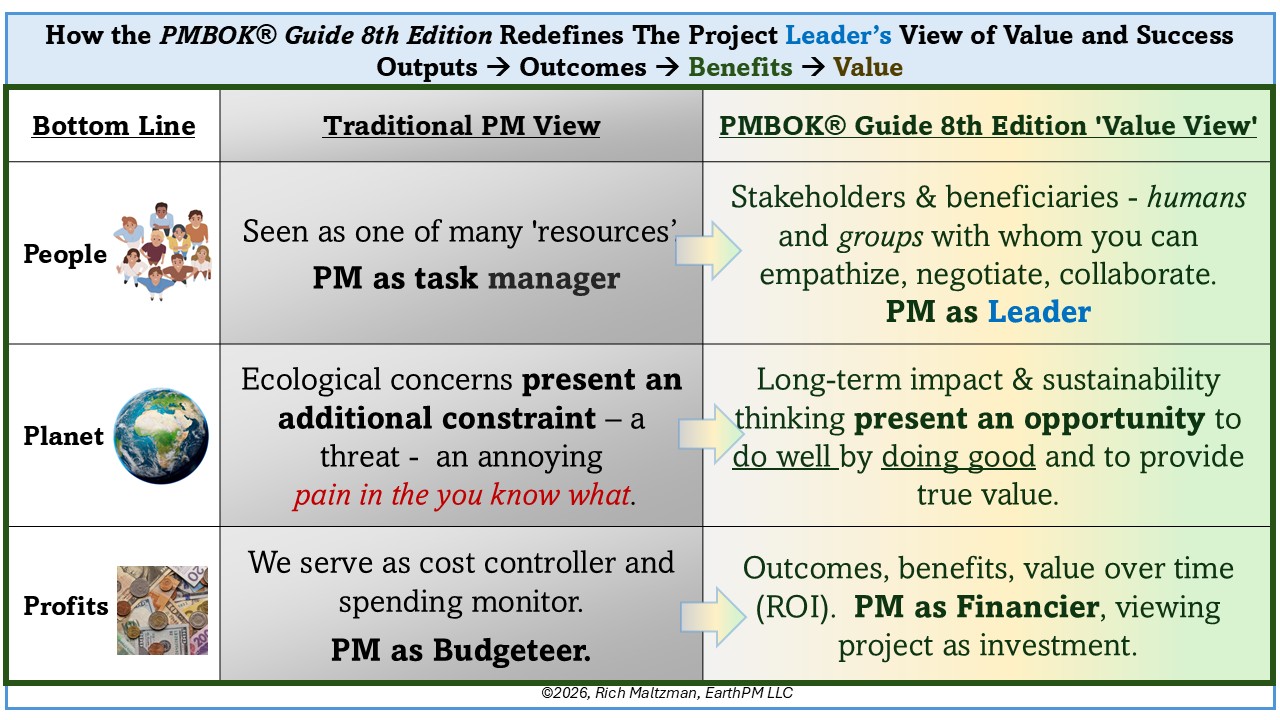 |
Resolve!
 It’s time to make New Years’ Resolutions. One of mine is to have shorter, more concise, and helpful blog posts. So… I have a few suggestions for project managers who want to 'elevate' to Project Leaders: Commit to being a lifelong learner
Check anything that an ‘expert’ tells you – and that ‘expert’ can be AI. Is what the expert told you:
Become more self-aware and develop your Power Skills • Communication: Clearly conveying information and ideas. • Problem-Solving: Effectively addressing challenges and finding solutions. • Collaborative Leadership: Guiding and working with teams to achieve common goals. • Strategic Thinking: Seeing the big picture and making plans for future success. • Active Listening • Adaptability • Conflict Management • Emotional Intelligence (EI) • Negotiation • Relationship Building • Team building and teamwork That’s it – I am consciously avoiding a long, boring post to keep my resolution! I hope to sustain it through 2026. Happy New Year! |
Guest Post: How Neuroscience Applies to Project Leadership
 Neuroscience (even empowered with AI) for Project Management by Luigi Morsa and Richard Maltzman Why Neuroscience The famous former basketball player Scottie Pippen once said: “Chemistry is a very important element for any team that wants to be serious about winning.” [1] By chemistry, most likely, Pippen meant the intangible bond and synergy among teammates that makes them function as a team - far more capable than just a collection of individuals. Pippen's quote bounces far beyond basketball. Similar expressions are heard in business, music, and any group effort where success depends on collaboration. In these contexts, chemistry acts as the emotional glue that makes cooperation smooth. It enables people to handle conflict constructively, celebrate each other’s achievements, and remain resilient under pressure. This raises an important question: What’s the science behind this? And if so, in project management — our field of interest — who is responsible for creating good and productive team chemistry and, above all, how is it best done? As underlined in a recently published article in PM World Journal (Bassi 2025, [2]), Neuroscience has achieved extraordinary progress in recent decades in helping us to understand the brain processes underlying decisions, emotions, and social interactions. The synergy between neuroscience and Project Management represents a promising frontier, capable of transforming the discipline into a truly predictive, adaptive, and sustainable approach. A leader who is aware of neurobiological dynamics can implement so?called ‘Neuroleadership,’ with evident benefits. Some of the most important are listed below.
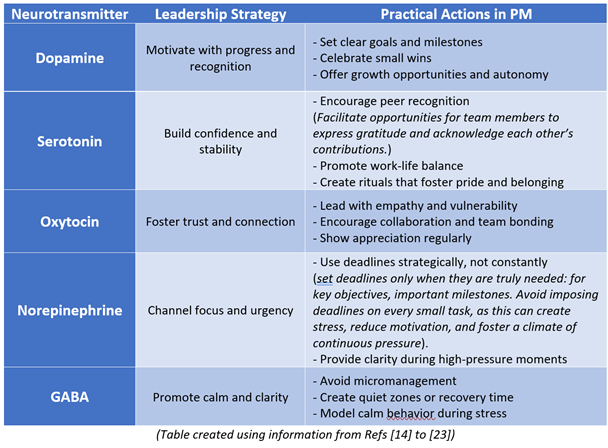
Key Brain Chemicals in Leadership and Project Management Let´s take a closer look at the Key Brain Chemicals of our interest. In order to introduce them, it is appropriate to give a general definition before. Neurotransmitters are chemicals that carry messages between nerve cells, also called neurons. Neurotransmitters help neurons to communicate and regulate everything from mood to muscle movement. Common neurotransmitters - for instance serotonin, dopamine, and GABA (gamma-aminobutyric acid) play critical roles in mental health and emotional balance [5]. Dopamine is a neurotransmitter produced in the brain that regulates functions like motivation, reward, movement, attention, mood, and learning [6]. Dopamine is linked to pleasure because it activates the brain’s reward system, driving motivation, anticipation, and reinforcement of pleasurable behaviors — but it’s more about wanting than pure enjoyment. The actual sensation of pleasure is mediated by other chemicals, like endorphins and serotonin, while dopamine drives the anticipation and effort to reach pleasurable outcomes [7]. Serotonin is a neurotransmitter that plays a crucial role in regulating mood, sleep, appetite, digestion, and overall emotional well-being. Lack of enough serotonin is thought to play a role in depression, anxiety, mania and other health conditions [8]. Oxytocin is a hormone and neurotransmitter often called the “love hormone” because it plays a key role in bonding, trust, and emotional connection [9]. Low levels may be linked to social anxiety, depression, and difficulty forming relationships. Norepinephrine (also called noradrenaline) is a neurotransmitter and hormone that plays a key role in the body’s stress response, alertness, and regulation of blood pressure [10]. It helps prepare the body for action during stressful situations. Low levels are associated with depression, fatigue, and poor concentration [11]. GABA is the brain’s primary inhibitory neurotransmitter, meaning it helps calm down neural activity. It plays a crucial role in reducing anxiety, promoting relaxation, and maintaining a balanced mood [12, 13]. Our focus, of course, lies on the relationship between neurotransmitters and leadership. The table below summarizes how leaders may leverage neuroscientific insights to enhance motivation, cultivate trust, and regulate stress.
Neuroleadership in Action: Platforms and Software — Final Advice The table presented in the previous section offers a valuable overview and general guidelines. However, to act effectively and navigate the complexities of daily leadership, project managers and project leaders must undergo proper training. Specialized courses are essential—and fortunately, today there are even AI-powered tools that provide real-time support. Among the most notable platforms, several stand out with remarkably similar names:
Clearly, investing time in training and equipping oneself with the right tools is essential. This also requires support from companies, which should recognize that having managers trained to lead people and teams more effectively yields significant benefits: greater efficiency and productivity, improved retention and knowledge growth, and enhanced innovation. In short, it is a smart investment—not a wasted one. According to a recent Forbes article titled “The Neuroscience Behind Business Growth” [27], companies that adopt neuroscience-based strategies have reported a 12% improvement in productivity, along with increased creativity and innovation among employees. References [1]. Basketball Mindset Training. "51 Basketball Team Quotes on Sacrifice, Teamwork & Chemistry." Last modified March 20, 2024. https://www.basketballmindsettraining.com/blog/basketball-team-quotes. [2]. Bassi, Antonio. “Neuroscience and Project Management: Towards a New Frontier in Project Management.” PM World Journal 14, no. 10 (October 2025). https://pmworldjournal.com/article/neuroscience-and-project-management. [3]. Magnusson, Olga. “Project Management and Neuroscience: Leveraging Cognitive Biases for Better Decision-Making.” Institute of Project Management. June 25, 2025. https://instituteprojectmanagement.com/blog/project-management-and-neuroscience/. [4]. Miller, Ben. “What Is Neuroleadership? Definition, Examples, and Applications in Project Management.” The Digital Project Manager. October 24, 2023. https://thedigitalprojectmanager.com/project-management/what-is-neuroleadership/.. [5]. Olivia Guy-Evans, "Neurotransmitters: Types, Function and Examples", Simply Psychology, updated May 16, 2025, https://www.simplypsychology.org/neurotransmitters.html [6].Harvard Health Publishing, “Dopamine: The pathway to pleasure”, no date, https://www.health.harvard.edu/mind-and-mood/dopamine-the-pathway-to-pleasure. [7]. Editors of ScienceNewsToday. "Your Brain on Dopamine: The Science of Motivation and Pleasure." ScienceNewsToday, 8 Aug. 2025, https://www.sciencenewstoday.com/your-brain-on-dopamine. [8]. “Serotonin.” Cleveland Clinic. November 21, 2025. https://my.clevelandclinic.org/health/articles/22572-serotonin. [9]. “Oxytocin: The Love Hormone,” Harvard Health Publishing, November 21, 2025, https://www.health.harvard.edu/mind-and-mood/oxytocin-the-love-hormone. [10]. “Norepinephrine (Noradrenaline),” Cleveland Clinic, November 21, 2025, https://my.clevelandclinic.org/health/articles/22610-norepinephrine-noradrenaline. [11]. Adrienne Dellwo, "What Does Norepinephrine Do in the Body? A Chemical/Hormone That Affects Mood, Energy, and More," Verywell Health, October 9, 2025, https://www.verywellhealth.com/norepinephrine-noradrenaline-5208854. [12]. “Gamma-Aminobutyric Acid (GABA): What It Is, Function & Benefits.” Cleveland Clinic, 25 Apr. 2022, https://my.clevelandclinic.org/health/articles/22857-gamma-aminobutyric-acid-gaba. [13]. Pugle, Michelle. “6 GABA Benefits That Can Support Long-Term Health.” Last updated October 20, 2025. Medically reviewed by Violetta Shamilova, PharmD. Verywell Health. https://www.verywellhealth.com/gaba-5095143. [14]. Gonzalez, Marlene, Justin James Kennedy, and Kerrie Alanen. “Neurotransmitters of Leadership.” Psychology Today. June 23, 2023. https://www.psychologytoday.com/us/blog/brain-reboot/202306/neurotransmitters-of-leadership. [15]. Falk, Stefan. “Understanding the Power of Intrinsic Motivation.” Harvard Business Review. March 8, 2023. https://hbr.org/2023/03/understand-the-power-of-intrinsic-motivation. [16]. Hails, Daniel. “The Neurological Chemistry of Leadership.” People Development Magazine. November 9, 2023. https://peopledevelopmentmagazine.com/2023/11/09/chemistry-of-leadership/. [17]. Harvard Health Publishing. “Serotonin: The Natural Mood Booster.” Harvard Health. Accessed November 22, 2025. https://www.health.harvard.edu/mind-and-mood/serotonin-the-natural-mood-booster. [18]. Wisconsin School of Business. “The Chemicals of Leadership.” Wisconsin School of Business. Accessed November 22, 2025. https://business.wisc.edu/chemicals-of-leadership. [19]. Rudd, Julie, and Jane E. Dutton. “Connect, Then Lead.” Harvard Business Review. July–August 2013. https://hbr.org/2013/07/connect-then-lead. [20]. Neurolaunch. “The Neurochemistry of Focus.” Neurolaunch. Accessed November 22, 2025. https://neurolaunch.com/neurochemistry-of-focus. [21]. McKinsey & Company. “Performance Under Pressure.” McKinsey & Company. April 2, 2020. https://www.mckinsey.com/capabilities/people-and-organizational-performance/our-insights/performance-under-pressure. [22]. McLeod, Saul. “GABA (Gamma-Aminobutyric Acid): Function & Effects.” Simply Psychology. August 15, 2023. https://www.simplypsychology.org/gaba.html. [23]. BetterUp. “Psychological Safety and Leadership: How Leaders Can Create Safe Environments.” BetterUp. June 28, 2022. https://www.betterup.com/blog/psychological-safety-and-leadership. [24]. https://www.neuralead.org/ [25]. https://neurolead.net/model/ [26]. https://neuroleadership.com/niles [27]. McGruer, Dawn. “The Neuroscience Behind Business Growth.” Forbes. September 4, 2024. https://www.forbes.com/councils/forbescoachescouncil/2024/09/04/the-neuroscience-behind-business-growth/. From the Blog: Thanks to Dr. Luigi Morsa for this guest post. Below is his bio and other information. The relevance to People, Planet, Profits, and Projects is this: understanding ourselves - being self-aware and knowing how we think - that's key to thinking long-term and to providing value in our projects.
Over the course of his career, he has gained substantial experience in leading teams within highly challenging and demanding environments. His passion for project management has led him to contribute chapters and case studies to several books by Dr. Harold Kerzner, the globally recognized pioneer in the field. These include Project Management Case Studies (Wiley, 2017, 2022), Innovation Project Management (Wiley, 2019, 2023), and Global Project Management (Wiley, 2026). Together with Richard Maltzman, PMP and Master Lecturer at Boston University Metropolitan College, Luigi co-authored the chapter 10 Lessons Learnt from Irresponsibility in Project Management for the De Gruyter Handbook of Responsible Project Management (De Gruyter, 2023). In April and June 2023, Luigi delivered online lectures on the “Boeing 737-Max Case Study” for the courses Portfolio and Program Management and Project Value Strategies at Boston University. In 2018, Luigi was a speaker at the Project Management Institute EMEA Congress in Berlin, where he discussed the complexity of the aircraft industry market, with particular emphasis on aligning product development with customer needs. He also presented at the 18th Annual Project Management in Practice Conference in Boston (2024), showcasing the latest advancements in artificial intelligence software for project and innovation management. In November 2024, he spoke alongside Richard Maltzman at the International Project Management Day hosted by International Institute for Learning, delivering a talk titled Human-AI Synergy in Practice: From Traditional to Innovation Project Management. Since 2019, Luigi has been a regular contributor to the IIL Blog, publishing articles on topics such as employee engagement, innovation, team management, risk management, conflict resolution, Agile methodologies, and artificial intelligence. |
 Luigi Morsa is a Team Leader, Project Manager, and Aerospace Engineer who has been working in the aircraft industry in Germany since 2012. He holds a Ph.D. in Space Fluid Dynamics from the University of Naples. He holds a Ph.D. in Space Fluid Dynamics from the University of Naples and was a Visiting Ph.D. student at the University of Michigan (2011).
Post-haste, Post-Summit Poster Post Part 2
Categories:
definition of a project
Categories: definition of a project
 In my last post, I discussed how a simple poster at the PMI Global Summit in Phoenix, AZ, USA made me feel like there is real progress being made towards a value-based view of project management – a LEADESRSHIP role for project ‘managers’ (really project LEADERS) who see themselves – and through their mindset and actions convince others that they are indeed leaders and not just a project task overseer (manager). In this brief post (more later) I will discuss the brand new PMBOK® Guide’s 8th Edition, announced also at that PMI Global Summit – which I was honored to attend. The 7th Edition of the PMBOK® Guide did bring value to the forefront and in a limited way, encouraged project managers to think long-term and to think broadly about not only their projects’ outcomes but also of the impact (benefits and nasty impacts) of the product of the project in steady-state use. It made some steps forward in terms of triple-bottom-line thinking (as in the title of this very blog – People, Planet, Profits). A scan of the document shows that “sustainability” in one form or another is mentioned quite a bit (see figure below). Section-by-Section SummaryBelow is an overview of how sustainability is referenced throughout the PMBOK® Guide – 8th Edition. While the PMBOK® Guide emphasizes sustainability most strongly in Section 3.7, related themes thankfully are not only segregated into one section – they appear in several principles and performance domains.Section 3.7 – Integrate Sustainability Within All Project AreasThis is the dominant focus area for sustainability. It contains the majority of the sustainability terminology and establishes sustainability as a core project management principle. This is where the 8th edition is taking leaps instead of steps forward.Section 3.3 – Adopt a Holistic ViewSustainability is referenced through systemic thinking and interconnected project impacts. Now, I would have liked to have seen this say ‘impacts of the project’s product’ but this is still a big step forward.Section 3.5 – Embed Quality Into Processes and DeliverablesSustainability is included as one of the dimensions of quality (of course, quality itself should not be limited to any one section, a project leader would think broadly and deeply about what he or she is doing at any stage of a project and in thinking about the project’s product in use a week from now, a month, a year, a decade from now.Section 2.3 – Schedule Performance DomainMentions integrating sustainability into scheduling considerations.Value How about value? Does the PMBOK® Guide 8th Edition value value? It certainly does. Here are a few highlights:
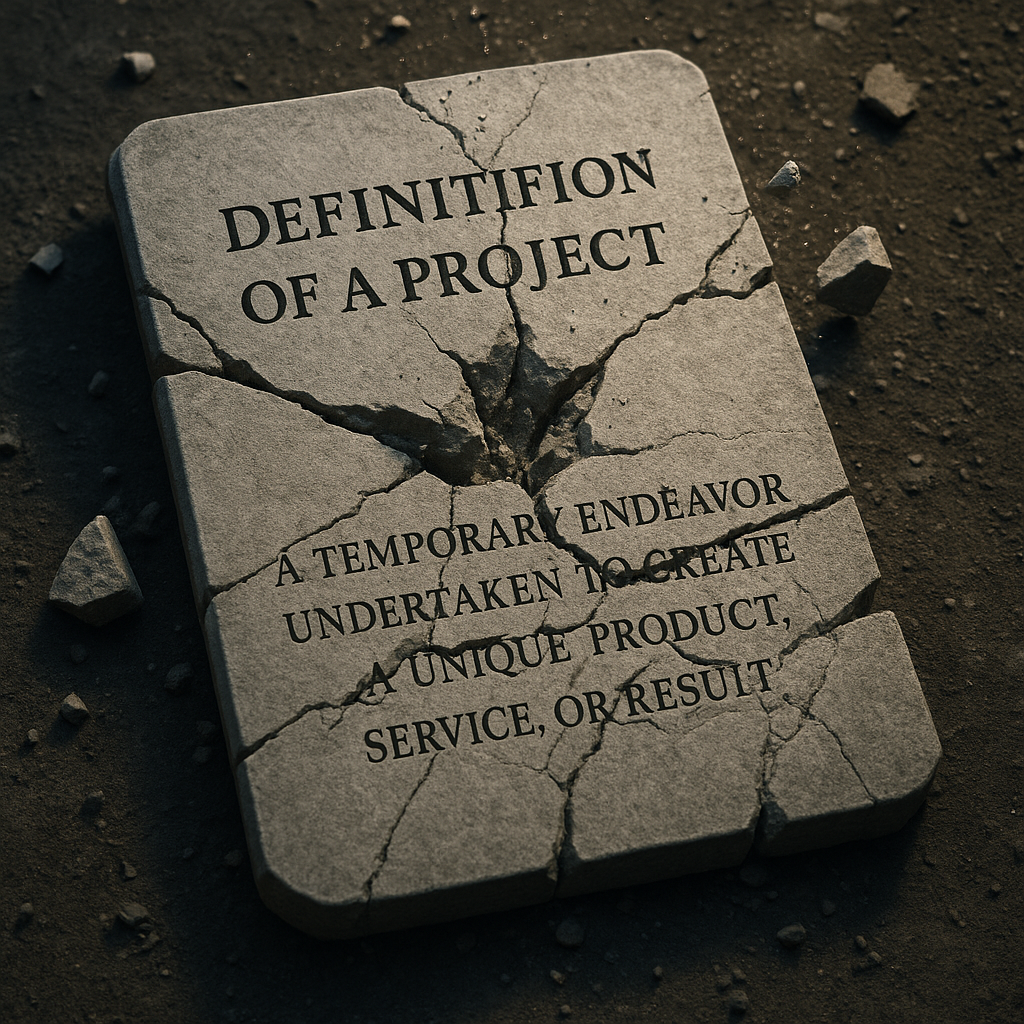
I’ll close this quick review post with the very definition of PROJECT. Here it is: 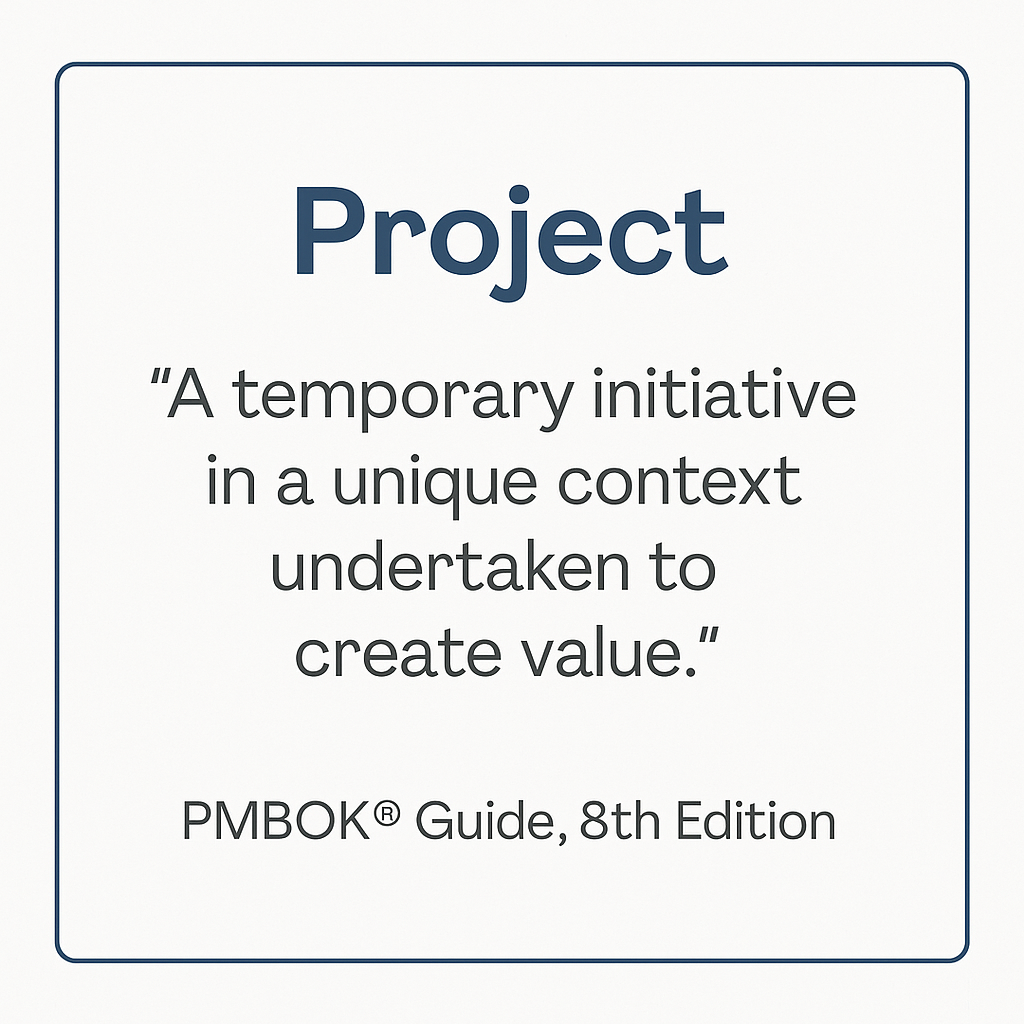 This is is no small change. And it is a change that is a long time coming As you'll hear in the video below, we thought this was etched in stone. Nope. Rather than taking my word for it, or hearing my opinions on this change, I invite you to watch this video conversation between Cornelius Fichtner and Jesse Fewell (the Chair of the PMBOK® Guide 8th Edition Development)  ttps://www.linkedin.com/events/insidepmbokguide8-whatprojectma7397053929219346432/ ttps://www.linkedin.com/events/insidepmbokguide8-whatprojectma7397053929219346432/ |


