

A citrus fruit schools us on material science and project leadership (Part 1 of 2)


| A recent video ‘short’ from Boston University, which features dropping a citrus fruit – a pomelo – from the roof of a university building – caught my attention. This video focuses on the possible connection between the pomelo and better phone cases, but keep in mind that the implications are much bigger (literally and figuratively) than phone cases. Click on the picture or the link for the short video.  Click here for video. Since it caught my interests as a good example of applying biomimicry in design, I followed some of the research, and I am glad I did – on top of the biomimicry here, it has some good lessons on project leadership. The way I am approaching this blog post is to break it into to two parts. The first focuses on the science. Since this is about biomimicry, and since I fell into the rabbit-hole while trying to understand this myself, I thought I would share the ‘bio’ part first, and then go into the ‘mimicry’ and leadership piece with that well in hand. I know…this is going to seem a bit science-geeky, but I promise that this will connect to the intersection of project leadership and sustainability, and if you don’t want the science piece, you can wait for part 2 which should be available in a week or two. So let’s cut to the chase – literally, by looking at a cross-section of a pomelo: 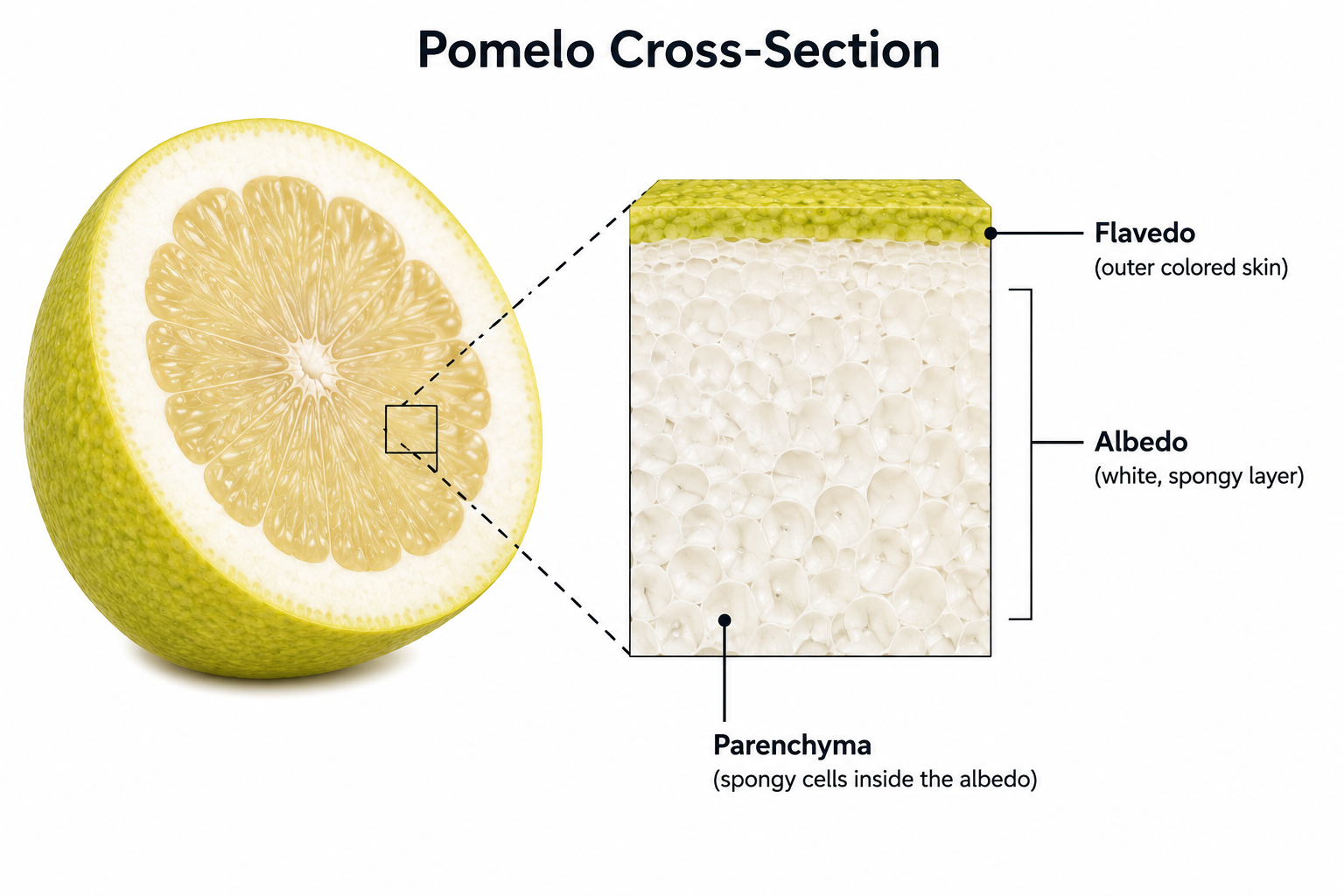 The albedo – the piece involved in the biomimicry - is effectively a natural, porous foam. Its parenchyma cells have intercellular air spaces that help dissipate energy when a fruit falls, protecting the internal pulp and seeds. The parenchyma refers to the soft, living plant tissues that make up this layer Researchers at Boston University and Texas A&M University and beyond have studied this for several years. Their work focused on the pomelo peel's unique gradient porosity—small pores near the outside, larger pores in the middle, and finer pores again near the fruit. They developed finite-element models and Voronoi-based foam structures that replicated this architecture. Their simulations showed improved energy dissipation and impact resistance compared with conventional uniform foams. Wait a second, you say. What’s this about Voronoi-based foam structures? What’s that about? I couldn’t help myself, I had to follow that rabbit-hole as well. Voronoi structures are patterns that naturally divide space into many adjoining regions, each centered around a particular point. They were first described mathematically by the Russian mathematician Georgy Voronoi, but similar structures are found throughout nature.It’s not an actual Voronoi structure but a giraffe’s coat pattern gives you the basic idea. Whether in biological tissues, mineral formations, animal markings, or cellular materials, Voronoi-like patterns often emerge when space is filled efficiently and neighboring regions grow until they meet. The function of a Voronoi structure is to organize space into distinct territories with minimal gaps and overlaps. In biological systems, these structures can help explain how cells pack together, occupy available space efficiently, or distribute forces. That last part – about distributing forces – is key here.Shock absorption is precisely about that! To bring this back to the pomelo, I used a simple example of five PMI Exam test centers first, and then expanded that to 2,000 sites so you can see the similarity to the pomelo’s albedo. 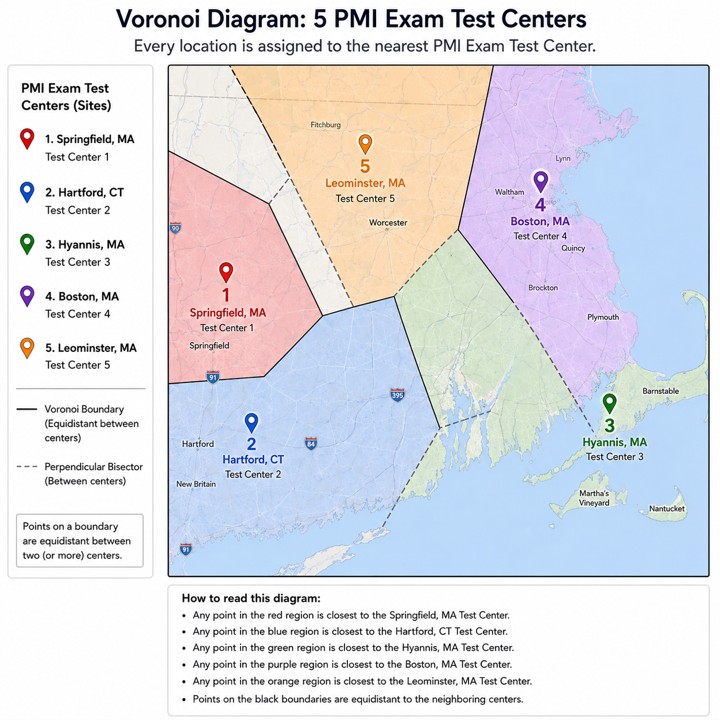 Now let's expand that by a couple of orders of magnitude... 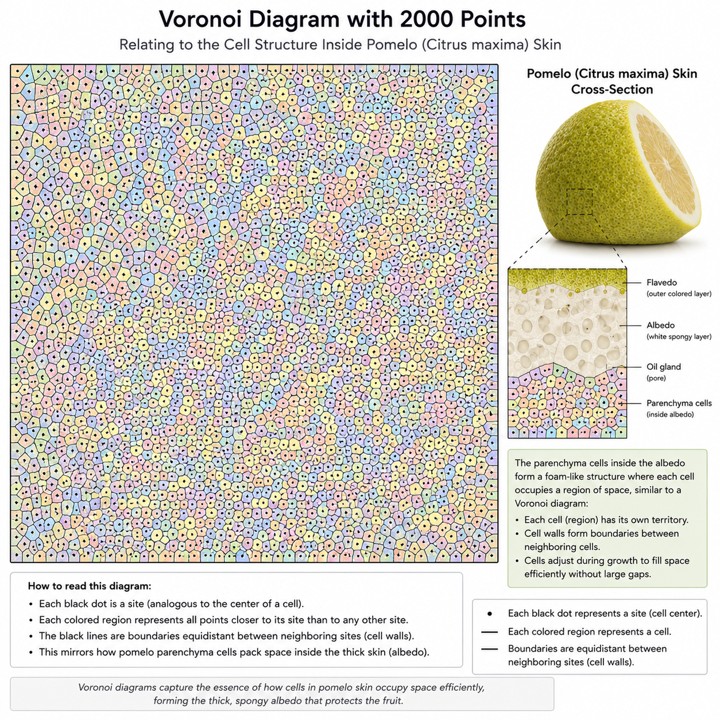 OK, so now that you know what a Voronoi structure is… let’s continue with how this very real fruit exhibiting Voronoi structures is telling us. Researchers have noted potential applications including:
So what is biomimicry? In project management terms, it's leveraging nature's ultimate continuous-improvement program—a process refined through millions of years of iterative experimentation, adaptation, and learning (we could call that evolution). Nature has been running Agile sprints long before humans coined the term, testing countless prototypes, discarding what doesn't work, and scaling what does. I will pick up on the project leadership and sustainability piece of this in Part 2. |
Black Tape Over the Engine Light
 I’m going to combine three things in this post, and it is going to end up getting a bit political, but I think for a good project leadership lesson. The three things:
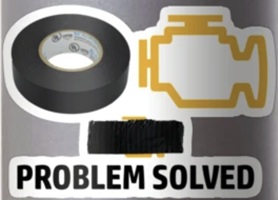
A story broke this week on CNN that stopped me in my tracks. Here’s the teaser for the story. In the North Atlantic Ocean, south of Greenland and Iceland, a large patch of water is doing something very strange. While the rest of the ocean heats up, it’s been getting colder. A new study says it has the answer to this mystery — and it’s an ominous sign the world is hurtling toward one of the most alarming climate tipping points. There is an image of the 'cold blog' below - with and without the black tape. Turns out that scientists have been puzzling for years over a mysterious "cold blob" in the North Atlantic — a patch of ocean south of Greenland that has been cooling while the rest of the world's oceans warm. A new study, just published in Geophysical Research Letters, has now confirmed what many suspected: it's a fingerprint of a weakening AMOC — the Atlantic Meridional Overturning Circulation — the vast ocean conveyor belt that moves warm water from the tropics northward and keeps the Northern Hemisphere's climate in balance. Why should project managers care? Because an AMOC shutdown would mean accelerated sea level rise on the U.S. East Coast, a deep freeze across Europe, and prolonged droughts from disrupted monsoons in Africa. Planetary-scale consequences. And, it’s another indicator of why this is called ‘climate change’ and not ‘global warming’. Here’s the real point: we only know this threat exists because of decades of painstaking ocean temperature monitoring. Now here's the part that should make every project leader wince. We are actively dismantling the systems that told us this and can tell us about such threats in the future. And I think you can begin to see the connection to black tape over the engine light. More on that later. The Trump administration had already cut nearly $100 million from NOAA's research arm — described internally by the administration as a "down payment" on plans to eliminate the office entirely. On May 21 of this year, the National Science Foundation (NSF) has announced the decommissioning of the Ocean Observatories Initiative, a network of 900 deep-sea instruments tracking ocean temperature, salinity, and chemistry across the Atlantic and Pacific. One researcher called it "the end of a federal commitment to basic scientific research that has served this nation well for 70 years." Now let's put on our Project Leadership hats. In project (or program, or portfolio) risk management, we distinguish between (1) informed risk acceptance — where a team deliberately decides a threat's probability or impact (or the combination) is tolerable — and (2) what I'd call risk acceptance by ignorance. The first (1) – informed acceptance of risk - is a legitimate strategy, and a good one, because it lets us focus on the threats that have a high combination of probability and impact. The second (2) is just blindness - due to being overly focused on the budget of the moment – or even thinking of that particular threat as a hoax. In any case, it certainly doesn't make the threat - in this case, a big one - go away. The cold blob is a textbook early warning signal. It's exactly the kind of trigger you build into a risk register — a leading indicator that something larger and more serious may be developing. The AMOC story only exists because instruments were in the water, collecting data, year after year, long before anyone knew what they were looking for. Remove those instruments, and the next warning signal goes undetected. You don't retire the risk. You just lose your only chance at a timely response. If we think of the Earth — its climate, oceans, ecosystems, and inhabitants — as a long-running program (the ultimate long-running program!), then NOAA's monitoring network is its status reporting system. Its dashboard. And no project leader, facing budget pressure, or scared of a threat, or thinking the threat may be a hoax, starts by unplugging the dashboard or covering up the nasty bits by turning off sensors or covering them with black tape. You might reduce scope. You might defer features. But you protect and keep scanning the sensors of your project or program - because without them, you're not managing the project anymore. You're just hoping. People, Planet, and Profit all suffer here. People lose warning systems for hurricanes and floods. The Planet loses its ability to detect accelerating changes before they become irreversible. And Profits — fisheries, insurance, coastal real estate, agriculture — all depend on the data these systems provide. The cold blob is a gift, in a way. It's nature handing us an early warning signal, right on schedule, exactly as our monitoring systems were designed to catch it. It’s a “Check Engine” light. And that brings us to Boston (Cambridge, actually) and a beloved show called Car Talk (which unfortunately has gone silent after many years). Learn about the history of The Car Talk Guys here. It’s worth a side trip. 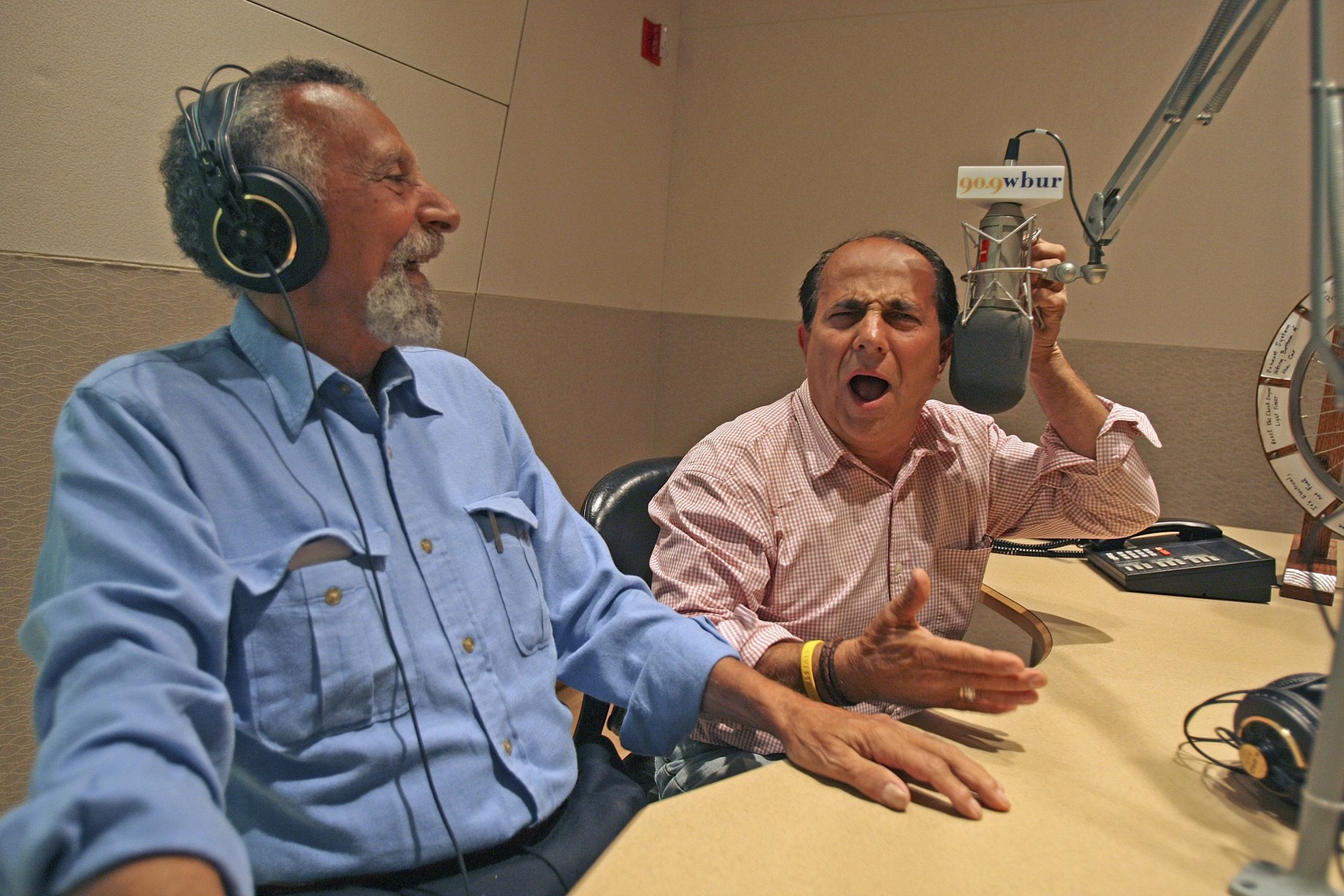 Fans of this late, great NPR show Car Talk will remember that Click and Clack (wacky but brilliant brothers Tom and Ray Magliozzi, MIT graduates and car repair shop owners, pictured above) had a running joke about the "check engine" light. Callers would describe their dashboard warning lights and wonder what to do about it. The brothers' tongue-in-cheek solution? Black tape. Just cover it up. They even sold their own branded Car Talk Black Tape — the ultimate solution to any dashboard warning light, guaranteed to make the problem invisible. It's funny because it's absurd. Everyone knows that putting tape over the check engine light doesn't fix the engine. The threat is still there. You've just made yourself blissfully unaware of it. And yet… Defunding NOAA's ocean monitoring network is black tape at planetary scale. The AMOC doesn't care about our budget process. It doesn’t care whether we think climate change is real. The cold blob doesn't disappear because we stopped measuring it. We've just taped over our check engine light. I hope we peel it off soon. 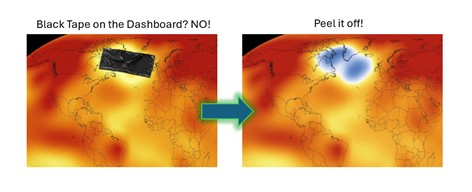 |
Saving the Sahel (Part 1)
| In a recent post, I blogged about the Great Green Wall of China. Today I would like to start a series about another ongoing Program called the Great Green Wall of Africa (more formally the Great Green Wall Initiative). This Program is in the Sahel region of Africa (see map below) and is described well in an article from National Geographic. 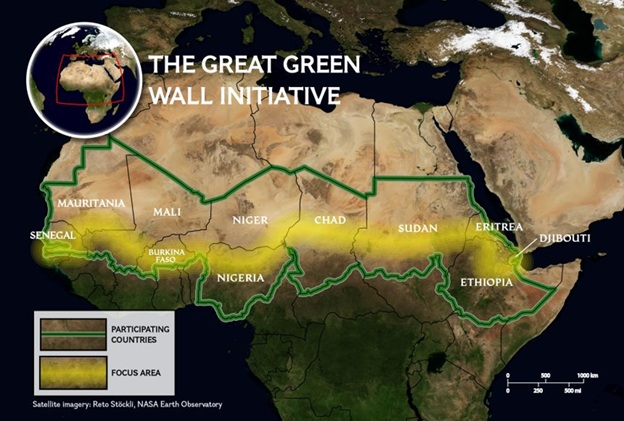 Here's a quick summary for that article: In recent years, northern Africa has seen the quality of land significantly due to and poor land management. Land degradation stems from human-related and natural factors, including unsustainable farming practices, , climate change and . Land degradation contributes to the loss of and ; more than 9,000 plants and animal species are considered endangered as a result. Land degradation also poses serious threats to agricultural productivity, , and quality of life. Nowhere is the threat of land degradation more urgent than in the Sahel, where millions of people live on land undergoing , the most extreme form of land degradation. Without action to combat it, desertification will continue to drive people to migrate away from the Sahel. In 2020 alone, more than 2.5 million people in the Sahel region were displaced. The Sahel region, by the way, is a vast semi-arid transitional zone in North-Central Africa, stretching between the Sahara Desert to the north and the tropical savannas to the south. Acting as an ecological and climatic buffer, the word Sahel - ironically - comes from the Arabic sāḥil, (الساحل) meaning "coast" or "shore" (even though it's all about a desert). The Great Green Wall: a brief description The Great Green Wall Initiative is an African-led environmental restoration program launched by the African Union in 2007 to combat desertification, climate change, food insecurity, and poverty across the Sahel region of Africa. Originally envisioned as a continuous “wall” of trees, the initiative has evolved into a broader effort focused on restoring ecosystems, improving sustainable agriculture, and strengthening community resilience. The initiative stretches approximately 8,000 kilometers (5,000 miles) across the width of Africa, from Senegal on the Atlantic coast to Djibouti on the Red Sea, involving more than 20 countries. Its goals include restoring 100 million hectares of degraded land, capturing 250 million tons of carbon, and creating 10 million green jobs across one of the world’s most climate-vulnerable regions. It was designed as a long-term initiative with major targets tied to 2030. But what is it? Project, Program, Portfolio? This is a naming problem we generally have in our discipline. I have seen this as a problem in my own background as a practitioner and continue to see confusion over these terms as I create and teach Project Management (or Program... or Portfolio Management) courses. It's not a project... A project:
The Africa Great Green Wall (GGW) is a fascinating case because it looks very different depending on whether you assess it as:
In the remainder of this post (and continuing with more) I will provide an assessment of how the Program is doing as measured by classic PM measurements (scope, cost, time, risk, success metrics). I think there are learning opportunities simply by seeing how these do (and do not) apply to a large sustainability program. When I teach my PM courses, I try to convey the idea that although the "triple constraint' elements interweave and are interdependent and overlapping, generally the flow is first Scope, then Schedule, and then Cost. In other words we need to know what's in an initiative, and only then can you sequence tasks and milestones, and only then can you really determine costs. Agree or not, I am going to follow that order in my assessment of this sustainability program. The Great Green Wall of Africa - Scope Performance Scope Definition Originally: “A wall of trees across Africa.” Later evolved (I would say massively scope-crept) into:
Status: Massive Scope Expansion The project experienced major scope evolution [scope creep and upscope {consciously-accepted inclusion of new scope}]. Positive side of this growth of scope:
The initiative transitioned from a deliverable-driven program to a (much more ambitious) transformation program. This ambition was well-intentioned, but weakened measurability. In the next post of the series - Schedule and Cost of the Great Green Wall Initiative |
You Can't Get They-ah From Hee-yah
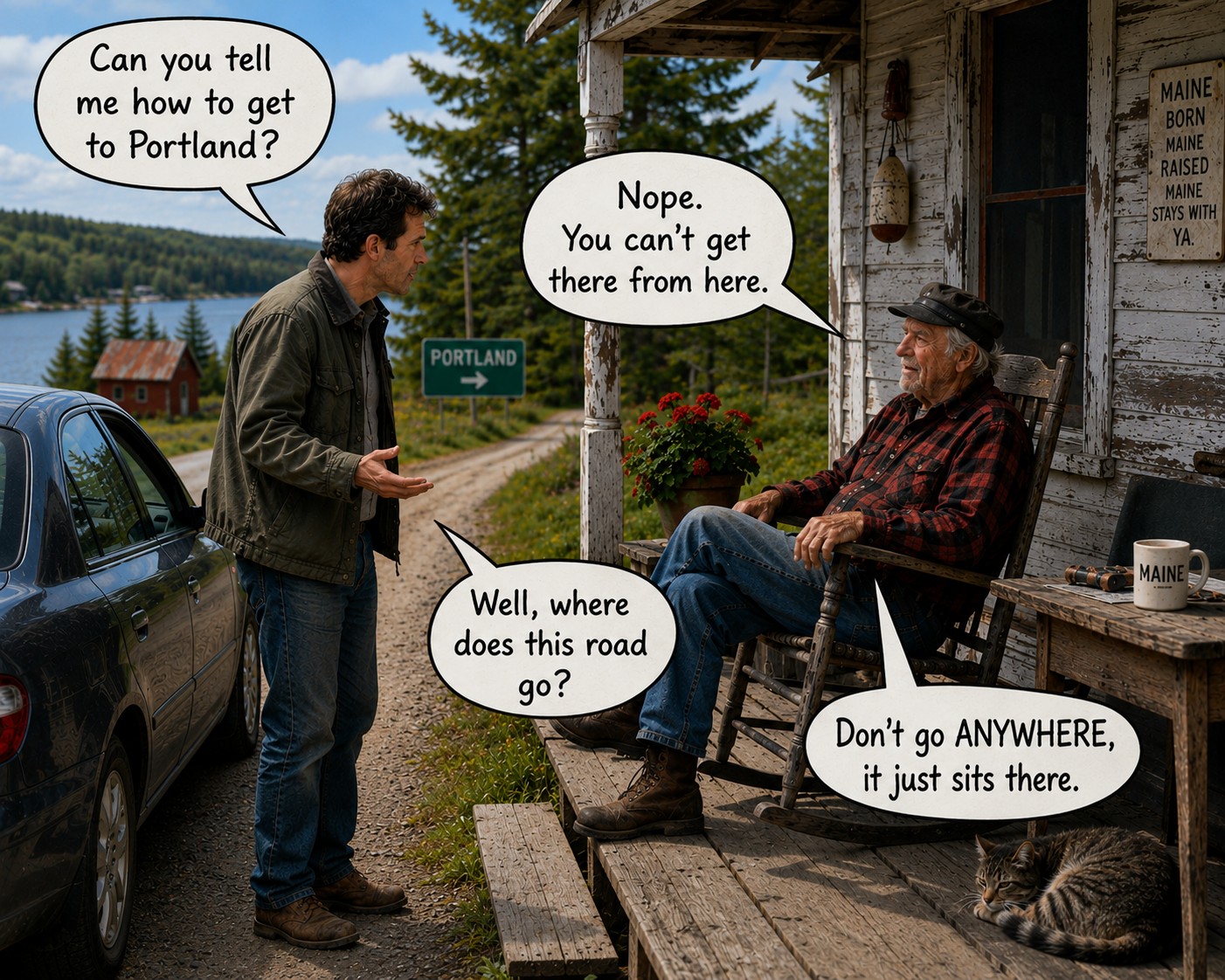 In a recent post, I talk about the paradox of AI - how it promises to be a savior of sorts in many ways (see my last post about how it is aiding with floating solar projects), but also is an energy hog and causes much in the way of problems in terms of water use, carbon production, and disruption to the local area. I want to go back to the 'dark side' of AI, MAINE-ly the area of local disruption - and as you may have guessed, I will focus on Maine, USA. Let me set this up with a bit of culture. Maine - the most northeast of the New England states in the USA, has its own culture (really several cultures). There's a thread of very sarcastic, practical, pointed comedy in this culture. Indeed, there was a humorist duo made up of Marshall Dodge and Bob Bryan, who told (or retold) stories set in that dry, literalism culture of traditional "downeast" Maine. These were published/recorded and broadcast in the 1950s and the 1960s. Here's one story: A fellow driving through Maine stops and asks an old Mainer sitting on the porch: “Can you tell me how to get to Portland?” The Mainer thinks for a while and says: “Nope… you can’t get there from here.”* The traveler looks puzzled and says: “Well then… where does this road go?” The Mainer says: "Don't go nowhere - it just sits there". So with this in mind, let's look at the news - the controversy and legislation regarding AI Data Centers in Maine. According to this article, published on 17-April-2026, Maine lawmakers passed a statewide freeze on large data centers this week, the first of its kind in the country. If Gov. Janet Mills signs the bill into law, it would impose a moratorium on building data centers that use more than 20 megawatts of power in the state for a year and a half. During those 18 months, a council of government officials, experts and other stakeholders will be tasked with developing guidelines and recommendations for building future data centers, according to The Hill. However, Governor Janet Mills did not sign the bill. She vetoed it on April 24, 2026. The bill (LD 307) would have created the nation’s first statewide moratorium on large AI/data-center projects in Maine, temporarily blocking new facilities using more than 20 megawatts of power while the state studied impacts on electricity costs, water use, and the grid. The Governor said she actually supported the idea of a temporary pause in general, but objected because the Legislature refused to exempt a major proposed redevelopment project in Jay, Maine, at the former Androscoggin paper mill site. According to her statement:
The Maine debate captures the AI Sustainability Paradox perfectly. While AI systems may help humanity:
...and in general be a sustainability "hero"... To train and run large AI models, society is rapidly building hyperscale data centers that:
That’s the paradox: AI may help solve climate and efficiency problems globally while simultaneously intensifying environmental and social pressures locally. The Maine case is especially interesting because it forces a collision between two different scales of thinking: 1. The Global Scale Argument Supporters of AI infrastructure say: • the economic future depends on AI, • the energy transition itself may require AI, • and states that reject infrastructure risk missing major investment waves. From this perspective, a data center is seen almost like a railroad, hydroelectric dam, or semiconductor fab — foundational infrastructure for the next era of civilization. 2. The Local Scale Argument Opponents or skeptics ask: • Why should one town absorb the environmental burden? • Will electricity prices rise for residents? • Will water systems be stressed? • Are the promised jobs permanent or mostly temporary? • Who benefits — local citizens or distant tech firms? • What happens to community identity and land use? This is a classic “externalities” debate: • the benefits are diffuse and global, • while the costs are immediate and local. The irony is profound: AI may help reduce worldwide waste and carbon emissions through optimization, but the infrastructure needed to do that may itself require enormous resource consumption. There’s also a deeper systems-thinking lesson here that aligns strongly with portfolio and program management concepts that I discuss here on People, Planet, Profits, and Projects, as well in my courses: AI resembles a portfolio-level optimization problem - thinking of projects as INVESTMENTS At the project level, a single data center may appear environmentally costly. But at the systems level, AI-enabled efficiencies could theoretically produce net-positive outcomes. The challenge is that: • local stakeholders - like the Mainer sitting on his porch and radiating sarcasm all day - experience the project costs directly, but global society may receive the portfolio benefits later. That is going to naturally involve friction between that local and global scale - and will pit Joe Mainer against (at least what are seen as) corporate oligarchs. The Maine story also reflects a broader transition in how society thinks about technology. For decades, digital technologies were treated as “clean” because they lacked smokestacks and assembly lines. AI is revealing that advanced computation - at least the way it is headed now - has very tangible ecological consequences. And there’s yet another paradox layered underneath: the more AI succeeds, the more 'computing power' society demands, which increases infrastructure expansion, which increases energy demand, which requires even more optimization - an AI "power spiral" of sorts. That’s why some analysts now argue that the future of AI is inseparable from: • energy policy, • nuclear power, • water management, • transmission infrastructure, • and regional economic planning. In other words, AI is no longer just a software story. It is becoming an industrial-policy story as you see in this Maine example. The Maine governor’s response actually reflects an attempt to balance this paradox: • rejecting a total moratorium, • while acknowledging the need for oversight and study. That middle position implicitly recognizes that the issue is not simply “AI good” or “AI bad.” The real challenge is governance: How do we capture AI’s transformative benefits without imposing disproportionate environmental or social costs on specific communities? That may become one of the defining program-management and public-policy questions of the next decade. And I hope that we can get there from here. *this is pronounced, "ya can't get they-ah from hee-yah" |
Floating an idea into reality: the other side of the AI Project Paradox
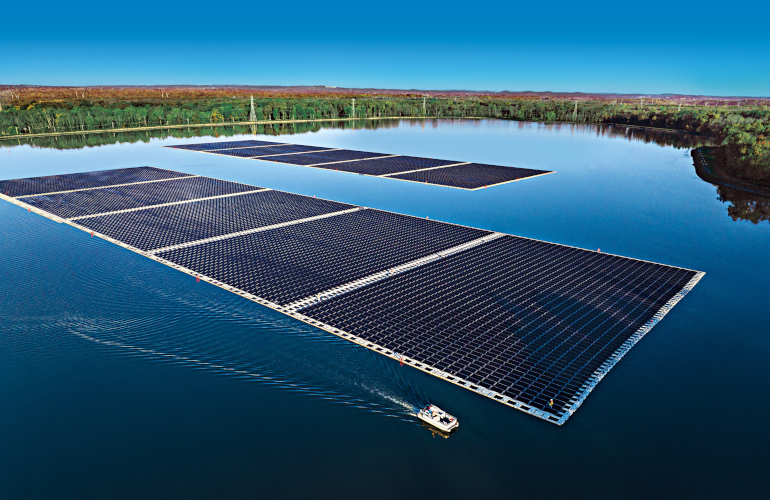 In my last post, I explored the growing concerns around artificial intelligence—energy consumption, carbon footprint, data privacy, and even the “noise” it introduces into our systems. These concerns are real, and in some cases, they’re driving moratoriums on new data center construction. But that’s only one side of the story. This post explores the other side of the paradox: AI as a positive force—not as a drain on resources, but as a multiplier of sustainable outcomes. And one of the most compelling examples is floating solar. A Pilot in Colorado Just outside Denver, in Golden, Colorado, a modest project is quietly pointing toward the future. Developed by Noria Energy, the Aurea Solar Project sits atop the Fairmount Reservoir. At roughly 50 kW, it’s small by utility-scale standards—but its significance goes far beyond its size. This is the first floating solar array in the United States to incorporate tracking technology. Instead of remaining fixed, the panels rotate on the water to follow the sun, increasing energy production by an estimated 10–20%. But what makes this project especially compelling is not just the technology—it’s the system it supports. The energy generated helps power a local water utility, directly linking renewable energy production with water infrastructure systems. At the same time, the panels reduce evaporation from the reservoir—an important benefit in the water-constrained American West. This is not just a solar project. It’s an integrated energy–water system. You’ll soon find out why the heck I keep highlighting the word SYSTEM. A real one in NJ Because (as you know if your follow this blog) I like to feature moving pictures (aka videos), have a look at this video to see a real floating solar project. Back to the Paradox: Where AI Enters the Picture At first glance, you might not see AI at work here. But like with most things today… it’s THERE. Today, the system tracks the sun mechanically. Tomorrow, AI will: -Optimize panel orientation in real time based on weather and cloud cover -Predict energy output and dynamically adjust operations -Balance what are normally competing objectives—maximizing energy generation while minimizing water loss -Anticipate maintenance needs before failures occur Across renewable energy and smart infrastructure projects, AI-driven optimization has been shown to:
Let’s take a look at these from the viewpoint of this blog: People, Planet, Profits, and Projects People The Aurea project supports a water utility serving tens of thousands of residents and promotes workforce development. Planet Floating solar reduces land use and water evaporation, while AI enhances efficiency and sustainability. Profits The system approach and clever, reasoned, thoughtful application of AI makes this system more efficient and profitable. Projects This pilot project involves multiple stakeholders and uncertainty—an ideal environment for AI-enabled decision-making, taking decision to action, thoughtfully, and based on real-time information. And now…as promised…the systems piece…. From Static Infrastructure to Intelligent Systems The Colorado project is becoming a proving ground for intelligent, adaptive infrastructure systems. This is also a powerful example of systems thinking in action—what the Systems Thinking & Systems Intelligence (STSI) community highlights as the need to see relationships, not just components. We are working within a system of systems—energy, water, environment, and community—all interconnected. STSI Insight: “The performance of a system is driven not by its parts alone, but by the quality of the relationships among those parts.” Learn more about this at stsi.pro. Reframing the AI Conversation AI stands properly accused of being an energy hog, a privacy stealer, and other nasty stuff. On the other side of the paradox, however, AI can generate clean energy, conserve water, improve resilience, and support communities. The key is where and how we apply it, how we guardrail it, how we thoughtfully work with it. Closing Thought AI, when aligned with purpose, becomes a force for integrating systems, and systems of systems—connecting people, planet, and projects in powerful new ways. |


