










Guessing is not a strategy: How to build decision velocity with AI and real-time data
June 10, 2026 | Live Webinar

You Can't Get They-ah From Hee-yah
Floating an idea into reality: the other side of the AI Project Paradox
The Environment of the Built Environment: an AI Paradox
6th, 6th Edfition, 6th Edition PMBOK, 7th Edition, 7th Edition PMBOK, 8th Edition PMBOK, 8th Edition PMBOK Guide, Activism, actuarial, actuary, adapt, addition by subtraction, Africa, africa, agriculture, airforce, ajaita, Alaska, amazon, analogous, analytics, ancient, and more power, antarctica, anti-science, apple, apps, architecture, arctic, arrakis, Artificial Intelligence, asch paradigm, Assistant, asthma, astronomy, automobile, automotive, autonomous cars, b, bankhar, Banksy Crypto, basalt, baseball, bats, batter, beauty products, benefit, benefits, Benefits Realization, beyond epica, biases, bicycle, big data, big dfata, big dig, bike, biodiversity, biomedicine, birdhouse, blockchain, blood, blue blood, blue trees, bluefin, bluefin tuna, book review, boston, boston university, Boyce, Brazil, brazil, Breakdown Structures, BS, building, buildings, built environment, built environment, bumblebee, cake, capacitor, car, Carbon, carbon, carbon capture, carbon negative, carbon neutral, carbon pool, carbon sequestration, carbonate, careers, CEO, ChatGPT, chatGPT, chatgpt, chatgpt, chess, China, china, chopsticks, citrus, cli-fi, climate, climate change, climate resilience, climeworks, Clumsy, CO2, co2, CO2 Utilization, coalition, cobalt, coffee pods, cognition, cognitive, Collabortion, colombia, concrete, Conflict, construction 5.0, cool projects xyloscope, cooling, coral, corn, cost of good quality, cost of poor quality, cost of quality, crazy, criticism of project management, cryptocurrency, CSR, csr, data, data analytics, data privacy, datacenter, dataset, death spiral, Decision Making, decomposition, Defense and Climate, definition of a project, deforestation, dependencies, dependency, desert, DIKW, dikw, dimopoulos, disposal, dna, DOD, dogs, dolphins, dream, drilling, drink, dune, dune, dutch, early start, earth, eatlocal, eco-tourism, ecological, economic, economics, EKC, electric grid, electricity, electronics, elysis, embodied carbon, emerging technologies, empower, Energy, energy efficiency, environmental degradation, escalate, escalation, ESG, extreme weather, fallacy, FARC, farming, finance, fish, fish brains, fishing, fix, fixing the earth, flint water, Flint Water Supply, flood, flooding, Food supply chain, food waste, forest, forest for the trees, forestation, forrestgump, frank herbert, Fruitcake, fungus, fusion, Galvao, garage, gas, gasoline, geese, gender equality, gender partnerships, generational differences, Generative AI, gladwell, gold, Goodness, google, Government, GPT, great pacific garbage patch, green, green building, green buildings, green energy, green iguana, green project, green project management, greening, guest post, gyre, harkonnen, Harvesting Benefits, hawasina, hedgehogs, heursitics, historical data, hlb, holitsic, holland, horseshoe crab, human-caused climate change, hydrogen, hydrology, ice, iceland, ignition, iguana, imagery, impact, india, inequality, information, initiatives, injection, insurance, intelligence, interacting risk, internal combustion engine, invasive species, investment, isomer, issue escalation, issues, ITER, jobs, Jupiter, justification, kids, kill point, knowledge, koch brothers, Kuznets, laboratory, LAL, landscape mode, lapampa, launch, LCA, Leadership, Leadership, life cycle analyses, life cycle analysis, lifecycle, Linkedin, liquid, lizard, local, long term, long-term, long-term thinking, look up, loud, maintenance, maker, makermovement, malcolm gladwell, management, marathon, marine biology, market, mars, Martin Luther King, mean, megawatt, MeHg, melting, mercury, metal, Microgrid, microplastics, migration, military, millennial, mindset, minerals, mission, mitigate, MLK, mongolia, museum, museum of london, nature, nematodes, net gain, Net Project Success Score, net zero, netherlands, network, New book, New Jersey, New Practitioners, new york, NFT, nitrogen, noise, noreaster, norway, nova, NPSS, NREL, ocean, ocean cleanup, ocean life, oil rig, oil rigs, oklahoma, oman, only murders in the building, opportunity, overall risk, oxygen, packaging, pareto, PBS, permafrost, persistence, peru, Pharmaceutical, planet, planet.com, planning, plant, plasma, plastic, playground, pm, pm education, pmbok, pmbok guide, pmnetwork, PMXPO-2018, podcast, pollutants, pollution, poop, poor, portfolio, power, power skills, privacy, privacy concerns, professors, program, Program Management, project, project leader, project leadership, project management, project management 3.0, project on fire, project progress, Project Success, project success, projecticity, projectleadership, projectmanagement, projects, psychology, pulse of the profession, purple bacteria, purpose, quiet, rainforest, rationale, reef, refugees, renewable, renewables, Repair, repair, repeatable process, repeatable processes, repurpose, research, resource breakdown strucuture, Resource Management, reversing climate change, revisionist history, rich, rigs2reefs, ripe, risk, risk avoidance, Risk Management, risk mitigation, risk response, risk responses, river, robots, rocks, rules of thumb, rural, rural India, russia, Sarcasm/Irony, satellite, saudi, schedule, sci-fi, Science, science, science-fiction, scientific american, screaming monkeys, sea, sea life, Sea-Level Rise, sea-level rise, seagreens, seawall, seawater, seawater temperature, seaweed. beat;es. farming, secondary risk, selena gomez, sequestration, shipping, skyscraper, SLR, smart cities, smart city, smelting, social, social pressure, soil, solar, solar panels, solar perovkites, solar saheli, sonic, sponge cities, SRI, stage-gate, stagegate, stakeholder, stakeholder management, steward, stewardship, storage, strategy, stupid, success, suffer, sulphur, sunk cost, supercapacitor, supply chain, survey, Sustainability, sustainability, Sustainable Investing, Sustainable Tourism, sybiosis, symbiosis, system 03, TBL, temperature, terraform, terraforming, test, threat, threats, totem, touchscreen, tour, tower, Trains, transparency, transportation, trash, tree, tree species, trees, trillion, triple bottom line, triple constraint, truth to power, UMass, us army corps of engineers, USDA, vacuum, value, venus, vision, voice, voltage optimization, vw scandal, washing machine, waste, wastewater, water, we mean business, whales, Whirlpool, wind, wisdom, women, Women in Project Management, wood wide web, woonerf, Work Breakdown Structures (WBS), world breakdown structure, worms, xian, xylotron, Yale


|
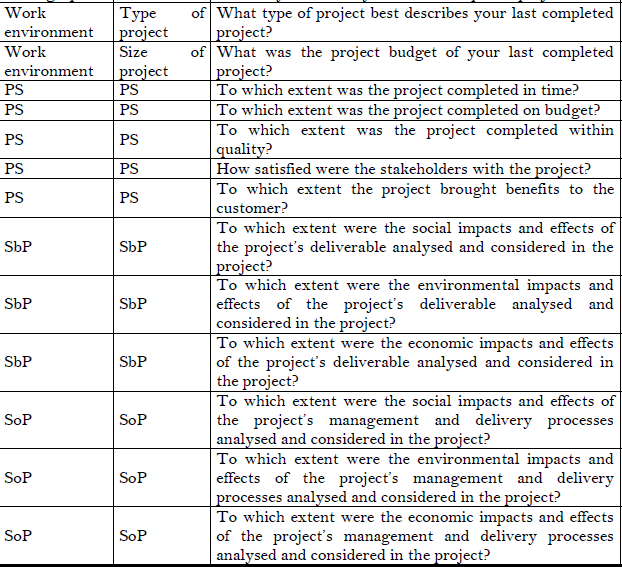
When we last left our star-crossed pair – Sustainable Project Management and Project Success (SPM and PS from here on in), we knew there was a certain tension between them but we also sensed that they may be made for each other. In this short entry we conclude the story. Sort of. Since this is based on academic research the answer, as usual, is “more research is needed”. And it is. However we do have a conclusion to share. The authors of the referenced article (Dubois and Silvius) got results from 112 participants in their survey. From the article: 112 responses were received. Based on the assumed total population of over 1 million project managers, the sample provides a confidence interval of 9.26% at a 95% confidence level. Given the 5-point Likert scales that were used in the questionnaire, this confidence interval is satisfactory. If you recall from Part 1 of this post, SbP is Sustainability by Projects and SoP is Sustainability of Projects. Those terms are defined in Part 1 (and of course, in the article itself). Here is a sample of the questions that were asked by the researchers:
The answers to this survey were very illustrative especially in the relationship of PS to SPM. Instead of going through the entire data analysis as did the authors, I will go right to the illustrative conclusion. And here it is: • SPM and PS show a strong positive correlation The main finding of the study reported in this paper focuses on the relation between SPM and PS. In line with the earlier studies on this relationship, also this study found a positive correlation that can be considered as strong. And despite the concerns that Silvius and Schipper (2016) expressed about the potential negative effects of considering sustainability on the iron triangle criteria of PS, the overall relation between SPM and PS still appeared as positive. Khalilzadeh et al. (2016) The study reported in this paper aimed to answer the question How does considering sustainability in project management relate to project success? Based on a literature analysis of the concepts of Sustainable Project Management and Project Success, the study developed a conceptual model of the relationship in which the independent variable SPM was operationalised in six questions, three questions related to SbP and three questions related to SoP. The dependent variable PS was operationalised in five items, which provided a holistic set of criteria. Based on the analysis of the responses of 112 professionals involved in projects, the study found that both variables PS and SPM showed a high level of internal consistency…This correlation subsequently showed a strong and positive correlation between SPM and PS. And although the study was not aimed at developing proof for the causality between SPM and PS, this conclusion does provides another indication that SPM supports PS. This is illustrated in the graph below as well:
So yes: Sustainable Project Management, which I assert means, “keeping the big picture in mind”, and “thinking through the end of the project to the steady-state”, and “Focusing on Benefits Realization Management and Value”, does indeed actually have a POSITIVE net effect on Project Success. So as you watch “It’s a Wonderful Life” this Holiday Season (you can’t help it in many parts of the world), starring Jimmy Stewart and Donna Reed (pictured at the top of this post), consider the wonderful life your project can have if it does indeed include Sustainable Project Management! |
|
In honor of the 10th anniversary of our book, Green Project Management, I’d like to aim this post at the relationship between Project Success (PS) and Sustainable Project Management (SPM). The connection was always there for me but it sort of came full-circle with the recent publication by Gilbert Silvius and Ophélie Dubois of their article, The Relation Between Sustainable Project Management and Project Success. This article directly cites Green Project Management (despite its ancient 2010 publishing date!) and brings home many of the ideas we published a decade ago. It’s not the only such article. A quick search yielded many more, for example, click here for one from 2016. However, the Silvius/Dubois article was the most recent and eloquent – and it is supported with data. In Episode 1 of this romantic suspense thriller, I will summarize some key points and set the stage for the dramatic and (spoiler alert!) happy ending. In the second, I will wrap things up, end the drama, and provide you with further resources to investigate if the subject interests you. It should. You are, after all, right here on this planet. Although we are currently in the throes of a global pandemic which is of urgent and immediate concern to all of us as it should be, the issues of climate change and social impact of project deployment has not been canceled. They’ve been there all along and remain another high priority for our species. So: on to the article. In the introduction, the authors say: Project success is indicated as one of the ‘impact areas’ of sustainability in project management (Silvius, Schipper, Planko, van den Brink, & Köhler, 2012) and the relationship between project success and sustainability is identified as one of the emergent ‘narratives’ in the literature on sustainable project management (SPM) (Sabini et al., 2019). Studies on this relationship are still limited in literature review on the topic found only five studies that specifically focused on the relationship (Khalifeh, Farrell, & Al-edenat, 2019) quality. The studies also differ in their operationalization of the variables SPM and project success, making it hard to derive an overall and undisputable conclusion. For example where Martens and Carvalho (2016a) found that considering sustainability is expected to have a positive effect on project success, Silvius and Schipper (2016) concluded that “paying attention to sustainability aspects in projects may also be perceived as costing time or money and therefore as not supportive to the time and budget constraints of a project”. We therefore agree with Khalifeh et al. (2019) that conclude that this relationship is still inadequately addressed in the literature and that more research is needed. It is this gap in the literature that the study reported in this paper addresses. Based on a quantitative survey-based research design, this study aims to answer the question, “how does considering sustainability in project management relate to project success?” When our book was published, we got lots of pushback from project managers. It often sounded something like this: “Come ON, Rich and Dave, we already get constrained by schedule, budget, and the need to meet requirements. We have to work without authority, in projects, which by definition are unique and therefore are dealing with unknowns. And now, you have the nerve to ask us to also think about the long-term, and bottom lines that have to do with social and environmental stuff that won’t be a factor until after our project is turned over? No THANK YOU, guys, we have PROJECTS to run! Shut up and let us get on with our work!” It wasn’t always that strong, but sometimes it was even stronger. What we’ve noticed is that this resistance has diminished in the past few years. Perhaps it is the introduction of concepts and practices such as Benefits Realization Management, Value Engineering, and including the ‘transition’ as part of the project closing process, that have softened the responses and even turned them around so that opponents to this idea have now become cheerleaders to including sustainability thinking in projects. But the real ‘kicker’ would be if there was some evidence that putting effort into sustainability thinking in PM provided the PM with higher levels of project success. This article takes a big step in that direction. Let’s start by getting our terminology straight. Here’s what we mean by Sustainable Project Management (SPM): “the planning, monitoring and controlling of project delivery and support processes, with consideration of the environmental, economic and social aspects of the life-cycle of the project’s resources, processes, deliverables and effects, aimed at realizing benefits for stakeholders, and performed in a transparent, fair and ethical way that includes proactive stakeholder participation.” There is an additional wrinkle here: From the literature on SPM, it appears that the relationship between sustainability and project management can be interpreted in two ways (Sabini et al., 2019; Silvius, 2015). These two interpretations are characterized by Huemann and Silvius (2017) as: • “Sustainability by the project” (SbP): the sustainability of the deliverable or result that the project realizes. • “Sustainability of the project” (SoP): the sustainability of the delivery and management processes of the project. This is very similar to the Rainbow of Green we introduced in Green Project Management in 2010. In the Spectrum of Green, SbP would be Green by Product Impact and SoP would be Green in General. See image below.
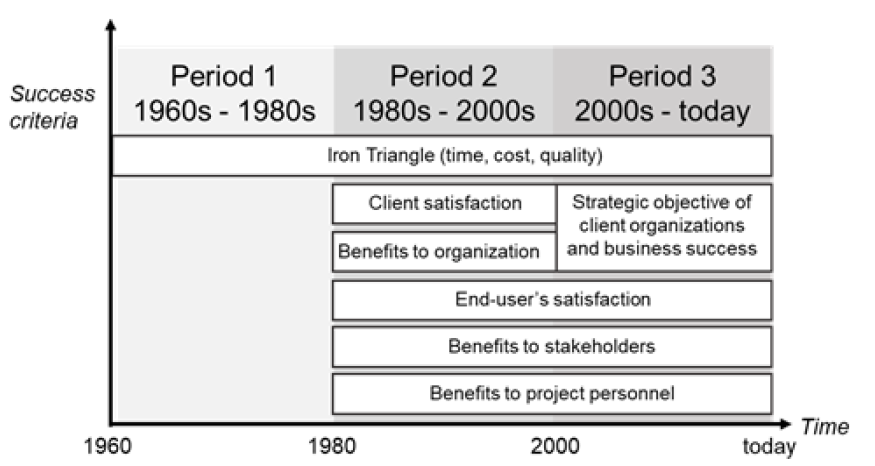
Project Success (PS) is a very squishy and even controversial topic. Of course one of the aspects driving this squishiness and controversy is the point of measurement. This is a big deal. When we have our ‘ribbon-cutting ceremony’ are we done as project managers? How much of a role do we have in transitioning the project? Are we concerned about use? Long-term use? Disposal? All of this smacks of life-cycle PM as covered in the 6th Edition of the PMBOK® Guide and much more so in the soon-to-be-released 7th Edition – and it is covered in Prince2 and IPMA standards as well. So PM as a discipline is buying into a longer-term view of ‘Project Success’. See below, from the Silvius article:
Even if the definition of Project Success includes the more ‘evolved’ definition, it’s clear that there is ‘more to your project’ – and a potential negative - if you focus on SPM. As the article states: …incorporating environmental and social considerations into projects suggest extra requirements and specifications (Maltzman & Shirley, 2010; Taylor, 2010), which increase the complexity of the project. For example Hwang and Ng (2013) conclude that incorporating sustainability in construction projects makes planning harder, causes more variations in design, causes difficulty in selecting subcontractors, causes uncertainty in the required materials and equipment, requires more coordination with different parties, and leads to more unexpected circumstances at project closure. This increases the pressure on project managers and decision makers (Knight & Jenkins, 2009). Moreover, it has been argued that incorporating sustainability raises the level of expectations of stakeholders of the project (Marcelino-Sádaba et al., 2015) and may increase tensions between them (Brandoni & Polonara, 2012; De Brucker, Macharis, & Verbeke, 2013; Singh, Murty, Gupta, & Dikshit, 2007; Tam, Shen, Yau, & Tam, 2007). Therefore, the expected impact of SPM on the iron triangle variables of PS is considered uncertain. So we can see that there is tension between these. Is there a chance that the investment of effort into SPM could instead have a positive net effect on Project Sustainability? You’ll just have to wait until the next entry (Part 2 of 2). Blogger’s note 1: I have permission to use quotes and images from this article directly from the author. Blogger’s note 2: This post’s banner image above is from The Big Heat (1953). For more about this and 99 other thrillers, see this site: https://www2.bfi.org.uk/thriller/100-thrillers-see-before-you-die
|
|
In honor of Halloween (celebrated today in the US and elsewhere) I thought I would just at least start a very scary story. How would you feel if your project never operated – never actually realized any of the benefits and value it was meant to provide? Even worse, what a nightmare it would be if there was also no end in sight in terms of dis-assembling the work you did? This is the case for Wind 1 and Wind 2, renewable energy projects on Cape Cod. I will be tackling this story early in November. It’s going to be a spooky story about stakeholders - but one you can learn from. Stand by. |
|
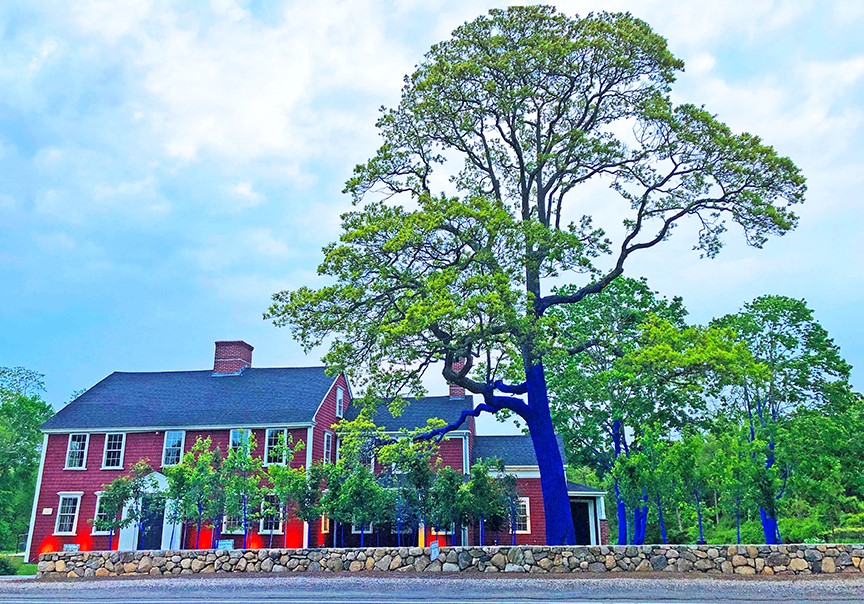
They took all the trees, put ‘em in a tree museum. And they charge the people a dollar and a half just to see ‘em…. I went to see an art exhibit today at the Calhoon Museum in Falmouth, Massachusetts… and ended up focused on something outside the window, instead of inside the museum. And like Joni Mitchell’s lyric above, it was about trees and museums, but not trees in the museum, trees outside the museum, and the trees were painted an unearthly blue so that you really could “see ‘em”, and maybe in a different way. Here's an example of what I actually saw:
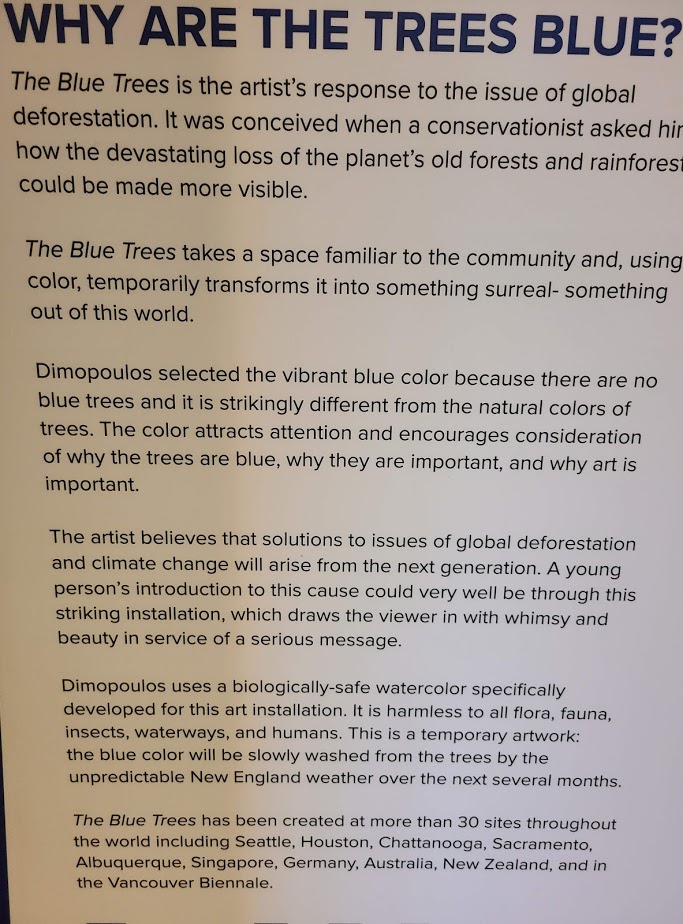
What was that about? Why are these trees all an electric royal blue color? Then I saw this sign:
The artist, Melbourne, Australia-based Konstantin Dimopoulos, says this about the tree project (actually a program): As a conceptual and installation artist I create artworks that are grounded in my sociological and humanist philosophies. In my environmental art installation, The Blue Trees, the colour and the Tree come together to transform and affect each other; the colour changing the Tree into something surreal, while the Tree, rooted in this earth reflects what we may lose. This change highlights ecological issues, such as the ecocide of our forests and climate change, and effects a transformation in the psyche of people by raising our social consciousness referencing how individually and collectively we shape the world we inhabit. The Blue Trees has a strong regenerative aspect to it, an organic work that is continually changing and evolving. From season to season the trees grow through the cycles of nature and the colors begin to change and disappear. Time passing is a part of the concept; time that determines our own existence is measured through these trees. Perhaps the best way to learn about this is with this charming video: "The Blue Trees" in Chattanooga, TN from Public Art Chattanooga on Vimeo. This got me thinking about communications. What an interesting way to communicate a message! Not an email or a text, or an advert, but a community-based display that gets attention and engagement. I'm not suggesting that if your project has some issues you should paint all the trees in your town amber. I'm just thinking that we can think outside the box a little bit when we need to convey a message and take some inspiration from The Blue Trees. And of course, we should pay attention to the message that Dimopolous is sending! After seeing the video, what are your thoughts about this program*? Are you inspired to improve your own messaging? *I call it a program because each city ‘engagement’ is a slightly-different implementation of the art project – it has been done in many cities around the world. Oh. And for those of you who don’t know the Joni Mitchell (or Counting Crows) reference, have a look at this: Learn more about the Blue Tree program at these links: |
|
Photo Copyright © 2013 Jim Moore In this brief post, I hope to do a few things:
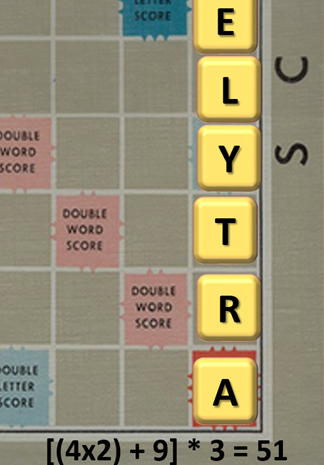
Here we go. Let’s start off with improving your Scrabble game. The word is Elytra. Hey,if you position that word just right (see figure) it can net you 51 points!
OK, now that I've improved your Scrabble game, let's move from etymology to entomology. So what is “elytra”? Actually it is the plural of elytron, which sounds like a robot villain but is actually the hardened forewings of certain insects, especially beetles. Most beetles use them in flight. However, some beetles have chosen to be earthbound. The Diabolical Ironclad Beetle has made that choice eons ago. Their elytron have fused together to help form a protective shield for this critter. The protective shield in this case is quite amazing, and it’s only recently that scientists have uncovered how this works. Biomimicry Biomimicry is the process (art and science) of emulating what nature does and taking advantage of some of the amazing things that nature has evolved. I have blogged about this in the past, covering, for example, the ‘stickiness’ of the gecko and the new adhesives developed by engineers and scientists at UMass Amherst. If you haven’t seen that post, or the concept, you really should visit this site: https://geckskin.umass.edu/. In the case of the diabolical ironclad beetle, the attribute scientists are after is this level of protection yielded by the beetle’s fused elytron. How are they connected? What’s the trick that allows them to withstand, literally, being run over by a car? In an article from Nature, entitled Toughening Mechanisms of the Elytra of the Diabolical Ironclad Beetle, this is all revealed. The highlights are as follows:
This is very important, because as engineers, project managers, and actually anyone who flies in an airplane, drives a car, or rides a bike, we are interested in how we fasten things to other things (for example, how an engine is attached to a plane wing!). That last one really always concerns me. Blogger's confession: Haven’t you ever been seated near the wing, and looked out in wonder (or fright) at how that heavy engine is connected to the wing? I admit it. I have. Anyway, if we can emulate this form of ‘suture’, we can redesign connectors, strengthening them, avoiding extra weight, and avoiding sources of corrosion and weakness. It’s well explained in the video below from Purdue University. Think about how advances like this – and others from studying nature – can accelerate and improve the deliverables from your projects! |
|
"There are only two ways to live your life. One is as though nothing is a miracle. The other is as though everything is a miracle." - Albert Einstein |