










Guessing is not a strategy: How to build decision velocity with AI and real-time data
June 10, 2026 | Live Webinar

You Can't Get They-ah From Hee-yah
Floating an idea into reality: the other side of the AI Project Paradox
The Environment of the Built Environment: an AI Paradox
6th, 6th Edfition, 6th Edition PMBOK, 7th Edition, 7th Edition PMBOK, 8th Edition PMBOK, 8th Edition PMBOK Guide, Activism, actuarial, actuary, adapt, addition by subtraction, Africa, africa, agriculture, airforce, ajaita, Alaska, amazon, analogous, analytics, ancient, and more power, antarctica, anti-science, apple, apps, architecture, arctic, arrakis, Artificial Intelligence, asch paradigm, Assistant, asthma, astronomy, automobile, automotive, autonomous cars, b, bankhar, Banksy Crypto, basalt, baseball, bats, batter, beauty products, benefit, benefits, Benefits Realization, beyond epica, biases, bicycle, big data, big dfata, big dig, bike, biodiversity, biomedicine, birdhouse, blockchain, blood, blue blood, blue trees, bluefin, bluefin tuna, book review, boston, boston university, Boyce, Brazil, brazil, Breakdown Structures, BS, building, buildings, built environment, built environment, bumblebee, cake, capacitor, car, Carbon, carbon, carbon capture, carbon negative, carbon neutral, carbon pool, carbon sequestration, carbonate, careers, CEO, ChatGPT, chatGPT, chatgpt, chatgpt, chess, China, china, chopsticks, citrus, cli-fi, climate, climate change, climate resilience, climeworks, Clumsy, CO2, co2, CO2 Utilization, coalition, cobalt, coffee pods, cognition, cognitive, Collabortion, colombia, concrete, Conflict, construction 5.0, cool projects xyloscope, cooling, coral, corn, cost of good quality, cost of poor quality, cost of quality, crazy, criticism of project management, cryptocurrency, CSR, csr, data, data analytics, data privacy, datacenter, dataset, death spiral, Decision Making, decomposition, Defense and Climate, definition of a project, deforestation, dependencies, dependency, desert, DIKW, dikw, dimopoulos, disposal, dna, DOD, dogs, dolphins, dream, drilling, drink, dune, dune, dutch, early start, earth, eatlocal, eco-tourism, ecological, economic, economics, EKC, electric grid, electricity, electronics, elysis, embodied carbon, emerging technologies, empower, Energy, energy efficiency, environmental degradation, escalate, escalation, ESG, extreme weather, fallacy, FARC, farming, finance, fish, fish brains, fishing, fix, fixing the earth, flint water, Flint Water Supply, flood, flooding, Food supply chain, food waste, forest, forest for the trees, forestation, forrestgump, frank herbert, Fruitcake, fungus, fusion, Galvao, garage, gas, gasoline, geese, gender equality, gender partnerships, generational differences, Generative AI, gladwell, gold, Goodness, google, Government, GPT, great pacific garbage patch, green, green building, green buildings, green energy, green iguana, green project, green project management, greening, guest post, gyre, harkonnen, Harvesting Benefits, hawasina, hedgehogs, heursitics, historical data, hlb, holitsic, holland, horseshoe crab, human-caused climate change, hydrogen, hydrology, ice, iceland, ignition, iguana, imagery, impact, india, inequality, information, initiatives, injection, insurance, intelligence, interacting risk, internal combustion engine, invasive species, investment, isomer, issue escalation, issues, ITER, jobs, Jupiter, justification, kids, kill point, knowledge, koch brothers, Kuznets, laboratory, LAL, landscape mode, lapampa, launch, LCA, Leadership, Leadership, life cycle analyses, life cycle analysis, lifecycle, Linkedin, liquid, lizard, local, long term, long-term, long-term thinking, look up, loud, maintenance, maker, makermovement, malcolm gladwell, management, marathon, marine biology, market, mars, Martin Luther King, mean, megawatt, MeHg, melting, mercury, metal, Microgrid, microplastics, migration, military, millennial, mindset, minerals, mission, mitigate, MLK, mongolia, museum, museum of london, nature, nematodes, net gain, Net Project Success Score, net zero, netherlands, network, New book, New Jersey, New Practitioners, new york, NFT, nitrogen, noise, noreaster, norway, nova, NPSS, NREL, ocean, ocean cleanup, ocean life, oil rig, oil rigs, oklahoma, oman, only murders in the building, opportunity, overall risk, oxygen, packaging, pareto, PBS, permafrost, persistence, peru, Pharmaceutical, planet, planet.com, planning, plant, plasma, plastic, playground, pm, pm education, pmbok, pmbok guide, pmnetwork, PMXPO-2018, podcast, pollutants, pollution, poop, poor, portfolio, power, power skills, privacy, privacy concerns, professors, program, Program Management, project, project leader, project leadership, project management, project management 3.0, project on fire, project progress, Project Success, project success, projecticity, projectleadership, projectmanagement, projects, psychology, pulse of the profession, purple bacteria, purpose, quiet, rainforest, rationale, reef, refugees, renewable, renewables, Repair, repair, repeatable process, repeatable processes, repurpose, research, resource breakdown strucuture, Resource Management, reversing climate change, revisionist history, rich, rigs2reefs, ripe, risk, risk avoidance, Risk Management, risk mitigation, risk response, risk responses, river, robots, rocks, rules of thumb, rural, rural India, russia, Sarcasm/Irony, satellite, saudi, schedule, sci-fi, Science, science, science-fiction, scientific american, screaming monkeys, sea, sea life, Sea-Level Rise, sea-level rise, seagreens, seawall, seawater, seawater temperature, seaweed. beat;es. farming, secondary risk, selena gomez, sequestration, shipping, skyscraper, SLR, smart cities, smart city, smelting, social, social pressure, soil, solar, solar panels, solar perovkites, solar saheli, sonic, sponge cities, SRI, stage-gate, stagegate, stakeholder, stakeholder management, steward, stewardship, storage, strategy, stupid, success, suffer, sulphur, sunk cost, supercapacitor, supply chain, survey, Sustainability, sustainability, Sustainable Investing, Sustainable Tourism, sybiosis, symbiosis, system 03, TBL, temperature, terraform, terraforming, test, threat, threats, totem, touchscreen, tour, tower, Trains, transparency, transportation, trash, tree, tree species, trees, trillion, triple bottom line, triple constraint, truth to power, UMass, us army corps of engineers, USDA, vacuum, value, venus, vision, voice, voltage optimization, vw scandal, washing machine, waste, wastewater, water, we mean business, whales, Whirlpool, wind, wisdom, women, Women in Project Management, wood wide web, woonerf, Work Breakdown Structures (WBS), world breakdown structure, worms, xian, xylotron, Yale


|
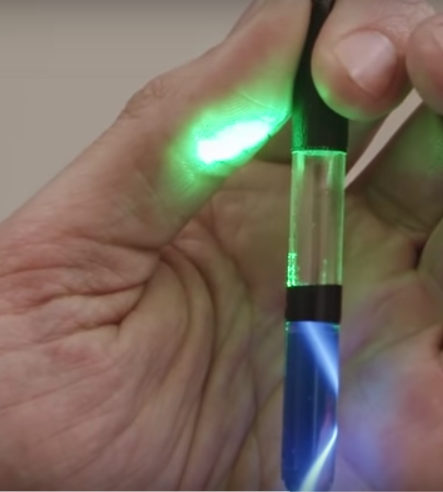
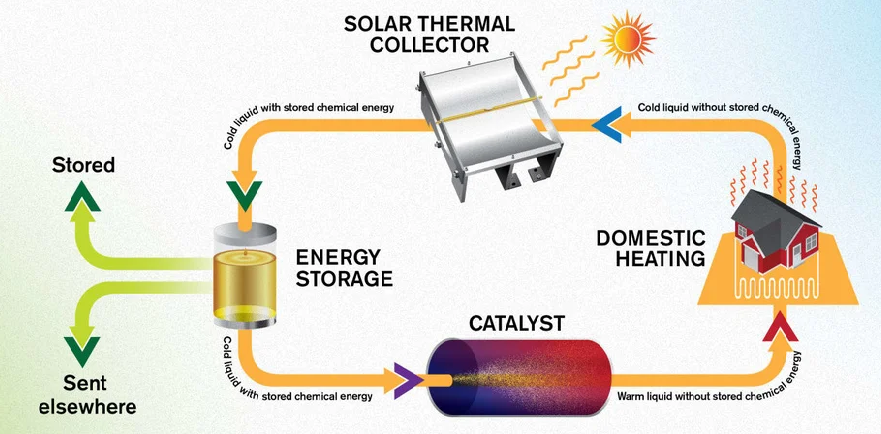
I avoid posting on April 1, since it’s likely that all-y’all may not take the posting seriously. So this is posted on April 2. Because it's good news - serious good news. My last post was about ammonia as potential ‘liquid battery’, a means to store renewable energy in liquid form. It turns out that this is not the only liquid under investigation with this potential. Let’s back up a moment and review why we’re even talking about this here on People, Planet, Profits & Projects. First of all, any of these efforts to do apply research to reality is, by definition, a project. Then, implementing the result into (in this case) using the ‘liquid storage’ will be a project. The focus here is the intersection of sustainability in PM, which sometimes is directly dealing with ‘green’ topics, environmental protection or renewable energy or reducing carbon, or saving species, but sometimes is the integration of sustainable thinking – long-term thinking – into project planning. This post is more on the former. An article from MNN caught my attention. It opens as follows: It's hard to believe that we still use climate change-inducing fossil fuels when we have a sun that's bombarding our planet with plentiful, clean renewable energy on a daily basis. But fossil fuels do have one oft-overlooked advantage over solar power that has long prevented solar from truly emerging: they're a fuel. That’s right. As a fuel, fossil fuels (think gasoline) are easy to transport, deliver, and store. Not so with energy from a wind farm. We need a huge leap forward in battery technology (there will be posts on this as well here on this blog) and/or another method to store, transport, and deliver that renewable energy to users of energy. This post, like the one before it, is about a means to do just that. Again, from the article: Researchers in Sweden have discovered a specialized fluid that works like a rechargeable battery. Shine sunlight on it, and the fluid traps it. Then, at a later date, that energy can be released as heat just by adding a catalyst. It's quite remarkable, and it could be how we power our homes by 2030. Made up of molecules of carbon, hydrogen and nitrogen, this liquid reacts to sunlight by reconfiguring atomic bonds, transforming the structure of the molecules into a sort of container that holds energy from the sunlight within itself. And here’s the part that I thought you’d see as an April Fuel’s joke: even when the liquid cools back down to room temperature, the energy remains stored within the liquid. A cobalt-based catalyst (cobalt phthalocyanine) is used to release the energy when it is wanted. Does it work? Early results have demonstrated that once the fluid is passed through the catalyst, it warms up by 113 degrees Fahrenheit. But researchers believe that with the right manipulations, they can increase that output to 230 degrees Fahrenheit or more. Already, the system can double the the energy capacity of Tesla's reputed Powerwall batteries. Needless to say, this has drawn the interest of numerous investors. Even better, researchers have tested the fluid through as many as 125 cycles, and the molecule has shown almost no degradation. In other words, it's a rechargeable battery that continues to take a charge without losing much capacity over many uses. The technology seems to allow the storage of energy in such a liquid for up to 18 years. The image below is courtesy of Chalmers University of Technology (Sweden).
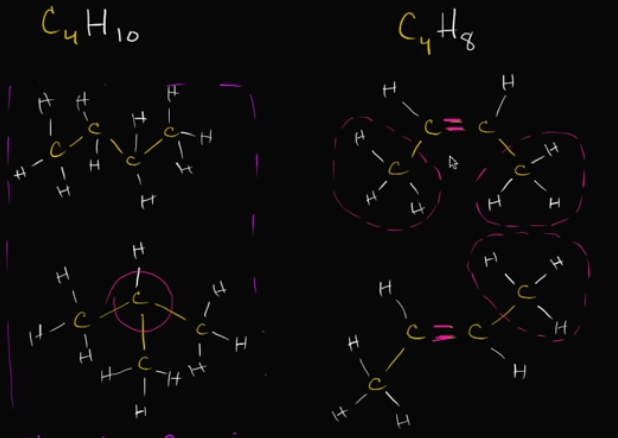
I felt this needed validation and further research so I dug in and found this article which indicates that the researches have published their results in four respected journals. The name for the molecule that stores the energy is an isomer - a molecule made of the same atoms, but bound together differently. If you want a quick review of isomers (like I did) click here.
The storage capability is called (by the researchers) MOST (Molecular Solar Thermal Energy Storage). For those of you who are scientifically inclined, here’s the abstract from the paper published in the highly-ranked journal, Energy and Environmental Science, published by the UK’s Royal Society of Chemistry. The entire article is available as a PDF here. The development of solar energy can potentially meet the growing requirements for a global energy system beyond fossil fuels, but necessitates new scalable technologies for solar energy storage. One approach is the development of energy storage systems based on molecular photoswitches, so-called molecular solar thermal energy storage (MOST). Here we present a novel norbornadiene derivative for this purpose, with a good solar spectral match, high robustness and an energy density of 0.4 MJ kg−1. By the use of heterogeneous catalyst cobalt phthalocyanine on a carbon support, we demonstrate a record high macroscopic heat release in a flow system using a fixed bed catalytic reactor, leading to a temperature increase of up to 63.4 °C (83.2 °C measured temperature). Successful outdoor testing shows proof of concept and illustrates that future implementation is feasible. The mechanism of the catalytic back reaction is modelled using density functional theory (DFT) calculations rationalizing the experimental observations. So: No April Fool situation but rather a very promising technology to further enable renewable energy and to reduce our dependence on problematic and limited fossil fuels. And project managers like you and I may be the ones making this a reality within the decade! |
|
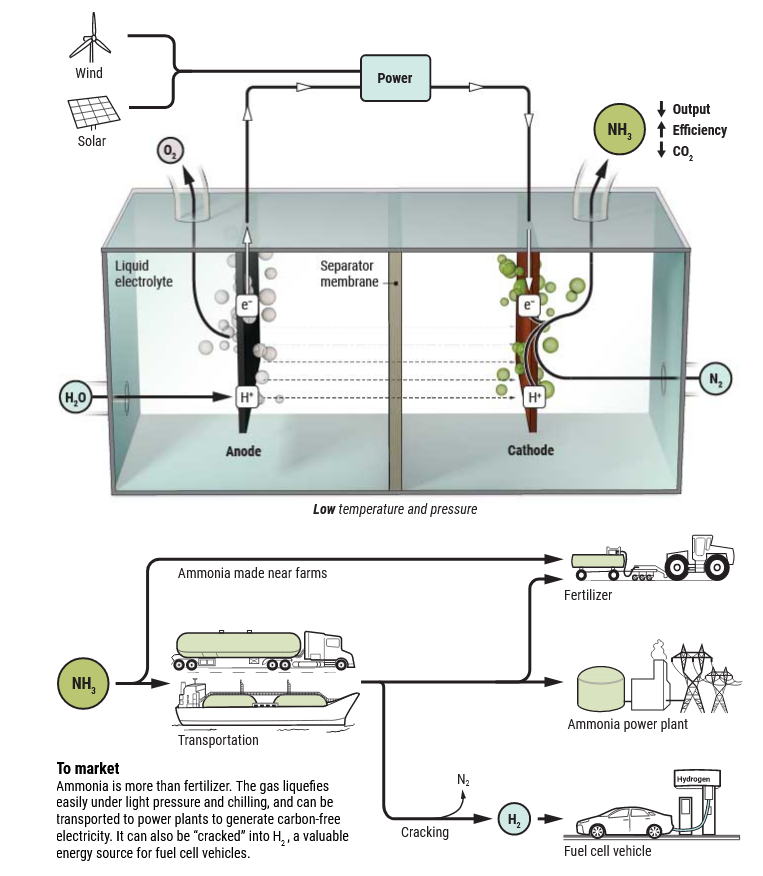
I’ve been fascinated this week by the idea of ammonia (NH3) as a fuel, or as a means to store and transport renewable energy. First, let me talk about that storage part. How can a household cleaner store energy??? Ammonia fuel cells can convert renewable electricity into an energy-rich gas that can easily be cooled and squeezed into a liquid fuel, which effectively bottles sunshine and wind, turning them into a commodity that can be shipped anywhere in the world and converted back into electricity or hydrogen gas to power fuel cell vehicles. This video from Science magazine tells the story (click on image to launch). But the concerns of creating NH3 without its own problems needs to be solved. The article from Science magazine has an excellent graphic (sample below) that shows not only the problems, but the way that NH3 fuel cells work, and how ammonia can ‘transport’ energy.
Here’s another recent story, from phys.org about NH3 as a form of ‘conveyance’ for renewable energy. Now, how about even more science? This comes from Science Daily: Taking measures against climate change and converting into societies that use significant amounts of renewable energy for power are two of the most important issues common to developed countries today. One promising technology in those efforts uses hydrogen (H2) as a renewable energy source. Although it is a primary candidate for clean secondary energy, large amounts of H2 must be converted into liquid form, which is a difficult process, for easier storage and transportation. Among the possible forms of liquid H2, ammonia (NH3) is a promising carrier because it has high H2 density, is easily liquefied, and can be produced on a large-scale. Researchers at the International Research Organization for Advanced Science and Technology (IROAST) in Kumamoto University, Japan focused on a "catalytic combustion method" to solve the NH3 fuel problems. This method adds substances that promote or suppress chemical reactions during fuel combustion. Recently, they succeeded in developing a new catalyst which improves NH3 combustibility and suppresses the generation of NOx. The novel catalyst (CuOx/3A2S) stayed highly active in the selective production of N2, meaning that it suppressed NOx formation, and the catalyst itself did not change even at high temperatures. Since 3A2S is a commercially available material and CuOx can be produced by a method widely used in industry (wet impregnation method), this new catalyst can be manufactured easily and at low cost. Its use allows for the decomposition of NH3 into H2 with the heat from (low ignition temperature) NH3 fuel combustion, and the purification of NH3 through oxidation. "Our catalyst appears to be a step in the right direction to fight anthropogenic climate change since it does not emit greenhouse gasses like CO2 and should improve the sophistication of renewable energy within our society," said study leader Dr. Satoshi Hinokuma of IROAST. "We are planning to conduct further research and development under more practical conditions in the future." And there you go! That’s why I’m posting this here – the further research is a project. And if you want projects on a smaller scale, how about converting your vehicle to run on ammonia? Here’s an article (fun to read) about a gentleman in Canada who has modified his Ford F-150 to run on NH3: |
|
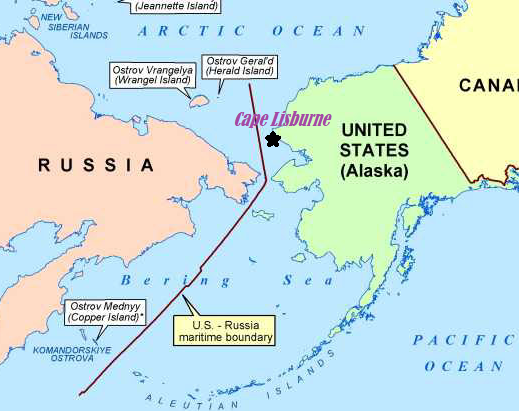
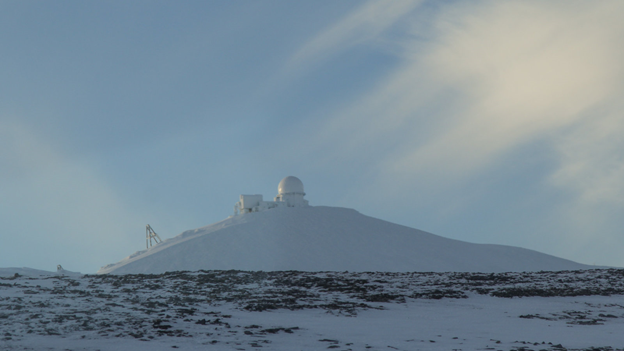
A wall. A wall to stop a persistent and troublesome invasion from the ‘unwanted’. While our news has been dominated by requirements for a wall on the southern border of the US, this is a story about another wall, much, much further to the North. And the “unwanted” entity in this case is not human, but rather, it’s the ocean. This particular wall was requested by the US Department of Defense. As mentioned in my prior post, “Trouble In Tin City”, US radar installations are increasingly endangered by the onslaught of rising seas, a problem more noteworthy and extensive in Alaska than in other parts of the world. This wall is, of course, if nothing else, a project. A 5-year, US$47M project. Orion Marine Contractors – with headquarters in Houston, Texas, but experienced in marine work in Alaska - won the bid on a five-year project to reconstruct a deteriorating seawall on Cape Lisburne (see map above), a remote, long-range Air Force radar site about 40 miles northeast of Point Hope on the Chukchi Sea, and only a little over 100 miles from Russia. (Source: http://www.agcakroster.org/Page/62/waves_weather_shape_schedule_of_cape_lisburne_seawall_project). “There’s the radar site up there and a runway,” said Mark Leick, project manager for Orion Marine. “That’s all there is.” Well, that’s until this spring, when his crew travels north to fire up the heavy machinery that’s been sitting idle all winter. Orion Marine mobilized on the site in July 2016, then shut down in October because of the region’s early onset of winter. The project for the US Air Force consists of replacing and reinforcing a 5000+ foot seawall that protects the Air Force’s mile-long runway at Cape Lisburne from an every-encroaching ocean onslaught. Storms and rising seas have continued to decompose the seawall, originally built in 1952. The same tough climate that has contributed to the demise of the seawall presents project obstacles in the form of cold and wind. The project is expected to last five construction seasons. Orion previously completed a similar seawall project in Unalakleet and a breakwater extension in Seward for the Army Corps of Engineers. “We are looking forward to working with the Air Force and Corps of Engineers to a successful completion of the Cape Lisburne project,” Leick said. Here’s a description of the project from the US Department of Defense's report, "Climate-related Risk to DoD Infrastructure", just cleared for public release a couple of weeks ago (we try to keep things fresh here at People, Planet, Profits & Projects!).
Cape Lisburne Seawall Replacement Arctic sea ice is in constant change, growing in the fall and winter and receding in the spring and summer. The proximity of Air Force long range radar on the North Slope of Alaska to the Arctic shoreline makes them vulnerable to accelerated shoreline erosion from the duration and extent of sea ice fluctuations, increasing water temperatures, thawing of permafrost soils, and the effects of wave action. The rock seawall at the Cape Lisburne Long Rand Radar Station on the northwest Alaska coast line protects the installation’s gravel airstrip from tidal and storm driven wave action. Over the past decade the runway’s seawall has been depleted and eroded by wave action and extreme weather events. The damaged rock reinforcement became ineffective, and the 5,450 linear foot wall had to be replaced at a cost of $46.8 million. If you think that the issue of climate change is limited to the US Department of Defense, well, you have underestimated not only climate change but the way in which the US DoD has acknowledged its effects. I highly recommend this article: https://www.ecowatch.com/us-defense-department-climate-change-2609339797.html In the article, you will find references to the recently-published Worldwide Threat Assessment by Dan Coates, Director of National Intelligence.
(Quoting from the above document) Environment and Climate Change The impacts of the long-term trends toward a warming climate, more air pollution, biodiversity loss, and water scarcity are likely to fuel economic and social discontent—and possibly upheaval—through 2018. The past 115 years have been the warmest period in the history of modern civilization, and the past few years have been the warmest years on record. Extreme weather events in a warmer world have the potential for greater impacts and can compound with other drivers to raise the risk of humanitarian disasters, conflict, water and food shortages, population migration, labor shortfalls, price shocks, and power outages. Research has not identified indicators of tipping points in climate-linked earth systems, suggesting a possibility of abrupt climate change. Worsening air pollution from forest burning, agricultural waste incineration, urbanization, and rapid industrialization—with increasing public awareness—might drive protests against authorities, such as those recently in China, India, and Iran. Accelerating biodiversity and species loss—driven by pollution, warming, unsustainable fishing, and acidifying oceans—will jeopardize vital ecosystems that support critical human systems. Recent estimates suggest that the current extinction rate is 100 to 1,000 times the natural extinction rate. Water scarcity, compounded by gaps in cooperative management agreements for nearly half of the world’s international river basins, and new unilateral dam development are likely to heighten tension between countries.
This is all coming directly from US Government intelligence and defense agencies. If you want to go beyond simply ‘defense’, and beyond any one country, to look at the overall effects of climate change, and the projects that it will launch, have a look at this study by the USGS (US Geological Survey) on living in the Pacific Atoll region (such as the US Marshall Islands). In the midst of this research, I also discovered a very nice “interactive documentary” produced by PBS (US Public Broadcasting Service) show called Frontline.
Access it immediately here. So. Walls... we do need them sometimes...and when we do, project managers will be there to make sure they are on time, within budget, and are separating exactly what should be separated. |
|
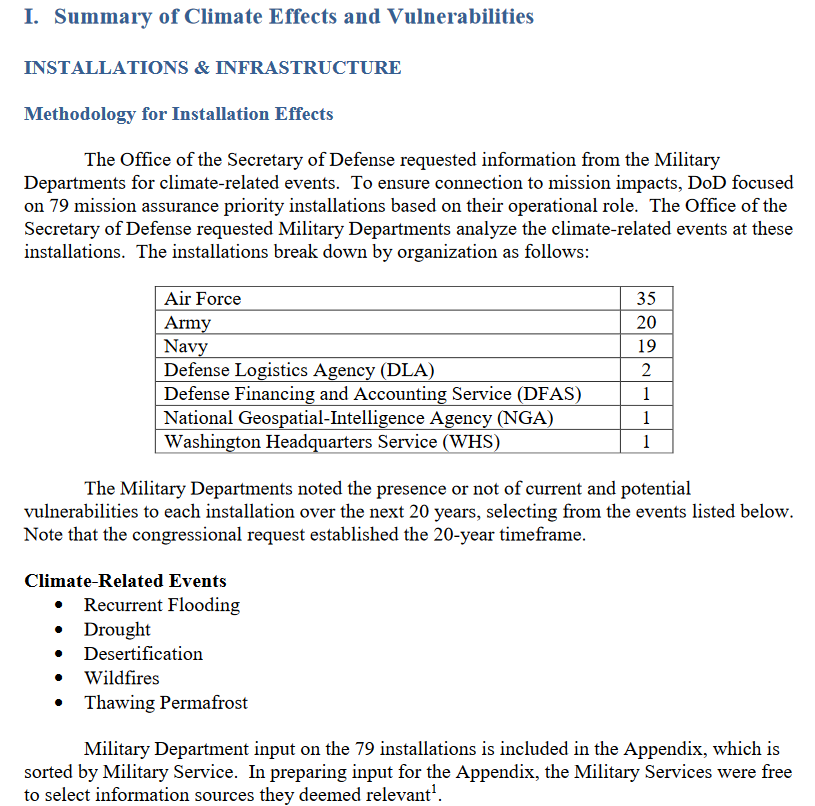
This is the first of what will be at least two posts on the effects of climate change on US Department of Defense installations, based on publicly-released documents from the present administration’s own departments. The focus will be on projects launched because of climate change, recognition of climate change as a driver of projects, and the need for project managers to be well-informed of the facts related to climate change and the facts related to how governments react to the effects of climate change. One point of this series is that regardless of your view of climate change – whether you believe it is happening or not, and if so, what is causing it – is actually much less important than understanding what governments are doing about it regardless, and what that may mean for projects and project managers. In this first part, I’ll cover the issue in general and illustrate this with one example of a these effects, and the possibilities for project managers – the example being in Tin City Alaska. I’ll follow up with a story about a wall, but not one on the border with Mexico, one pretty much on the border with Russia. The story that caught my attention was a very short podcast from NPR entitled “How Climate Change Is Affecting Alaska's Military Radar Stations” which you can listen to right here: The story is that the changing climate poses a threat to the radar installations. 3 out of 15 are facing situations in which shifting ice, based on more-rapidly-than-expected changes in ocean temperatures and sea-level rise, as well as shifts in the way sea ice blocks (or does not block) the approaches of storms, are debilitating those stations, with the other 12 possibly next (excuse this pun) on the radar. You can read more about the Tin City story in this article: Here’s a sample extract from the story if you don’t care to listen to the podcast: Running these radar stations has never been easy, but now, it’s getting even less manageable, as coastal erosion nibbles away the land around vital infrastructure supporting the sites. Col. Lemon is the Air Force commander in charge of remote radar sites stretching from the Pacific to the high Arctic. “I’m a military officer, so global warming, I dunno,” Col. Lemon said with a shrug during a briefing about the sites. The admission aimed at humility, denying that in his position he had the authority to offer grand scientific explanations. But for almost a decade, the Defense Department has acknowledged that a rapidly warming climate poses a threat to the military’s installations and operations around the globe, and they’ve initiated plans to cope with it. “Climate change is happening and there is erosion going on on the North Slope of Alaska. That’s a fact,” Lemon said. “I don’t know what’s causing it, but we have to do something about it, because it’s impacting our mission.” So far, three radar stations, all of them in the North Slope, are grappling with climate-driven threats to infrastructure. The installation at Tin City is not immediately imperiled by this issue. However, during our visit in mid-November, the Bering Strait, easily visible from throughout the lower camp, was an uninterrupted dark blue, the water completely free of sea ice. Much of the motivation for the new projects to be discussed in this series comes from a newly-released 2019 report from the US Department of Defense. Below is the cover, the Background, and a paragraph that shows the main areas of climate-change-related concern from this report from the Trump Administration’s own Department of Defense.
In the next post, I’ll discuss the US$47M seawall project under construction at Cape Lisburne, Alaska. |
|
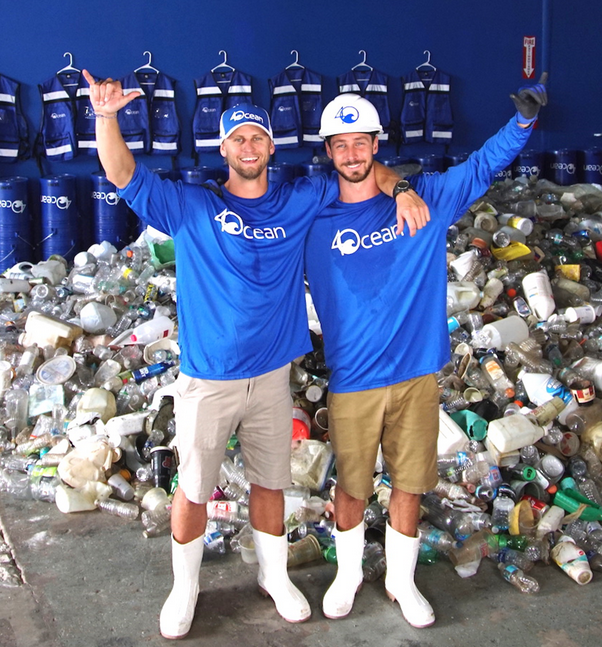
As promised in the last post, this is a follow-up about two other ocean cleanup projects. 4Ocean The first has to do with a couple of young men (pictured above) – Andrew Cooper and Alex Shulze - who were inspired by the mounds of plastic they were finding on shorelines while surfing in Bali, Indonesia. They had the idea to convert the fishermen in the region to “fish” for plastic rather than, well, fish – and to convert the plastic and other materials into jewelry which they’d then sell. They are not a non-profit, they are an LLC (Limited Liability Company) as spelled out on their website: 4ocean is a limited liability company (LLC) that is audited quarterly by the Better Business Bureau. Global cleanups are funded entirely through the sale of our products, where every item purchased funds the removal of at least one pound of trash from the ocean. By creating jobs, utilizing the latest technology and raising awareness about the impact of trash in the ocean, we are building the first economy for ocean plastic while creating a cleaner, more sustainable future for the ocean. 100% of our sales are directly or indirectly invested in our global ocean cleanup operation. This includes our daily local and international cleanups, boats, employees, tools, equipment, Community Cleanup events, and large investments like the Ocean Plastic Recovery Vessel. Still, they have a mission which is laudable. And they have some interesting accomplishments, including their Ocean Plastic Recovery program which involves stopping the plastic at the source – the mouths of rivers. They’re doing this with floating barricade systems. Each one not only collects tons of plastic, it employs 50-100 of local workers. Learn more about this here. Also check out these videos about 4Ocean. They’ve also been covered in recent editions of Forbes and Newsweek. 4ocean Was Born. from 4Ocean on Vimeo.
Soda stream: Holy Turtle The Holy Turtle is the name for a contraption which is a U-shaped floating collector, somewhat similar but not identical to the Ocean Cleanup covered in a prior post (see photo of the contraption below. The story is covered quite well in this story from Business Insider. From that article: The Holy Turtle was designed to capture trash floating in the ocean through large holes on the bottom half of the contraption. Birnbaum told Business Insider that the design was inspired by oil spill containment systems, and SodaStream developed it in partnership with American Boon & Barrier Corporation, which specializes in oil spill containment. The device attaches to two boats and forms a U-shape as it moves across the water. SodaStream did not patent its contraption, and SodaStream CEO Daniel Birnbaum said he views it as a public service to let other people use the design. This connects to the mission and vision of SodaStream. You can find more about this in the Sustainability section of their site, where you will also find some of the basic problems presented by plastic bottles. In the last decade, annual production of plastic bottles grew to over 300 million tons per year1. Today, an average person living in Western Europe or North America consumes 100 kilograms of plastic each year, mostly in the form of packaging2. Globally, people go through roughly 200 billion plastic water bottles annually .In the US alone, there are over 10,000 active landfills4 which contain over 2 million tons of water bottles alone5. Bottles used to package water take over 1,000 years to biodegrade and if incinerated, they produce toxic fumes. It is estimated that over 80% of all single-use water bottles used in the U.S. simply become litter6. There are 5 trillion pieces of plastic afloat in the world’s oceans7. Entanglement or ingestion of marine plastic debris affects 267 species worldwide. This included 86% of all sea turtles, 44% of all seabird species, 43% of all marine mammal species8. At SodaStream we not only make great sparkling water; but we also help to save the planet from plastic waste. With one reusable bottle we can save a family up to 3000 disposable bottles every year. SodaStream’s reusable carbonating bottles help to significantly reduce waste from store-bought bottles and cans, while simultaneously reducing the carbon footprint by up to 87% in comparison with generic PET-bottled sparkling water brands*. We have amazing fresh tap water in most parts of the world and it’s the natural, economic and sustainable thing to do. |
|
"You can't have everything. Where would you put it?" - Steven Wright |