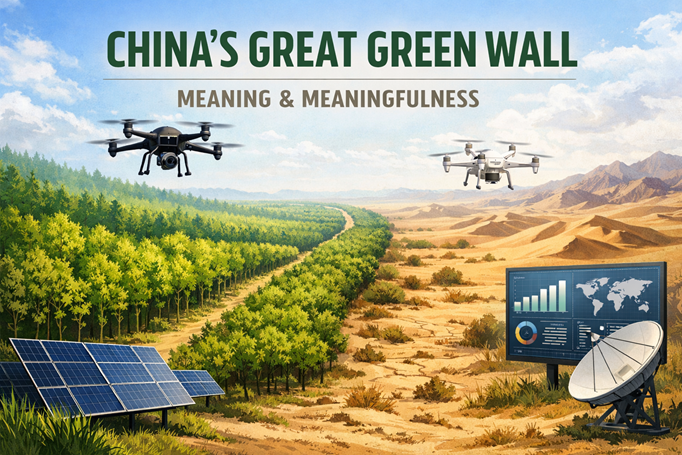
In Part 1 of this short series, we reviewed the portfolio which is China’s Great Green Wall. I promised that there’d be a Part 2 in which we discuss the meaning and meaningfulness of this amazing initiative – this portfolio.
And here it is!
First of all, let’s be clear about the difference (at least as I’ll define it here).
Meaning = interpretation (what does this portfolio tell us?)
Meaningfulness = value (why should we care about that interpretation, about this story, and what should we do – how can we apply it in our efforts?)
Meaning of the Great Green Wall This portfolio succeeded because it was designed for long-term value realization, not short-term outputs. Instead of thinking about meeting quarterly or even annual targets or quotas, instead of thinking short-term, this portfolio was intentionally focused on a 45+ year planning horizon. It focused on value in the broadest sense of the word – monetary, well-being, societal, planetary. Value is not always only measured in dollars or yuan. This was a government project which realized that there would be leadership changes and considered that in the planning.
Meaningfulness of the Great Green Wall At the start of the post, I define meaningfulness as “how we can apply this in our projects (and programs and portfolios). So this is about Lessons Learned. Some of the key Lessons Learned:
Projects fail when we optimize for outputs
Portfolios succeed when we optimize for in-operation and end-state value
This portfolio outlived political cycles, leaders, and trends. Today, especially in North America, most organizations think quarterly, or at best a year or two out into the future. True project leaders must protect long-term intent from short-term pressure. This means speaking truth to power.
This project avoided a task-oriented, “tree planting” mindset. Instead, as any good portfolio manager knows, it was an interdisciplinary effort involving:
Engineering
Ecology
Energy (solar)
Data/monitoring
AI and high tech (drones)
Complex problems – like remediation of climate change - require portfolio-level integration, not siloed projects, nor siloed functions.
This portfolio considered systems. They thought of the desert as a system they thought of the intervention needed to convert the desert to usable land as a system of systems. Project LEADERS must evolve into system stewards, not task managers or even project managers.
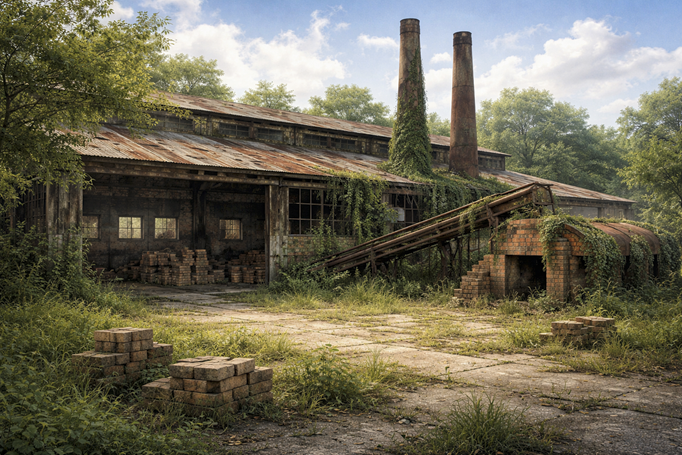
In this Green Great Wall, results (benefits) took decades to validate – success was not instantaneous. We need to be very clear about the way we define success.Like my colleague Alexandra Chapman likes to say, it’s about “a factory making bricks, not a brick-making factory*”. Real project success is not a ribbon-cutting ceremony, it’s the delivery of benefits over the long term (that is the REAL definition of value).
Here's a factory making bricks:
...and here is a brick-making factory:
Finally, this portfolio was a blend of projects, programs, portfolios and operations. Project leaders must be flexible in managing at the task level but also must be able to ‘jump up’ several levels in real time and take the broader view. Is there a connection to PMI’s Power Skills here? Absolutely.
Here’s some food for thought in that area:
Future-focused orientation → This portfolio’s 45-year vision
Strategic thinking → The portfolio design considered a system of systems
Adaptability → The project understood that there would be – must be -evolving techniques over decades and allowed for these transitions
Collaborative leadership → as mentioned above, the portfolio thrived on cross-disciplinary work
Accountability → the portfolio stayed focused even though there were leadership changes – the commitment was at a high level
OK, so really, what does a huge portfolio in China have to do with you, what changes can you make? What can you learn? What can you do? Are you managing outputs or enabling long-term value?
Are your projects connected to a meaningful portfolio?
Are you thinking in systems—or tasks?
Do you have the delivery of value in mind as you oversee every team meeting, every task? Or are you standing there with a (metaphorical) stopwatch and clipboard?
Take a breath. Step back. Patience. Systems Thinking. Integration. Value.
Think about your projects, programs, and portfolios in this context. Maybe you can bring your desert projects to life!
*I could (and probably should) do another post on this, perhaps along with Alexandra Chapman. For now, just think about the difference between those two ways of describing a project outcome and which is more value oriented.