





 Posted
by
Posted
by 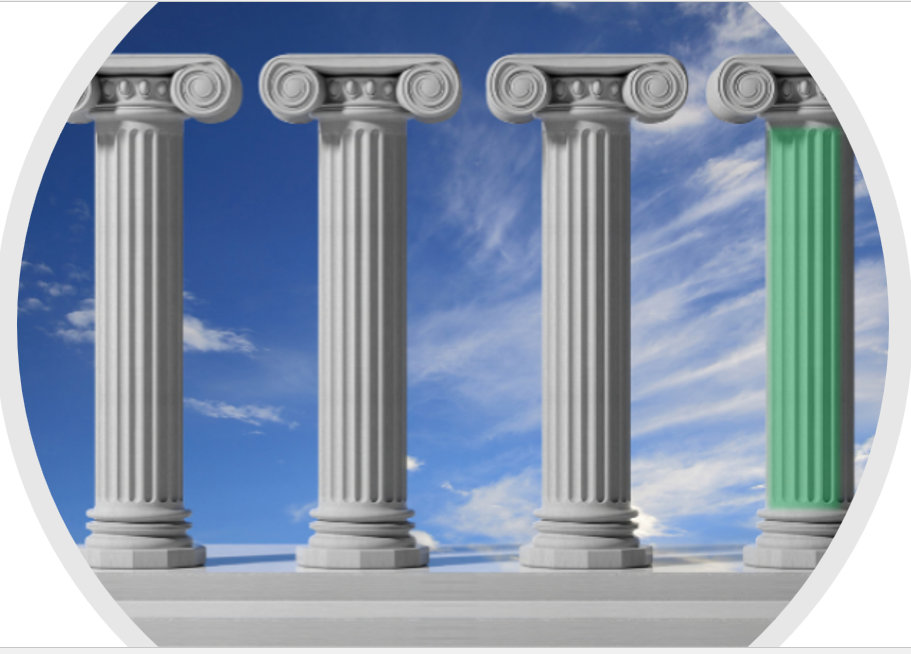





Guessing is not a strategy: How to build decision velocity with AI and real-time data
June 10, 2026 | Live Webinar

You Can't Get They-ah From Hee-yah
Floating an idea into reality: the other side of the AI Project Paradox
The Environment of the Built Environment: an AI Paradox
6th, 6th Edfition, 6th Edition PMBOK, 7th Edition, 7th Edition PMBOK, 8th Edition PMBOK, 8th Edition PMBOK Guide, Activism, actuarial, actuary, adapt, addition by subtraction, Africa, africa, agriculture, airforce, ajaita, Alaska, amazon, analogous, analytics, ancient, and more power, antarctica, anti-science, apple, apps, architecture, arctic, arrakis, Artificial Intelligence, asch paradigm, Assistant, asthma, astronomy, automobile, automotive, autonomous cars, b, bankhar, Banksy Crypto, basalt, baseball, bats, batter, beauty products, benefit, benefits, Benefits Realization, beyond epica, biases, bicycle, big data, big dfata, big dig, bike, biodiversity, biomedicine, birdhouse, blockchain, blood, blue blood, blue trees, bluefin, bluefin tuna, book review, boston, boston university, Boyce, Brazil, brazil, Breakdown Structures, BS, building, buildings, built environment, built environment, bumblebee, cake, capacitor, car, Carbon, carbon, carbon capture, carbon negative, carbon neutral, carbon pool, carbon sequestration, carbonate, careers, CEO, ChatGPT, chatGPT, chatgpt, chatgpt, chess, China, china, chopsticks, citrus, cli-fi, climate, climate change, climate resilience, climeworks, Clumsy, CO2, co2, CO2 Utilization, coalition, cobalt, coffee pods, cognition, cognitive, Collabortion, colombia, concrete, Conflict, construction 5.0, cool projects xyloscope, cooling, coral, corn, cost of good quality, cost of poor quality, cost of quality, crazy, criticism of project management, cryptocurrency, CSR, csr, data, data analytics, data privacy, datacenter, dataset, death spiral, Decision Making, decomposition, Defense and Climate, definition of a project, deforestation, dependencies, dependency, desert, DIKW, dikw, dimopoulos, disposal, dna, DOD, dogs, dolphins, dream, drilling, drink, dune, dune, dutch, early start, earth, eatlocal, eco-tourism, ecological, economic, economics, EKC, electric grid, electricity, electronics, elysis, embodied carbon, emerging technologies, empower, Energy, energy efficiency, environmental degradation, escalate, escalation, ESG, extreme weather, fallacy, FARC, farming, finance, fish, fish brains, fishing, fix, fixing the earth, flint water, Flint Water Supply, flood, flooding, Food supply chain, food waste, forest, forest for the trees, forestation, forrestgump, frank herbert, Fruitcake, fungus, fusion, Galvao, garage, gas, gasoline, geese, gender equality, gender partnerships, generational differences, Generative AI, gladwell, gold, Goodness, google, Government, GPT, great pacific garbage patch, green, green building, green buildings, green energy, green iguana, green project, green project management, greening, guest post, gyre, harkonnen, Harvesting Benefits, hawasina, hedgehogs, heursitics, historical data, hlb, holitsic, holland, horseshoe crab, human-caused climate change, hydrogen, hydrology, ice, iceland, ignition, iguana, imagery, impact, india, inequality, information, initiatives, injection, insurance, intelligence, interacting risk, internal combustion engine, invasive species, investment, isomer, issue escalation, issues, ITER, jobs, Jupiter, justification, kids, kill point, knowledge, koch brothers, Kuznets, laboratory, LAL, landscape mode, lapampa, launch, LCA, Leadership, Leadership, life cycle analyses, life cycle analysis, lifecycle, Linkedin, liquid, lizard, local, long term, long-term, long-term thinking, look up, loud, maintenance, maker, makermovement, malcolm gladwell, management, marathon, marine biology, market, mars, Martin Luther King, mean, megawatt, MeHg, melting, mercury, metal, Microgrid, microplastics, migration, military, millennial, mindset, minerals, mission, mitigate, MLK, mongolia, museum, museum of london, nature, nematodes, net gain, Net Project Success Score, net zero, netherlands, network, New book, New Jersey, New Practitioners, new york, NFT, nitrogen, noise, noreaster, norway, nova, NPSS, NREL, ocean, ocean cleanup, ocean life, oil rig, oil rigs, oklahoma, oman, only murders in the building, opportunity, overall risk, oxygen, packaging, pareto, PBS, permafrost, persistence, peru, Pharmaceutical, planet, planet.com, planning, plant, plasma, plastic, playground, pm, pm education, pmbok, pmbok guide, pmnetwork, PMXPO-2018, podcast, pollutants, pollution, poop, poor, portfolio, power, power skills, privacy, privacy concerns, professors, program, Program Management, project, project leader, project leadership, project management, project management 3.0, project on fire, project progress, Project Success, project success, projecticity, projectleadership, projectmanagement, projects, psychology, pulse of the profession, purple bacteria, purpose, quiet, rainforest, rationale, reef, refugees, renewable, renewables, Repair, repair, repeatable process, repeatable processes, repurpose, research, resource breakdown strucuture, Resource Management, reversing climate change, revisionist history, rich, rigs2reefs, ripe, risk, risk avoidance, Risk Management, risk mitigation, risk response, risk responses, river, robots, rocks, rules of thumb, rural, rural India, russia, Sarcasm/Irony, satellite, saudi, schedule, sci-fi, Science, science, science-fiction, scientific american, screaming monkeys, sea, sea life, Sea-Level Rise, sea-level rise, seagreens, seawall, seawater, seawater temperature, seaweed. beat;es. farming, secondary risk, selena gomez, sequestration, shipping, skyscraper, SLR, smart cities, smart city, smelting, social, social pressure, soil, solar, solar panels, solar perovkites, solar saheli, sonic, sponge cities, SRI, stage-gate, stagegate, stakeholder, stakeholder management, steward, stewardship, storage, strategy, stupid, success, suffer, sulphur, sunk cost, supercapacitor, supply chain, survey, Sustainability, sustainability, Sustainable Investing, Sustainable Tourism, sybiosis, symbiosis, system 03, TBL, temperature, terraform, terraforming, test, threat, threats, totem, touchscreen, tour, tower, Trains, transparency, transportation, trash, tree, tree species, trees, trillion, triple bottom line, triple constraint, truth to power, UMass, us army corps of engineers, USDA, vacuum, value, venus, vision, voice, voltage optimization, vw scandal, washing machine, waste, wastewater, water, we mean business, whales, Whirlpool, wind, wisdom, women, Women in Project Management, wood wide web, woonerf, Work Breakdown Structures (WBS), world breakdown structure, worms, xian, xylotron, Yale


|
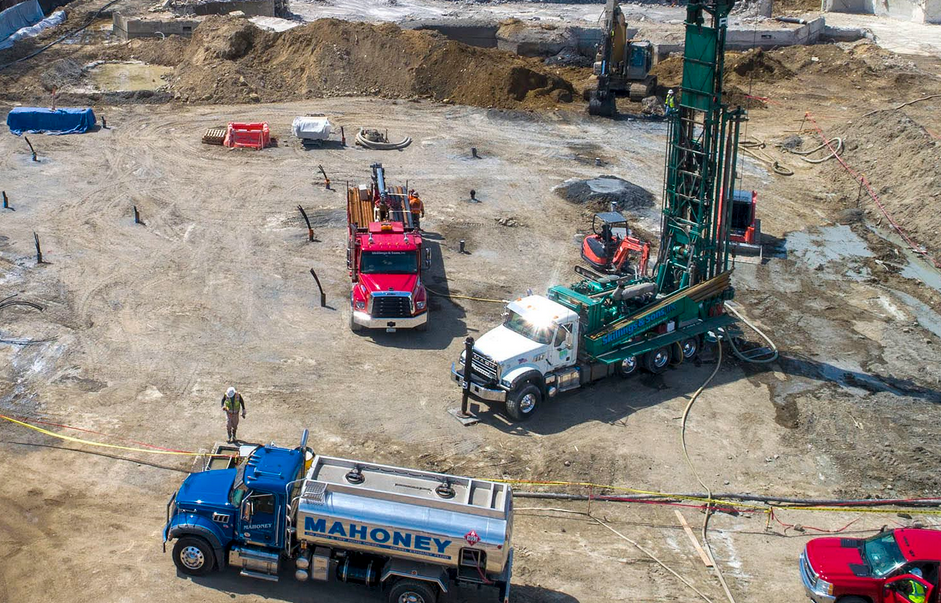
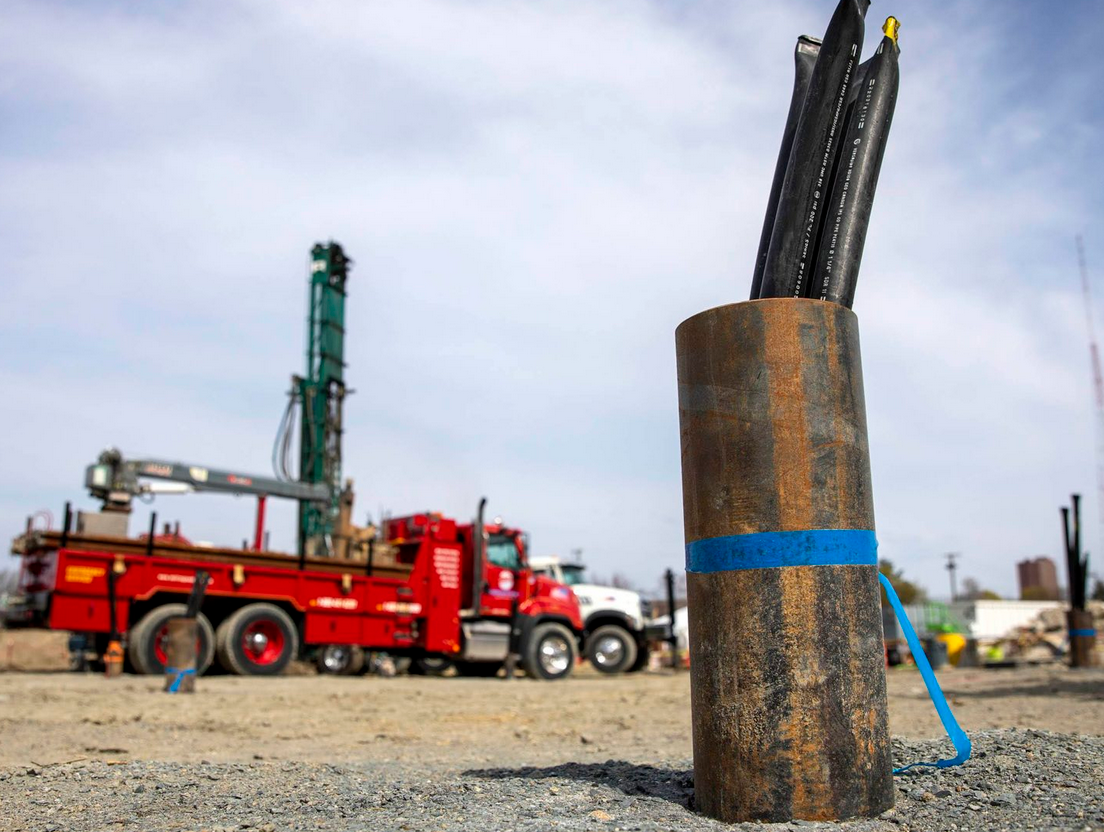
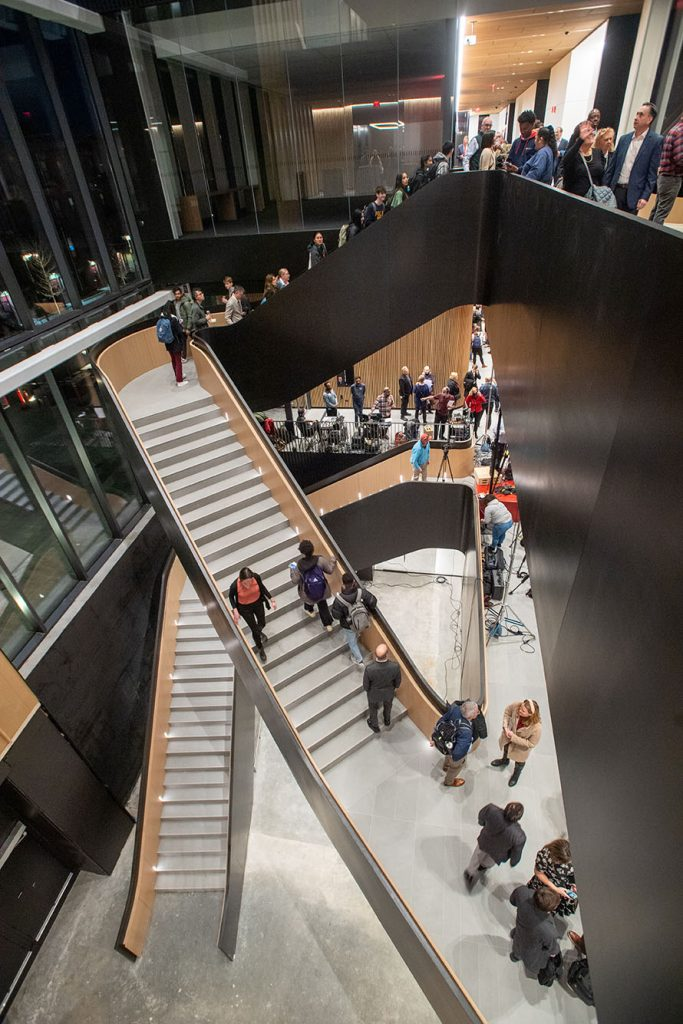
One of the key trends in project management now (as it should be!) is the idea of value delivery. The 7th Edition PMBOK® Guide has a chapter called “A System for Value Delivery”. Thought leaders like Alexandra Chapman, Dr. Harold Kerzner, and Carlos Serra have been talking about this for countless years. It seems that their thoughts have finally been brought to action. One aspect of value delivery is the idea that projects need to be firmly linked to the mission, vision, and values of an organization. This post is about building sustainable value. Emphasis on building. Let’s take Boston University as an example. For reference, Boston University is a large organization – a student body of nearly 37,000, approaching a half-million alumni, over 10,000 employees, including over 4,000 faculty. It’s big. It’s an organization. I’ll be borrowing from a recent article published by BU Today in this blog post. The title is intriguing: “No Gas. No Fuels. No Emissions. BU’s Greenest Building Ever”. The Link Boston University has published a Climate Action Plan, which aims to reduce the University’s carbon emissions to net zero by 2040. That’s a University-wide goal, tied to the University’s mission statement. “We envision a sustainable and equitable future where environmental, social, and economic conditions foster health and well-being for all people and the natural world, where all living beings have the resources they need to thrive. Boston University will reflect these conditions by serving as a model, locally and globally, through its leadership in climate action and knowledge sharing.’ So that’s the foundation here. And I use the word foundation quite intentionally and dad-joke-ingly. The Project The project to which I am referring is a building needs not only an aspirational foundation but a physical foundation. And as you’ll see, it’s also what’s UNDER the foundation that counts. The project is Boston University’s Center for Computing and Data Sciences, pictured below.
Here are six features that help this project’s outcome – a building – deliver value that is linked to the organization’s mission.
These are the sustainability-related features but what are the overall characteristics of the building? From Boston University’s own website, here’s the lowdown: Designed by KPMB Architects in Toronto to serve BU’s sustainability goals, and built by Suffolk Construction, the $305 million center is 19 stories (or 305 feet) tall and has nearly 350,000 square feet of floor space. What most people talk about is its unusual and controversial profile of cantilevered sections rising above the campus and the Charles River like a giant stack of books (BU leadership’s preference) or a precarious game of Jenga (everyone else’s). The Value Some like it – some hate it – but aside from the unique appearance, you cannot deny that it is an example of building sustainable value! |
|
In Part 1, I summarized one of the documents that resulted from COP27 (for all of the acronyms you haven’t heard before, they’re covered in Part 1). The document of interest to me, and I humbly assert, to you as well, is called “Compendium of Climate-related Initiatives) and summarizes 128 projects worth a total of US$128B. In researching the reports of NDCs, I came across a chart that led me to some new and even more exciting acronyms: INDCs and SSPs. Here’s that chart:
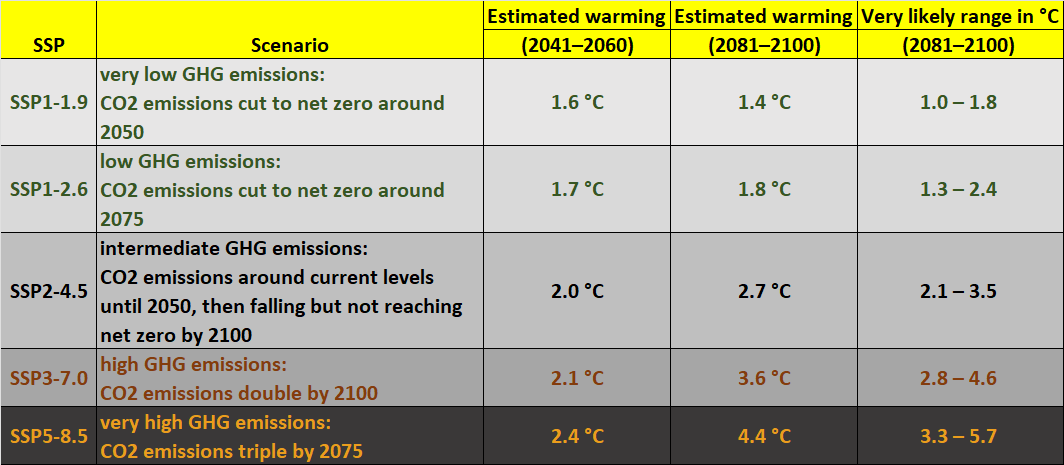
The chart shows the effect of the NDCs (see, I told you, you need to read Part 1!) and INDCs are shown over time, through the year 2060. NDCs are Nationally Determined Contributions. To help meet the Paris Agreement goals, every country is expected to prepare and communicate a nationally determined contribution (NDC) every five years. These include targets, measures and policies and are the basis for national climate action plans. INDCs? It’s a sort of ‘predictive’ form of an NDC – a plan for one. The World Resources Institute makes it very clear: In the lead up to the historic Paris Agreement on climate change, adopted in 2015, more than 160 countries and the European Union submitted their own plans to address climate change, known as Intended Nationally Determined Contributions (INDCs). According to the global climate pact, a country’s INDC is converted to a Nationally Determined Contribution (NDC) when it formally joins the Paris Agreement by submitting an instrument of ratification, acceptance, approval or accession, unless a country decides otherwise. This article from the World Resources Institute details which countries have been making changes to their INDCs and how they are converting them into NDCs, including making them more stringent. The different paths you see in the chart above reflect which SSP will drive the impacts on climate. OK, so what’s an SSP? There's a nice explanation of SSPs on CarbonBrief.org. I've chosen to provide this from “The Shared Socioeconomic Pathways and their energy, land use, and greenhouse gas emissions implications: An overview”: by Riahi, et al:The current set of SSP scenarios consists of a set of baselines, which provides a description of future developments in absence of new climate policies beyond those in place today, as well as mitigation scenarios which explore the implications of climate change mitigation policies. The baseline SSP scenarios should be considered as reference cases for mitigation, climate impacts and adaptation analyses. Therefore, and similar to the vast majority of other scenarios in the literature, the SSP scenarios presented here do not consider feedbacks from the climate system on its key drivers such as socioeconomic impacts of climate change. Think of SSPs as a simulation resulting in the spaghetti map that forecasters use to show potential paths of hurricanes depending on a multitude of factors. Below is a table created from various sources, including this one from Reuters.
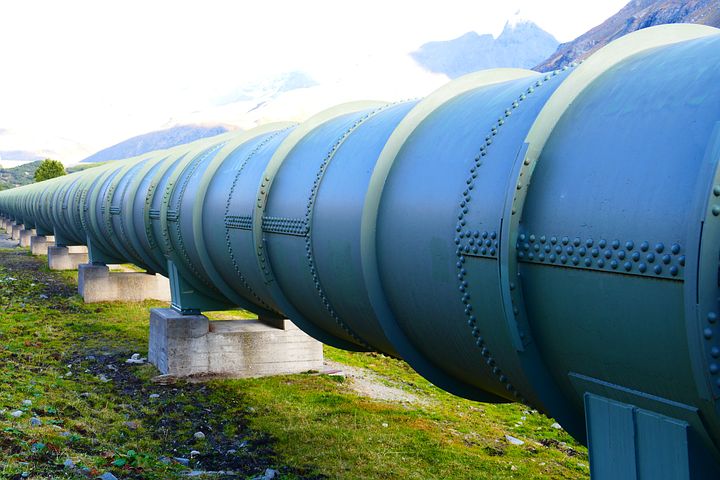
So what about that pipeline? Since this is a Project Management (or Project Leadership) blog, I want to leave you with some additional value besides the conversancy in climate related projects. The Portfolio of Climate Related Projects (as I re-titled the subject document) has an outstanding format, one that I assert we can learn from as project leaders. To wit, I attach below a few example “dashboard sheets”. Below is an overview graphic that is an excellent way for any Portfolio Manager to show their executives how their projects “stack up”.
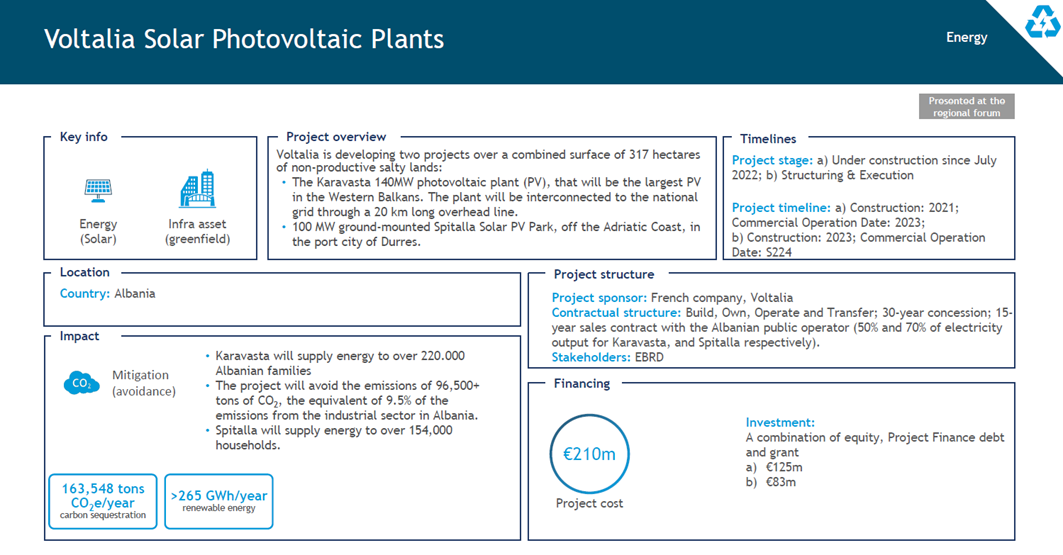
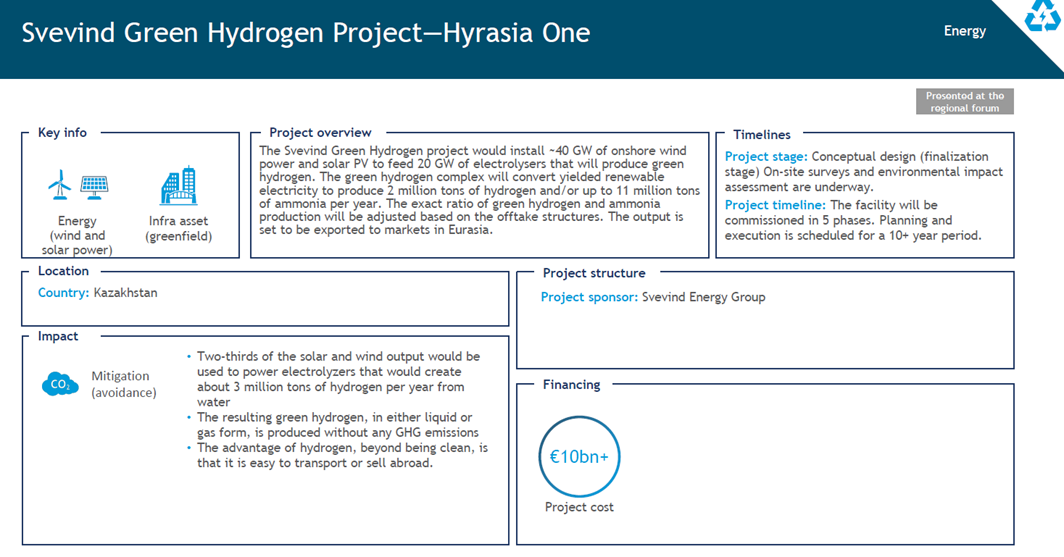
And, as promised, here are two examples of a project summary in an excellent dashboard format that shows funding, intent and other key elements in a very concise and clear manner.
I hope you found this very brief pipeline series informative and even a little inspiring.
|
|
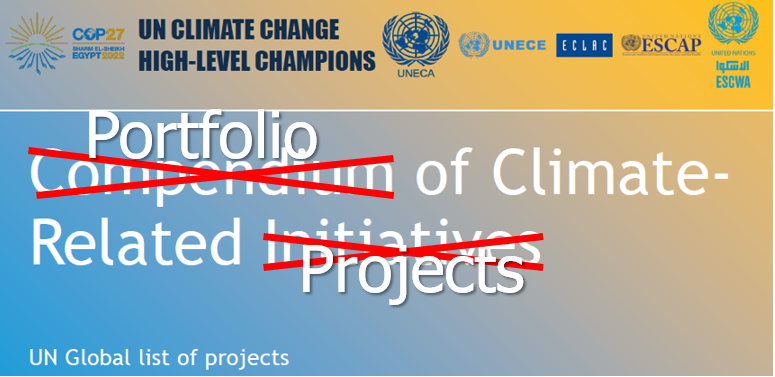
The UN’s Conference of the Parties (COP) number 27 has just ended in Sharm el-Sheikh, Egypt. One of its outputs is a large document called “The Compendium of Climate-Related Initiatives”. That does not sound like something belonging in a project management blog of any kind. But substitute two synonyms (portfolio for compendium, and projects for initiatives), and the document becomes A Portfolio of Climate-Related Projects (see below).
Indeed, this is a collection of projects and programs organized for a strategic purpose, to help achieve goals. Strategy is always about HOW you achieve goals and objectives. Here, the goals and objectives are to reduce climate change (and as much as possible, its causes) and counter its already-existing effects. And, as always, the connection between strategy and reality is – well, quite humbly, it’s us – project leaders, executing portfolios of programs and projects. The “Compendium” includes 128 projects, with a budget of $128B (that’s B as in Billions ... or Busy!) dollars. That’s a lot of projects and a lot of dollars, all aimed at very noble goals and objectives, so it may interest potential project leaders in terms of their career. The purpose of this post is to help familiarize you with the types of projects in this compendium, and some of the basic language used – to help make you conversant in this (excuse the pun) environment. Let’s start with how this was announced. A press release from the UN High-Level Climate Champions said: In 2022, the COP 27 Presidency, the High-Level Champions and the United Nations I understand the projects and billions of dollars, and I’m loving the idea of a ‘project pipeline’. In fact, the word pipeline is a bit ironic, given that pipelines are often associated with carbon-based fuels - thus the title of this blog post series. But… what is an NDC? Inquiring minds want to know. For the answer, we go to the source, the UN Climate Change website: "Nationally determined contributions (NDCs) are at the heart of the Paris Agreement and the achievement of its long-term goals. NDCs embody efforts by each country to reduce national emissions and adapt to the impacts of climate change." This short video describes NDCs in layperson’s terms: If you’re curious about your own country, you can explore the country-by-country goals by referring to the NDC registry. Here’s a snippet of some of the African countries.
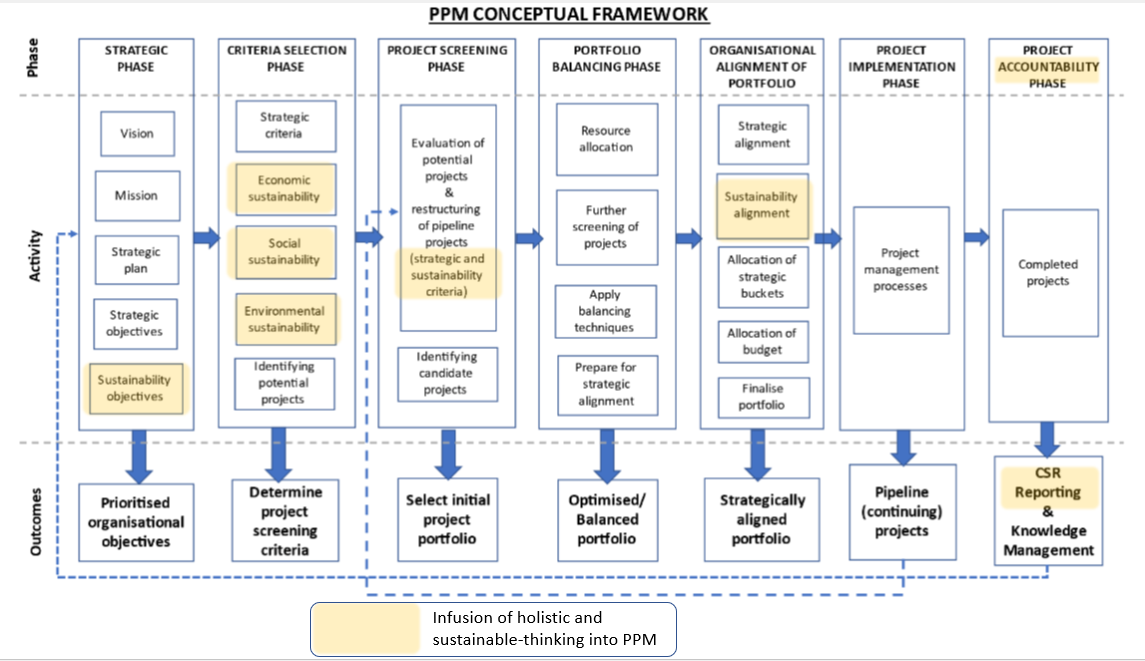
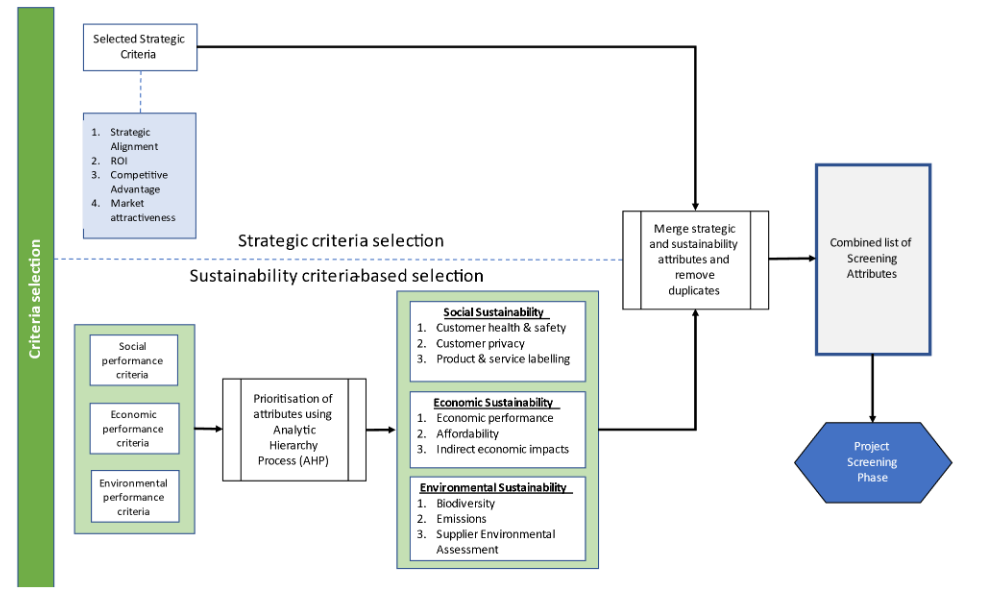
In the prior post I discussed the 3 Pillars of PPM (From scholar and all-around gentleman Jamal Moustafaev's book, Project Portfolio Management in Theory and Practice). The Three Pillars of PPM Then I covered the fact that in an article by Javed Mohammad, Yu-Chun Pan, published just in 2022, and forwarded to me by graduated student Daria Risso as we work on her thesis for Politecnico di Torino, these authors imagine a fourth pillar: a pillar dedicated to sustainability and a holistic view. I like that pillar. A lot. I would like to give a shout out to my former Boston University student Daria Risso for pointing this article out to me. In this post, I want to summarize the remainder of the article and, with the kind permission of the authors, to share some of the key points and figures. But please, don’t read only this blog post – please read their very-well assembled and meaningful article (you can find it available on ResearchGate at no charge – just click here). The authors start by re-imagining the PPM Framework in the following phases, each of which is tinged, or perhaps better-stated, infused with long-term, holistic, responsible thinking: See the figure below (highlighting mine) to show how they have done a great job to avoid tacking-on sustainability, but rather building it in. They have also put effort into criteria for project selection. It’s ironic that this comes up at a time when I happen to be teaching graduate PM students about exactly this – the selection of projects based on a multiplicity of criteria, including mathematical techniques like AHP: In this step, the participants may use any multi-criteria decision-making method (MCDM), e.g., the Analytic Hierarchy Process (AHP), that allows for pairwise comparison of variables thus establishing the relative importance of one variable against another. The process is repeated for the three categories of sustainability i.e., economic, environmental and social. See the figure below – it assures that these criteria categories are included. Figures above used with permission of the authors (thanks!). I’ve been thinking (and writing) for a while about how some organizations have apparently misguided, or perhaps disconnected projects – projects like VW’s special sensors and software which led to Dieselgate while their C-Suite was indicating their desire to be a automotive leader in environmental sustainability. Somewhere there is a break in the connection between vision and execution – a break that I insist is at the PPM level. Perhaps Mohammad and Pan have found the fix for that breakage – a renewed focus on sustainability by those at the PPM level, those in powerful PMO positions who could filter out, with the right criteria, those projects which are misaligned from a sustainability perspective. If the organization is telling the world that sustainability is strategically important, that has to prevent projects which are producing sustainability disbenefits from ever being chartered. Here is a piece of the authors’ conclusion: It is recommended that other reporting tools should be applied to the proposed framework for a much wider understanding of these processes. Another area that requires research is whether sustainability is built into the framework bottom-up or top-down in the process and which method would be more effective. Finally, the proposal is open to contributions from the research, academic and practitioner community and should be viewed as an initial step towards developing a tried and tested framework that addresses some of the difficulties that organisations face when implementing sustainability into their project-related processes. These authors, in my opinion, are one of a group on the leading edge of building sustainability thinking into projects with the intelligence and wisdom that comes from a PPM perspective. This is important. I urge you to read the article (that’s one reason I kept this blog post short – they say it all in their article!) and consider case studies or other suggestions that may help us as project leaders and citizens of the third rock from the sun to ‘get stuff done’ in efficient but also long-term effective ways. In the past few posts, I have been focused on breakthroughs in science that will yield new projects. I’ll continue to do that, of course, because they speak to the amazing new opportunities it will bring project leaders. Whole careers are going to be made for those who want to take on a project leadership role in, for example, the deployment of green hydrogen production, storage, distribution, and use, or, the creation of charging infrastructure for electric vehicles. Today, I’m shifting back to project (program, and portfolio) management itself and how it is maturing and blossoming, with our without wholly new scientific breakthroughs. In fact, the breakthrough here is more of a construction project inside Project Portfolio Management. It’s the idea of a shiny new, fourth pillar. We have the only known photo of this pillar, shown above. Naah, it’s not a literal pillar – it’s a metaphorical pillar. The original 3 pillars come from author and consultant Jamal Moustafaev, author, speaker, and CEO of Thinktank Consulting, Inc. Jamal is actually the author of a great book I’ve been using in my Program and Portfolio Management courses at Boston University for years. In his writing, Jamal has referred to the Three Pillars of PM as: The Three Pillars of PPM But in a recent article by Javed Mohammad, Yu-Chun Pan, published just in 2022, these authors imagine a fourth pillar: adding sustainability and a holistic view. I like that pillar. A lot. I would like to give a shout out to my former Boston University student Daria Risso for pointing this article out to me. In the Abstract of this article, the authors say: This paper pursues the premise that sustainability is strategic and distinct from functional and tactical project management processes. Integrating the principles of sustainability into project management should, therefore, deliver limited outcomes or lack a comprehensive solution that is flexible and adaptable to different business models, functions and situations. And they’re correct. This has been a point we’ve made on this blog and that project managers have been un-shy about bringing up to me when I ask them to consider the responsibility a PM has to take sustainability into account. So how about ‘kicking this up a notch’ to PPM? That’s what I’ve called for, and I was pleased to see that this is the view of this article: Project portfolio management (PPM), on the other hand, has a much wider application and perspective. It bridges project management with the overall organisational strategy, goals and objectives. Not only is PPM strategic, but it is a continuous process, unfettered by the limitations of individual projects or programmes. The article mentions that adding a framework for sustainability thinking can help determine long-term benefits and project outcomes (this is the good side), but it also “adds some complexity” into PPM practices and will cause PPM managers and stakeholders to “prepare for additional responsibilities”. Is this trade-off worth it? Are we ready for this additional complexity? Do we think the “additional responsibilities” will pay off? This is what I plan to discuss in the next post, including a deeper dive into the article. Want to dive in with me? The article is publicly available on Research Gate, click here to access it. See you on the other side of the door… One man can be a crucial ingredient on a team, but one man cannot make a team.
- Kareem Abdul-Jabbar |